If you’re managing staff or dealing with workplace issues, you might find yourself needing to address employee misconduct formally. Writing an employee misconduct letter can be a sensitive task. To help you communicate clearly and professionally, having a good sample or template on hand is invaluable. This article provides practical employee misconduct letter samples, explains when to use them, and offers tips for customizing your own.
What Is an Employee Misconduct Letter and When Is It Used?
An employee misconduct letter is a formal document issued by an employer or manager to address inappropriate behavior or violations of company policies. It serves as an official record and often initiates a disciplinary process.
Common situations include:
- Repeated tardiness or absenteeism
- Violation of safety rules
- Unprofessional behavior or harassment
- Misuse of company property or resources
- Failure to meet job responsibilities
Before drafting such a letter, ensure you have documented the misconduct and have a clear understanding of your company’s disciplinary procedures.
Key Components of an Employee Misconduct Letter
A well-structured misconduct letter includes several essential sections:
- Header: Includes the date, employee’s name, position, and department.
- Introduction: States the purpose of the letter.
- Description of misconduct: Clearly outlines the specific behavior or incident, including dates and details.
- Impact: Explains how the misconduct affects the team, workplace, or business.
- Expectations and next steps: Details what the employee needs to do to correct the behavior and any consequences if misconduct continues.
- Closing: Offers support or guidance for improvement and includes a signature line.
Step-by-Step Guide to Writing an Employee Misconduct Letter
- Gather facts: Document specific incidents, dates, and witnesses.
- Use a professional tone: Keep language respectful and direct.
- Be specific: Avoid vague statements; cite concrete examples.
- State the consequences: Clarify what actions will follow if behavior doesn’t improve.
- Offer support: Suggest ways the employee can improve or resources available.
- Review and edit: Proofread for clarity and professionalism before sending.
Example Employee Misconduct Letter Template
Here’s a sample to give you a starting point:
[Date]
[Employee Name]
[Position]
[Department]
Dear [Employee Name],
This letter is to formally address a recent incident of misconduct that occurred on [date]. It has come to our attention that you [describe specific behavior, e.g., arrived late to work multiple times without prior notice].
This behavior disrupts team productivity and violates our company policies outlined in the employee handbook. We expect all employees to adhere to scheduled work hours and communicate promptly if issues arise.
Please consider this a formal warning. Continued misconduct may result in further disciplinary action, up to and including termination. We encourage you to meet with your supervisor to discuss any challenges you may be facing and to develop a plan for improvement.
We trust you will take this matter seriously and make the necessary adjustments. Please acknowledge receipt of this letter by signing below.
Sincerely,
[Your Name]
[Your Position]
[Signature]
Acknowledgment:
I, [Employee Name], acknowledge receipt of this misconduct letter and understand its contents.
_____________________________ Date: _______________
[Employee Signature]
Common Mistakes to Avoid When Writing Misconduct Letters
- Being vague: General statements don’t provide clarity. Always specify what happened.
- Using emotional language: Keep tone respectful, even if you’re frustrated.
- Ignoring documentation: Rely on facts and records, not assumptions.
- Delaying delivery: Address misconduct promptly to reinforce seriousness.
- Overloading the letter: Focus on specific issues without bringing unrelated complaints.
Tips for Customizing Your Employee Misconduct Letter
- Adjust the tone based on the severity of misconduct—more formal for serious issues.
- Include relevant policies or sections from the employee handbook for clarity.
- Personalize the letter with specific incident details to avoid ambiguity.
- Offer solutions or support, like training or counseling, if appropriate.
- Keep copies for your records and consider consulting HR if unsure.
If you need to address other employee-related matters, look into templates for school fee reminder letters or contract extension letters. For formal communication with vendors or publishers, the author-to-publisher letter template might be helpful.
Having a clear, respectful, and factual misconduct letter can help correct behavior and protect your workplace. Customize these samples to fit your specific situation, and always keep a professional tone.
Document Examples & Template Samples
Formal Warning for Employee Misconduct
Dear [Employee Name],
It has come to our attention that your recent conduct on [date] was not in alignment with our company’s standards. Specifically, [describe misconduct briefly]. Such behavior compromises our workplace environment and undermines team cohesion.
We request that you acknowledge this warning and take immediate steps to rectify your behavior. Continued misconduct could lead to further disciplinary action, up to and including termination.
Please sign and return this letter to acknowledge receipt.
Notice of Investigation into Alleged Misconduct
Dear [Employee Name],
This letter serves as a formal notice that an investigation has been initiated regarding allegations of misconduct reported on [date]. The specific concerns relate to [brief description].
During this process, you are entitled to present your perspective and provide any relevant evidence. We aim to complete our review promptly and fairly. Please cooperate fully with the investigation team.
We appreciate your cooperation and will keep you informed of any findings or necessary actions.
Disciplinary Action Due to Employee Misconduct
Dear [Employee Name],
Following our recent investigation into the incident on [date], it has been determined that your actions, specifically [describe misconduct], violate company policies.
As a result, disciplinary action is being imposed, which includes [state disciplinary measures, e.g., suspension, demotion]. We expect all employees to adhere to professional standards, and failure to do so may lead to further consequences.
Please acknowledge receipt of this notice and schedule a meeting with HR to discuss next steps.
Employee Misconduct Apology Letter
Dear [Supervisor/Manager Name],
I am writing to sincerely apologize for my behavior on [date]. I acknowledge that my actions, specifically [describe misconduct], were inappropriate and did not reflect the standards expected of me as an employee.
I am committed to correcting my behavior and ensuring it does not recur. I appreciate your understanding and the opportunity to address this matter.
Sincerely,
[Employee Name]
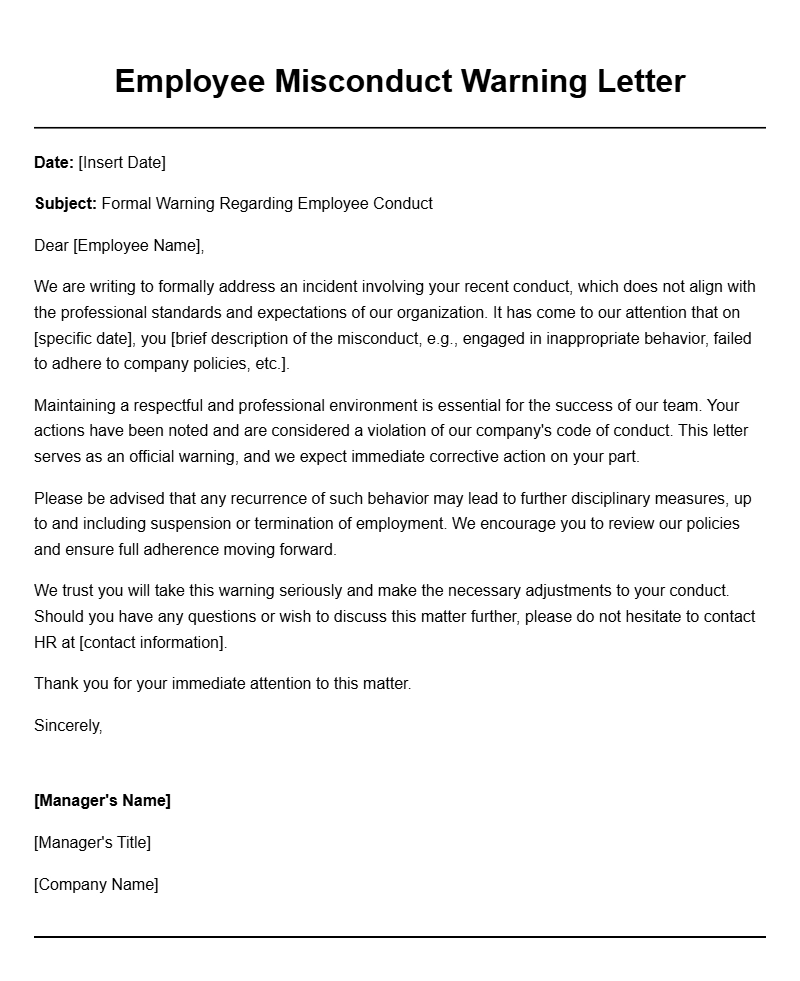
Employee Misconduct Warning Letter
Dear [Employee Name],
This letter serves as a formal warning regarding your recent conduct that was observed on [date]. The behavior, [describe misconduct], violates our company’s policies and standards.
We expect all employees to maintain professionalism and integrity at all times. Continued misconduct will result in further disciplinary measures, including possible termination.
Please sign below to acknowledge receipt of this warning.
Follow-up Letter After Employee Misconduct
Dear [Employee Name],
This letter is to follow up on our previous discussion regarding your conduct on [date]. We appreciate your acknowledgment of the issues raised and your commitment to improvement.
To support your development, we recommend the following steps:
- Attend a professionalism workshop
- Participate in coaching sessions
- Review company policies on conduct
We trust you will take this seriously and demonstrate positive change moving forward.
Employee Misconduct Documentation Form
Please complete the following form to document the incident of misconduct:
| Employee Name | Date of Incident | Location | Description of Misconduct | Witnesses (if any) |
|---|---|---|---|---|
| [Name] | [Date] | [Location] | [Description] | [Witness names] |
Submitted by: ______________________
Date: ______________________
Employee Termination Notice Due to Misconduct
Dear [Employee Name],
After a thorough review of the incident reported on [date] and subsequent investigation, we regret to inform you that your employment with [Company Name] is being terminated effective immediately.
This decision is based on the severity of the misconduct, which violates our company policies and ethical standards. Please return all company property and schedule an exit interview with HR.
We wish you the best in your future endeavors.
Employee Conduct Improvement Plan
Dear [Employee Name],
This letter outlines a performance improvement plan regarding recent concerns over your conduct, specifically [describe misconduct]. Our goal is to assist you in aligning your behavior with company expectations.
The plan includes:
- Weekly meetings with your supervisor
- Completion of professionalism training
- Monthly performance reviews
Failure to demonstrate improvement may lead to further disciplinary action, including possible termination. Please acknowledge receipt and commitment to this plan.