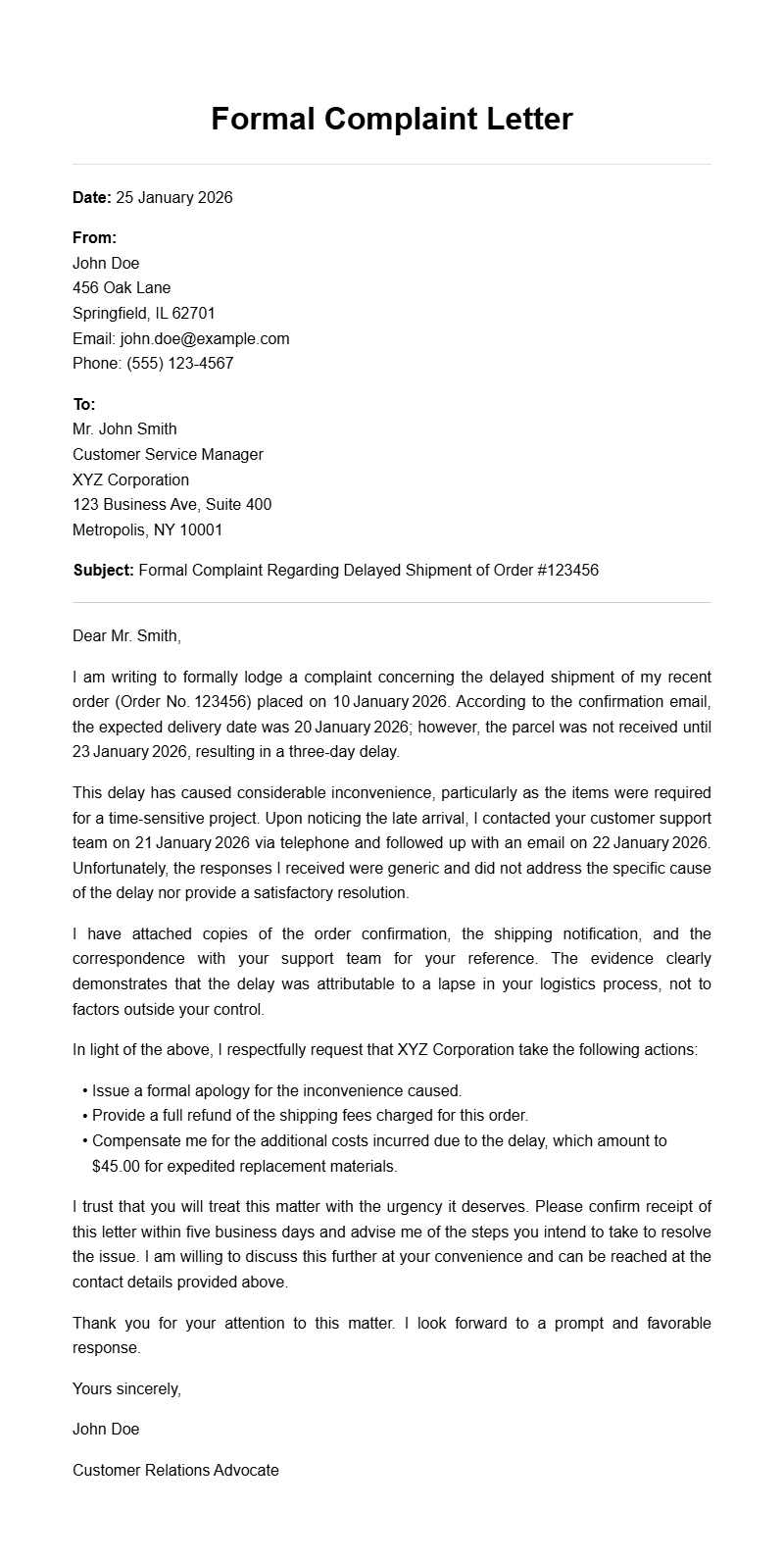
Most people don’t grow up dreaming of writing complaint letters. But at some point, you’ll need to document a problem that’s been ignored, a service that fell short, or a situation that demands formal action. Whether you’re dealing with a landlord who won’t fix heating, a company that keeps billing you incorrectly, or a workplace issue that requires a paper trail, knowing how to put your concerns in writing matters more than you might think.
That’s what this guide is here for. I’ve put together practical advice, real examples, and ready-to-use templates so you can write a formal complaint letter that actually gets results. No fluff, no corporate speak—just the stuff that works.
WHAT IS A FORMAL COMPLAINT LETTER?
A formal complaint letter is a written record of your dissatisfaction with a product, service, employee, or situation. Unlike a casual email to customer support, this type letter follows a structured format and escalates your concern to someone with authority to make changes. It creates accountability and documentation.
You might hear people call these different things depending on the context:
- Grievance letter
- Formal notice of complaint
- Written complaint
- Letter of concern
The name doesn’t matter much. What matters is that you’re putting your complaint in writing, clearly, professionally, and in a way that gives the recipient a chance to respond properly.
WHEN SHOULD YOU WRITE ONE?
Not every frustration needs a formal letter. But there are specific situations where writing one makes sense:
- Repeated issues — You’ve complained verbally or via email multiple times and nothing has changed. A formal letter signals that you’re escalating.
- Financial disputes — Incorrect charges, unauthorized fees, or billing errors that haven’t been resolved need written documentation.
- Housing problems — Landlords ignoring maintenance issues, lease violations, or security deposit disputes often require formal notice.
- Employment matters — Workplace grievances, harassment, or policy violations should be documented in writing.
- Legal protection — When you need proof that you took reasonable steps to resolve a problem before pursuing further action.
If you’re unsure whether your situation warrants a formal letter, err on the side of writing one. It’s easier to have documentation you don’t need than to need documentation you don’t have.
KEY PARTS OF AN EFFECTIVE COMPLAINT LETTER
Before diving into templates, let’s break down what every formal complaint letter needs to include. These components work together to make your letter clear, credible, and actionable.
HEADER INFORMATION
This section establishes who you are, who you’re writing to, and when you’re writing. Include:
- Your full name and contact information
- The date you’re sending the letter
- The recipient’s name and title
- Their organization or department
- A reference number (if you have one from previous correspondence)
CLEAR SUBJECT LINE
Your subject should immediately tell the reader what this letter is about. Avoid vague titles like “Complaint” or “Regarding My Issue.” Instead, be specific: “Formal Complaint: Unresolved Water Damage in Apartment 4B” or “Written Notice: Incorrect Charge on Account #XXXX-XXXX.”
STRAIGHT-TO-THE-POINT OPENING
State your purpose in the first paragraph. Don’t bury the lede. Tell them exactly why you’re writing:
- What product or service you’re complaining about
- When the problem occurred
- That you’ve already attempted to resolve it
- What outcome you’re looking for
DETAILED EXPLANATION
This is where you present the facts. Walk through what happened chronologically:
- When you purchased the product or started the service
- What went wrong
- Who you’ve already contacted about this
- What they’ve told you or failed to do
- How this has affected you
Be specific with dates, names, account numbers, and dollar amounts. Vague complaints get vague responses.
TANGIBLE EVIDENCE
Mention any attachments you’re including:
- Photos of damaged goods or unsafe conditions
- Copies of previous emails or correspondence
- Receipts or invoices
- Medical records (if health-related)
- Contract or lease excerpts
REQUESTED RESOLUTION
State clearly what you want them to do. Common requests include:
- Refund or credit
- Replacement or repair
- Policy change
- Apology or acknowledgment
- Action taken against an employee
Be reasonable but specific. “Please refund the full amount I paid” is clearer than “Please make this right.”
PROFESSIONAL CLOSING
End by stating what happens next if the issue isn’t resolved. Mentioning that you’ll escalate to a regulatory body, pursue Small Claims Court, or contact an attorney adds weight without sounding threatening.
STEP-BY-STEP GUIDE TO WRITING YOUR LETTER
Here’s how to approach writing your formal complaint letter, step by step.
STEP 1: GATHER YOUR INFORMATION FIRST
Don’t start writing until you have all the facts organized. Create a simple timeline of events, collect copies of all related documents, and note the names of everyone you’ve spoken with. This preparation makes the writing faster and ensures you don’t forget important details.
STEP 2: IDENTIFY THE RIGHT RECIPIENT
Address your letter to someone who can actually solve your problem. For small companies, this might be the owner or customer service manager. For larger organizations, look for:
- The complaints department
- A supervisor or manager
- A regulatory compliance officer
- The executive team (for unresolved issues)
If you’re not sure who to contact, call the main number and ask: “Who handles customer complaints that haven’t been resolved?”
STEP 3: WRITE THE FIRST DRAFT QUICKLY
Don’t try to make it perfect on the first pass. Get your story down, list the facts, and establish what you want. Edit for clarity and tone after you have a complete draft.
STEP 4: EDIT FOR TONE
Your letter should be firm but professional. Avoid:
- Emotional outbursts or personal attacks
- Accusations you can’t support with facts
- Demands or ultimatums (more on this in common mistakes)
- Sarcasm or passive-aggressive language
Imagine you’re explaining the situation to a calm, logical friend. Write the way you’d speak to them.
STEP 5: INCLUDE COPIES, NOT ORIGINALS
Always send photocopies of receipts, contracts, or other documents. Keep your originals in a safe place in case you need them later for legal proceedings.
STEP 6: SEND IT APPROPRIATELY
Unless the issue is time-sensitive, email first and follow up with a physical letter. Physical mail carries more weight because it’s harder to ignore and creates a paper trail. Consider using certified mail for important disputes, especially with landlords or businesses.
COMPLAINT LETTER TEMPLATES YOU CAN USE TODAY
Here are three templates tailored to common situations. Copy the structure, plug in your details, and adjust the tone to match your specific circumstances.
TEMPLATE 1: PRODUCT OR SERVICE COMPLAINT
[Your Name]
[Your Address]
[City, State ZIP]
[Email]
[Phone]
[Date]
[Recipient Name]
[Title]
[Company Name]
[Company Address]
Re: Formal Complaint – [Product Name/Service] (Account #[Number if applicable])
Dear [Recipient Name],
I am writing to formally complaint about [brief description of problem]. I purchased [product/service] on [date] from [location/website] for [price], and I’ve experienced [describe problem clearly].
I have already attempted to resolve this issue by [describe previous attempts—calls, emails, store visits with dates]. On [specific date], I spoke with [name if known] who told me [what they said or did]. As of today, [date], the issue remains unresolved.
Enclosed are copies of [receipts/ emails/photographs/documentation] that support my complaint. I am requesting [specific resolution—refund, replacement, repair, credit].
I would appreciate a response within [reasonable timeframe, typically 10-14 business days]. If I don’t receive a satisfactory resolution, I intend to escalate this matter to [relevant consumer protection agency/better business bureau/small claims court].
Thank you for your attention to this matter. I can be reached at [phone] or [email] to discuss this further.
Sincerely,
[Your Signature]
[Your Typed Name]
TEMPLATE 2: LANDLORD OR HOUSING COMPLAINT
[Your Name]
[Your Address]
[City, State ZIP]
[Email]
[Phone]
[Date]
[Landlord/Property Manager Name]
[Their Address]
RE: Formal Notice of Lease Violation – [Property Address]
Dear [Landlord/Manager Name],
This letter constitutes formal notice regarding [the issue—e.g., “the lack of functioning heating system in my unit” or “the mold issue that has developed in my bathroom due to the water leak you’ve been aware of since [date].”]
I have reported this problem on [date(s)] via [how—phone/email/in-person] to [name if known]. Despite these reports, no action has been taken, and the condition has [ gotten worse / continues to make my unit uninhabitable ].
This situation violates Section [X] of my lease agreement, which states [brief relevant excerpt]. Under [your state’s] landlord-tenant law, I am entitled to [habitable conditions/repairs within a certain timeframe].
I request that this matter be resolved by [reasonable date, typically 7-30 days depending on issue severity]. If repairs are not completed by that date, I will [withhold rent/deposit the repair cost and deduct from rent/pursue legal remedies] as provided by law.
Please contact me immediately to schedule a time to discuss this issue. I have documented the current condition with photographs, which are available upon request.
Sincerely,
[Your Signature]
[Your Typed Name]
TEMPLATE 3: WORKPLACE GRIEVANCE
[Your Name]
[Your Address]
[City, State ZIP]
[Email]
[Phone]
[Date]
[Supervisor/HR Manager Name]
[Title]
[Company Name]
[Company Address]
RE: Formal Workplace Grievance – [Brief Description]
Dear [Recipient Name],
I am writing to formally document a workplace concern regarding [brief description]. This letter is to create a formal record and request a meeting to discuss possible resolution.
Summary of Events:
On [date], [event happened—describe specific incident clearly, sticking to observable facts]. This occurred in [location] and was witnessed by [coworkers/other parties, if applicable].
[Additional incident or context if relevant, dated and described similarly].
Impact:
This situation has affected me by [describe impact—work performance, stress, health, relationships with colleagues]. I have reported this to [previous conversations with supervisor/HR documented, with dates].
Requested Resolution:
I am requesting [specific outcome—policy clarification, mediation, intervention, changed reporting structure]. I believe this would resolve the issue while allowing me to continue performing my duties effectively.
I am available to meet at your convenience to discuss this further. Please let me know a time that works within the next [timeframe].
Sincerely,
[Your Signature]
[Your Typed Name]
CC: [HR file copy / Personal records]
COMMON MISTAKES TO AVOID
Writing a complaint letter is straightforward—but people often undermine their cases with these errors. Watch out for them.
BEING TOO VAGUE
“Your service is terrible and has been for months” tells them nothing they can work with. “Your technician arrived 4 hours late on March 15th and did not complete the repair, leaving my HVAC non-functional for the past three weeks” gives them something to investigate and respond to.
WAITING TOO LONG
Most companies have time limits for complaints, and statutes of limitations apply to legal actions. File your complaint as soon as you’ve determined the issue can’t be resolved informally. Waiting weakens your position and reduces your options.
If you’re a student working through academic issues, timing matters just as much. That’s why having application letter examples and related correspondence organized early can make a real difference in how your concerns are received.
FORGETTING WHAT YOU WANT
Complaining without stating a requested resolution leaves the recipient uncertain. They might offer something that doesn’t help you or assume you’re angling for something unreasonable. Be clear about the specific outcome you’re seeking.
THREATENING LEGAL ACTION IN THE OPENING
Leads like “I am writing to inform you that I am considering legal action” immediately put people on the defensive. Save escalation language for the closing if you’ve already given them a reasonable chance to respond. Mentioning you “intend to pursue further remedies” in the final paragraph carries more weight than leading with it.
SENDING EMAILS WHEN MAIL MATTERS MORE
For serious disputes—especially housing, employment, or significant financial matters—a physical letter carries more weight. Email is easy to ignore or delete. A physical letter, especially one sent certified with return receipt, creates undeniable documentation.
NOT KEEPING COPIES
Always keep a copy of every letter you send, including email. Save it in a dedicated folder both digitally and physically. You may need to reference what you sent and when.
TIPS FOR CUSTOMIZING YOUR LETTER
These templates provide a foundation, but your specific situation may need adjustments. Here’s how to tailor them effectively.
ADJUST THE TONE BASED ON YOUR AUDIENCE
A letter to a small local business owner can be slightly more informal than one addressed to a corporate customer service department. A complaint to your landlord about a broken dishwasher warrants a different register than one about workplace harassment. Think about who will read this and write accordingly.
MATCH THE LETTER TO THE ISSUE SEVERITY
Minor billing errors might need a simple email correction request. Systematic problems that have gone unresolved for months require a multi-paragraph formal letter with documentation. Don’t over-engineer simple issues, but don’t under-document serious ones.
CONSIDER YOUR END GOAL
What do you actually want to happen? Sometimes you want a refund. Sometimes you want an apology. Sometimes you want policy changes that benefit others, not just yourself. Your requested resolution should reflect your true goal, not just what seems “reasonable.”
LOCALIZE TO YOUR JURISDICTION
Housing laws, consumer protection rules, and employment regulations vary by state and locality. If you’re citing legal grounds—which is appropriate for serious disputes—make sure you’re referencing the actual laws that apply to your situation. A quick search for “[your state] tenant rights” or “[your state] consumer protection laws” can clarify what protections you have.
INCLUDE RELEVANT CONTRACT LANGUAGE
If you’re disputing a
Common Document Templates & Previews