Starting a game development project often means bringing together multiple talents—artists, programmers, sound designers—and establishing clear expectations from the outset. A well-crafted game developer training agreement template can help set those expectations, protect your interests, and streamline the onboarding process. Whether you’re hiring freelancers, interns, or full-time staff, having a solid agreement in place is essential.
What is a game developer training agreement template?
A game developer training agreement template is a pre-formatted document designed to outline the terms and conditions when training or onboarding game developers. It details roles, responsibilities, confidentiality, intellectual property rights, and other key points. Instead of starting from scratch each time, you can customize a template to fit your specific project or company’s needs.
When do you use a training agreement in game development?
This type of agreement is useful when you hire someone to learn your processes or work under your guidance. For example:
- Interns gaining hands-on experience in game design or coding
- New team members undergoing training on proprietary tools or workflows
- Freelancers working on a trial basis before signing a full contract
It’s especially helpful to clarify ownership of work, confidentiality, and the scope of training early on.
Key components of a game developer training agreement template
While templates vary, most effective agreements include these sections:
- Parties involved: Names of the trainer and trainee or company and individual.
- Purpose of training: Clear description of what skills or knowledge will be transferred.
- Duration and schedule: Timeframe and training hours.
- Confidentiality clause: Protecting proprietary information, assets, and trade secrets.
- Ownership of work and intellectual property: Clarifies who owns the game assets, code, or designs created during training.
- Compensation or stipends: If applicable, details about payments or benefits.
- Termination conditions: How either party can end the agreement.
- Legal and miscellaneous provisions: Dispute resolution, jurisdiction, and miscellaneous clauses.
Step-by-step guide to writing a game developer training agreement
- Identify the parties involved: Clearly state the full legal names and roles of each party.
- Define the scope and objectives: Outline what the trainee will learn and the expected outcomes.
- Set the training timeline: Specify start and end dates, along with scheduled sessions.
- Address confidentiality concerns: Include a clause preventing the trainee from disclosing sensitive information.
- Clarify intellectual property rights: Decide whether work produced during training belongs to the company or the trainee.
- Detail compensation and benefits: Clearly state if there’s any payment, stipends, or other perks.
- Include termination terms: Describe how either side can end the agreement, including notice periods.
- Review legal clauses: Add dispute resolution and applicable law sections to protect both parties.
Example snippets of a game developer training agreement template
Here are some editable sections you can adapt:
Parties Involved
This Training Agreement is entered into between Company XYZ (“Company”) and John Doe (“Trainee”).
Purpose of Training
The Trainee will learn to develop a 2D platformer game using Unity, focusing on character control, level design, and scripting.
Ownership of Work
All code, assets, and designs created during training will be the exclusive property of the Company. The Trainee agrees not to claim ownership or reproduce these assets elsewhere.
Confidentiality
The Trainee agrees not to disclose any proprietary information or trade secrets learned during training to third parties.
Common mistakes to avoid when using training agreement templates
- Not clearly defining the scope of training—leads to misunderstandings about expectations.
- Ignoring intellectual property rights—might result in disputes over who owns the game assets.
- Skipping confidentiality clauses—can risk leaks of proprietary game mechanics or assets.
- Overlooking termination conditions—leads to confusion if either party wants to end the arrangement early.
- Using generic templates without customizing—can leave out important specifics relevant to your project.
Tips for customizing your game developer training agreement template
- Tailor the scope and objectives to match the specific skills being transferred.
- Include examples relevant to your game, such as art assets or coding tasks.
- Adjust confidentiality and IP clauses to fit your company’s policies and legal advice.
- Consult a legal professional to review the final document, especially if you’re dealing with complex IP rights or international trainees.
Having a clear, tailored training agreement helps ensure everyone is on the same page. It protects your creative assets and sets a professional tone from the start. If you’re interested in other types of agreements, you might find useful templates in related areas like influencer staffing agreements or subcontractor agreements.
Standard Format & Layout Reference
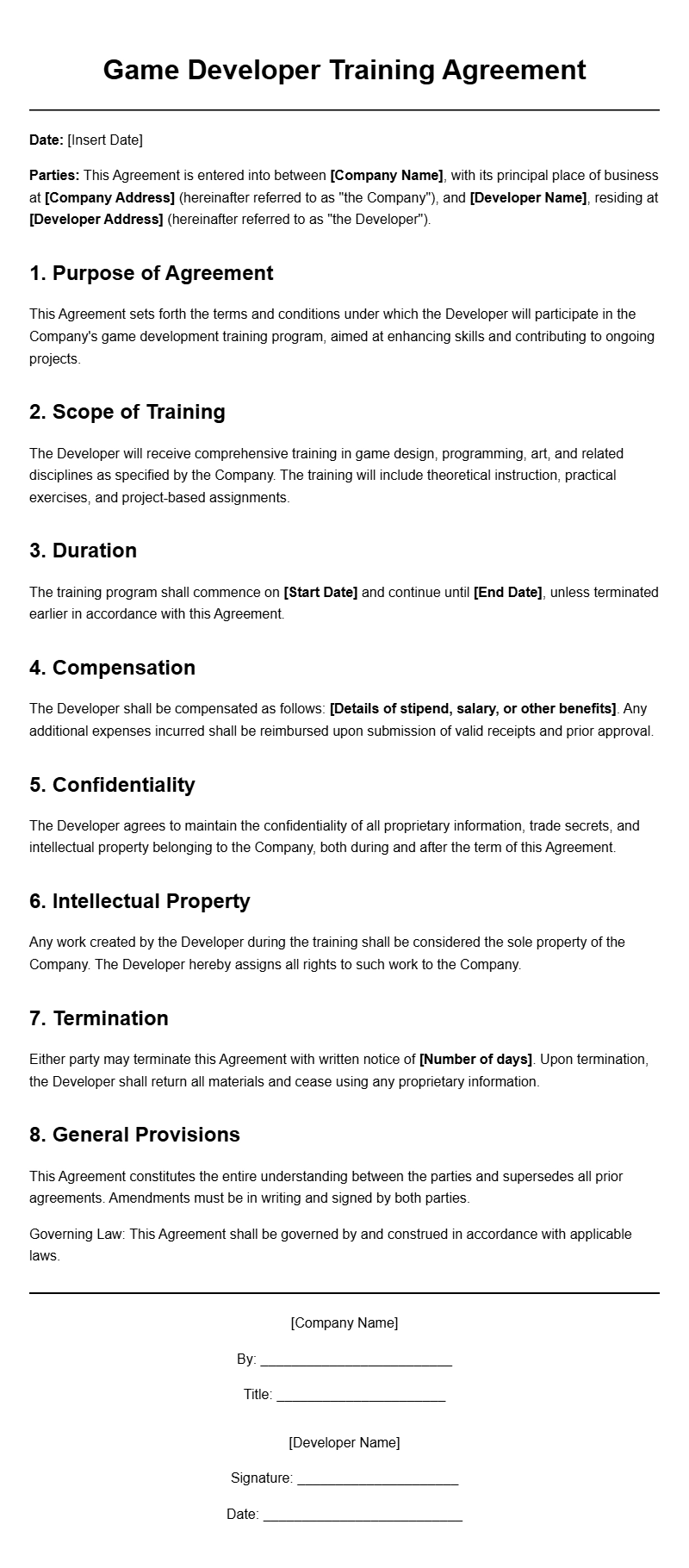
Standard Game Developer Training Agreement
This Agreement (“Agreement“) is entered into between Training Provider and Participant effective as of the date signed below.
The purpose of this Agreement is to outline the terms and conditions of the game developer training program.
Participant agrees to attend all scheduled sessions, complete assignments, and adhere to the program guidelines. In return, Provider will deliver structured training, resources, and mentorship.
Terms include confidentiality obligations, intellectual property rights, and termination clauses. Both parties acknowledge that participation is voluntary and that the Provider makes no guarantees regarding employment outcomes.
Signed by:
- Training Provider Representative: ______________________
- Participant: ______________________
- Date: ______________________
Game Developer Mentorship Program Agreement
This Mentorship Agreement establishes the relationship between Mentor and Mentee for the purpose of developing skills related to game development.
Mentor commits to providing guidance, feedback, and resources over a six-month period. Mentee agrees to actively participate, complete assigned projects, and respect confidentiality.
Both parties agree that any proprietary information shared remains confidential and that intellectual property developed during the program belongs to the Mentee unless otherwise specified.
This Agreement is binding upon signature by both parties.
Signatures:
- Mentor: ______________________
- Mentee: ______________________
- Date: ______________________
Game Developer Training Service Contract
This Service Contract (“Contract“) is made between Training Provider and Client for the delivery of game developer training sessions.
The Provider agrees to conduct a series of workshops over a three-month period, covering core aspects of game design, programming, and project management.
Payment terms are detailed in the attached invoice. Cancellation policies, session rescheduling, and participant requirements are also outlined.
Both parties affirm their understanding and acceptance by signing below.
Authorized Signatures:
- Provider Representative: ______________________
- Client: ______________________
- Date: ______________________
Game Developer Training Partnership Agreement
This Partnership Agreement (“Agreement“) is made between Training Organization and Corporate Partner to jointly promote and deliver game developer training programs.
The parties agree to share resources, co-develop curriculum, and facilitate student recruitment efforts. Revenue sharing and liability clauses are included in the attached terms.
Both parties commit to transparent communication and mutually beneficial cooperation. This Agreement is effective upon signing and remains in force for two years.
Signed by:
- Organization Representative: ______________________
- Partner Representative: ______________________
- Date: ______________________
Confidentiality and Non-Disclosure Agreement for Game Developer Training
This Non-Disclosure Agreement (NDA) is between Trainer and Participant to protect confidential information shared during the training program.
Both parties agree not to disclose proprietary content, trade secrets, or unpublished curriculum materials to third parties. The obligation remains in effect indefinitely beyond the training period.
Violations may result in legal action, and both parties acknowledge understanding of these terms by signing below.
Signature:
- Trainer: ______________________
- Participant: ______________________
- Date: ______________________
Game Developer Training Completion Certificate Template
This certificate confirms that [Participant Name] has successfully completed the Game Developer Training Program conducted by [Organization Name].
The participant has demonstrated proficiency in game design, programming, and project management, fulfilling all program requirements.
Issued on: [Date]
Authorized Signature: ______________________
Game Developer Training Enrollment Form
Please complete the following information to enroll in the game developer training program.
| Field | Details |
|---|---|
| Name | ______________________ |
| ______________________ | |
| Phone Number | ______________________ |
| Experience Level | Beginner / Intermediate / Advanced |
| Preferred Training Dates | ______________________ |
Submit Enrollment
Game Developer Training Feedback Form
We value your feedback on the game developer training program. Please fill out the form below.
- Rate the overall quality of the training:
- Excellent Good Fair Poor
- What did you find most beneficial?
- Suggestions for improvement:
Submit Feedback
Sample Game Developer Training Invoice
Invoice Number: INV-1001
Date: [Date]
Billed To:
- Name: ______________________
- Organization: ______________________
Services Rendered:
- Game Developer Training Program – 40 hours
Total Amount: $5,000.00
Payment Terms: Due within 30 days of invoice date.
Thank you for your business.