The user wants a deeply useful, SEO-friendly article targeting the keyword “invoice dispute letter samples”. They want a natural, human-sounding article with specific structure. They want HTML output (clean fragment), starting with a paragraph not a heading, no title/headline/H1, using only a specific limited set of HTML tags (p, h2, h3, ul, ol, li, strong, em, u, a). Avoid markdown. Must be internally linked to certain URLs with natural anchor text integrated into sentences. Must avoid filler transitions. Must avoid repetitive sentences. Must avoid certain overused AI words: “delve”, “crucial”, “comprehensive”, “transformative”, “landscape”, “pivotal”, “seamless”. Must not use keyword stuffing; include semantic variations.
The article structure: natural intro focusing on user intent. Explain what the document/template is. When it is used. Key components or sections. Step-by-step writing guide. Examples/templates. Common mistakes to avoid. Tips for customization. Short actionable closing paragraph.
Use headings (H2 and H3) that match search intent. Use tables? Possibly can embed simple tables. Use bullet lists. Provide practical examples and editable template snippets. Add entity-rich context relevant to keyword. Optimize for featured snippets and People Also Ask.
EEAT: accuracy, usefulness, trust. Avoid fluff. Write for humans first.
Add internal links to the list: /department-transfer-letter-samples-letter/, /event-invitation-letter-templates-letter/, /affiliate-partnership-letter-templates-letter/, /mother-to-daughter-letter-samples-letter/, /church-leader-to-member-letter-templates-letter/. Use natural anchor text integrated into sentences, not as standalone.
Links must be HTML anchor tags, e.g. anchor text. Use natural language within sentences. Avoid exact keyword anchors; e.g. use “sample letters for department transfers” or “templates for event invitations”. Must avoid generic CTA style like “click here”.
Make sure to embed these links within relevant context. Could be like: “If you’re also drafting a department transfer letter, you might find our sample helpful.” That would link to /department-transfer-letter-samples-letter/. Similarly for others.
Need to keep article flow.
Ok.
Let me think about content. The article is about invoice dispute letter samples. Need to define what is an invoice dispute letter. Explain when it’s used. Provide key components: header with contact info, date, subject line, salutation, body (explain dispute, mention invoice number, amount, reason, evidence, request), concluding statement, signature. Provide steps: gather documents, identify dispute reason, write clear factual description, propose resolution, proofread. Provide template snippets: example skeleton. Provide example of a dispute letter. Provide common mistakes: vague language, missing invoice number, forgetting to attach supporting documents, being too aggressive. Provide tips for customization: adjust tone based on relationship, include references to previous communications, specify desired outcome, include deadline.
Make sure to incorporate semantic variations: “invoice disagreement letter”, “billing dispute correspondence”, “payment dispute notice”. Variation may appear naturally.
Make article SEO friendly: use keyword “invoice dispute letter samples” in first paragraph maybe; but not overdo. Also include variations like “sample invoice dispute letter”, “invoice dispute template”.
Add internal links. Use anchor text like “our department transfer letter samples” for /department-transfer-letter-samples-letter/. For /event-invitation-letter-templates-letter/, maybe “like our event invitation letter templates”. For /affiliate-partnership-letter-templates-letter/, “our affiliate partnership letter templates”. For /mother-to-daughter-letter-samples-letter/, “our mother-to-daughter letter samples”. For /church-leader-to-member-letter-templates-letter/, “our church leader to member letter templates”. Use natural.
Ok.
Now, produce HTML fragment starting with a paragraph, not a heading. Should start with
. Then
headings capitalized case (meaning each word capitalized). Possibly use
for major sections. Use
for subsections.
for subsections.
The article must be “deeply useful”. Provide practical advice. Avoid fluff.
Also maintain “conversational but professional”. Use active voice.
Need to avoid “delve”, “crucial”, etc.
We’ll include a short actionable closing paragraph (like a call to action but not a CTA). Provide a final sentence: “If you need a quick start, copy the template above, adjust the details, and send it today.”
Now, let’s draft.
—
Paragraph (intro):
When a vendor sends you an invoice that doesn’t match the work you received, it can throw a wrench in your cash flow and vendor relationship. A well‑crafted invoice dispute letter gives you a clear, professional way to flag the problem, provide evidence, and request a fair resolution. Below is a practical guide with real‑world examples, editable snippets, and common pitfalls so you can write a dispute letter that gets noticed and acted on.
Now, next heading:
What an Invoice Dispute Letter Is (and When to Use One)
… explain.
Make it SEO friendly: include “invoice dispute letter” and “sample invoice dispute letter”.
Let’s start.
Will incorporate internal links:
– “Our department transfer letter samples” linking to /department-transfer-letter-samples-letter/.
– “If you’re also preparing an event invitation, our event invitation letter templates can streamline the process.”
– “For broader partnership communications, check out our affiliate partnership letter templates.”
– “If you’re drafting a personal note, our mother-to-daughter letter samples may help.”
– “When you need to reach out to a church community, our church leader to member letter templates are ready to use.”
Make sure anchor text not exact keyword.
Now, ensure all tags are allowed:
,
,
,
,
,
- , , , , .
We’ll need to embed a table? Possibly. But we can just use bullet lists. Use bullet lists for components and steps.
We need to include “Examples/templates”. Could show snippet:
Here’s a basic template you can copy and edit:
but we cannot use tag maybe allowed? The list of allowed tags includes only
,
,
,
,
,
- , , , , . No or . We can embed a snippet in
with line breaks maybe use
but we cannot use
? The allowed tags don’t include
. We can simply write as text but with spacing. Use indentation or separate paragraphs.
Better to show as:
Template snippet:
[Your Company Name]
[Address]
City, State ZIP
Date: [Month Day, Year]
To: [Vendor Name]
[Vendor Address]
Subject: Invoice Dispute – Invoice #[123456]
Dear [Vendor Contact Name],
I am writing to dispute invoice #[123456] dated [date] in the amount of $[amount] for the following reasons: …
Attached are supporting documents: [list].
I kindly request a review and correction of this invoice at your earliest convenience. Please confirm receipt of this letter by [deadline].
Thank you,
[Your Name]
[Your Title]
Make sure line breaks are represented as
if allowed?
is not in the allowed tag list. So cannot use
. Might need to separate with separate
tags for each line. That’s okay.
Thus snippet will be multiple
tags, each with a line.
Ok.
Now ensure “Common mistakes to avoid” is a heading with bullet list.
Now “Tips for customization”.
Now “Short actionable closing paragraph”.
Ok.
Now produce HTML.
We need to output only clean HTML fragment suitable for static HTML page body. No markdown.
Make sure to include internal links. Use anchor tags with proper href attributes.
We need to ensure not to place links as standalone or appended phrases. So embed in sentence.
Now generate.
—
Potential article skeleton:
When a vendor sends you an invoice that doesn’t match the work you received …
What an Invoice Dispute Letter Is (and When to Use One)
…definition… When you receive an invoice that is overcharged, duplicated, or for services not rendered, you should write a dispute letter promptly.
Key Sections Every Invoice Dispute Letter Must Include
list of sections
Example of a Clear Subject Line
Step‑by‑Step Guide to Writing Your Letter
list of steps
Editable Template Snippets You Can Copy Right Now
template snippet with paragraphs
Real‑World Example: Disputing a Duplicate Charge
example scenario…
Common Mistakes to Avoid
list
Tips for Customizing the Letter for Your Business
Tips…
closing paragraph…
Add internal links somewhere appropriate.
For example:
If you also need to handle a department transfer letter sample for internal moves, we’ve compiled a set that works for many industries.
And similar.
Let’s think about semantic variations: “billing dispute notice”, “payment discrepancy letter”, “invoice correction request”. Use these.
Now write content.
—-
Need to think about formatting for readability: short paragraphs, bullet lists.
Ok.
Will now write the article.
—-
First paragraph, as above.
Second heading.
We need to avoid filler transitions.
—-
Let’s start drafting.
— Write:
When a vendor sends you an invoice that doesn’t match the work you received, it can throw a wrench in your cash flow and vendor relationship. A well‑crafted invoice dispute letter gives you a clear, professional way to flag the problem, provide evidence, and request a fair resolution. Below is a practical guide with real‑world examples, editable snippets, and common pitfalls so you can write a dispute letter that gets noticed and acted on.
What an Invoice Dispute Letter Is (and When to Use One)
An invoice dispute letter is a formal note that informs a vendor you believe a billed amount is incorrect, duplicate, or not justified. You’ll send this type of letter when you spot an overcharge, a duplicate billing entry, a charge for a service never delivered, or a pricing error on an invoice you’ve received. Acting quickly—preferably within the payment terms—helps keep the relationship intact and prevents unnecessary late fees.
If you also need to handle an internal move, our department transfer letter samples show how to structure clear, factual correspondence.
Key Sections Every Invoice Dispute Letter Must Include
Even though you’re writing a short document, several parts make the letter credible and easy to act on:
- Header with your company info – name, address, phone, email.
- Vendor’s contact details – who you’re addressing and their address.
- Date of the letter – keeps a timeline.
- Subject line that spells out the issue – e.g., “Invoice #123456 – Dispute for Duplicate Charge”.
- Salutation – a respectful “Dear [Name],” works best.
- Body explaining the dispute – invoice number, amount billed, what’s wrong, and why.
- List of attached proof – contracts, screenshots, previous emails.
- Requested outcome – whether you want a credit, a revised invoice, or a refund.
- Closing with a deadline – “Please respond by [date].”
- Signature – name, title, and contact information.
Subject Line That Works
“Subject: Invoice #987654 – Request for Correction Due to Overbilling” tells the vendor instantly what the letter is about, which increases the chance it lands in the right inbox quickly.
Step‑by‑Step Guide to Writing Your Letter
- Gather all related documents. Pull the original invoice, purchase order, contract, and any emails that clarify the agreed price or scope.
- Identify the exact problem. Is it a line‑item error, a duplicated charge, or a service that wasn’t delivered? Write a one‑sentence summary of the issue.
- Draft the header and subject line. Put your company name at the top, then the vendor’s details, followed by a clear subject that includes the invoice number.
- Write the opening paragraph. State that you are writing to dispute a specific invoice and give the invoice number and date.
- Explain the dispute in factual language. Describe what’s wrong, why it’s wrong, and include any numbers that support your claim. Keep the tone neutral—avoid blaming language.
- Attach supporting evidence. List the documents you’re enclosing, such as “Copy of PO #456789” or “Screenshot of delivery confirmation”.
- State the requested resolution. Do you want a credit memo, a revised invoice, or a refund? Be specific.
- Add a deadline and thank‑you line. “Please let me know how you intend to resolve this by [date] so we can keep our accounts current.”
- Proofread. Check for typos, missing invoice numbers, and ensure the tone stays professional.
Editable Template Snippets You Can Copy Right Now
Use the blocks below as a starting point. Replace the bracketed placeholders with your details.
[Your Company Name]
[Street Address]
[City, State ZIP]
Date: [Month Day, Year]
To: [Vendor Name]
[Vendor Street Address]
[City, State ZIP]
Subject: Invoice Dispute – Invoice #[Invoice Number]
Dear [Vendor Contact Name],
I am writing to dispute invoice #[Invoice Number] dated [Invoice Date] in the amount of $[Amount] for the following reasons:
[Bullet or paragraph describing the problem – e.g., “The amount billed exceeds the agreed price of $X as per contract #123 dated [date].”]
Attached are supporting documents that confirm my claim:
- Copy of Purchase Order #[PO Number]
- Email chain showing agreed pricing
- Screenshot of delivery confirmation
I kindly request that you review the matter and either issue a corrected invoice, apply a credit, or provide a refund of $[Disputed Amount]. Please confirm receipt of this letter by [Response Deadline] so we can resolve the discrepancy promptly.
Thank you for your attention to this matter.
Sincerely,
[Your Name]
[Your Title]
[Phone Number]
[Email Address]
Real‑World Example: Disputing a Duplicate Charge
Imagine you received an invoice for $1,250 that includes two line items for the same consulting hours. You have a contract that shows the rate is $125 per hour, so only $1,000 should be billed. Here’s how the body of the letter could read:
“Our records show that invoice #876543 dated March 5, 2024, contains a duplicate charge for consulting services. According to the service agreement signed on February 20, 2024, the agreed rate is $125 per hour, and the total for 8 hours is $1,000. The invoice, however, lists two separate entries of $625 each, totaling $1,250. I have attached the signed agreement and the original email confirming the scope of work. Please issue a revised invoice for $1,000 or apply a $250 credit to our next billing cycle.”
Notice the letter stays factual, references a concrete document, and spells out the exact amount to be corrected.
Common Mistakes to Avoid
- Sending a vague request – “There’s a problem with the bill” can be ignored. Always include the invoice number and specific discrepancy.
- Missing deadlines – If you wait beyond the payment terms, the vendor may assume the invoice is correct.
- Forgetting to attach proof – Your claim will be weaker without supporting documents.
- Using aggressive tone – “You overcharged me” sounds accusatory. Keep the language neutral and professional.
- Overloading the letter with irrelevant detail – Stick to the facts that directly support the dispute.
If you also need to coordinate an event, our event invitation letter templates can help you communicate clearly with attendees.
Tips for Customizing the Letter for Your Business
- Match the vendor’s communication style. If you normally send brief emails, keep the dispute letter concise; if you work with formal contracts, add full legal references.
- Include a direct contact name – Addressing the letter to the accounts‑payable manager rather than a generic “To Whom It May Concern” speeds up processing.
- Set a reasonable deadline – Typically 10‑15 business days gives the vendor enough time to investigate without disrupting your payment schedule.
- Specify the desired outcome – “Please issue a corrected invoice for $950” is clearer than “please fix the error.”
- Keep a copy for your records – Document the sent date and delivery method (email read receipt, certified mail) in case you need to follow up.
For broader partnership communications, you might also review our affiliate partnership letter templates to maintain consistency across business correspondence.
If you ever need a personal touch for family notes, our mother‑to‑daughter letter samples offer a range of tone and format ideas.
When reaching out to a faith‑based community, our 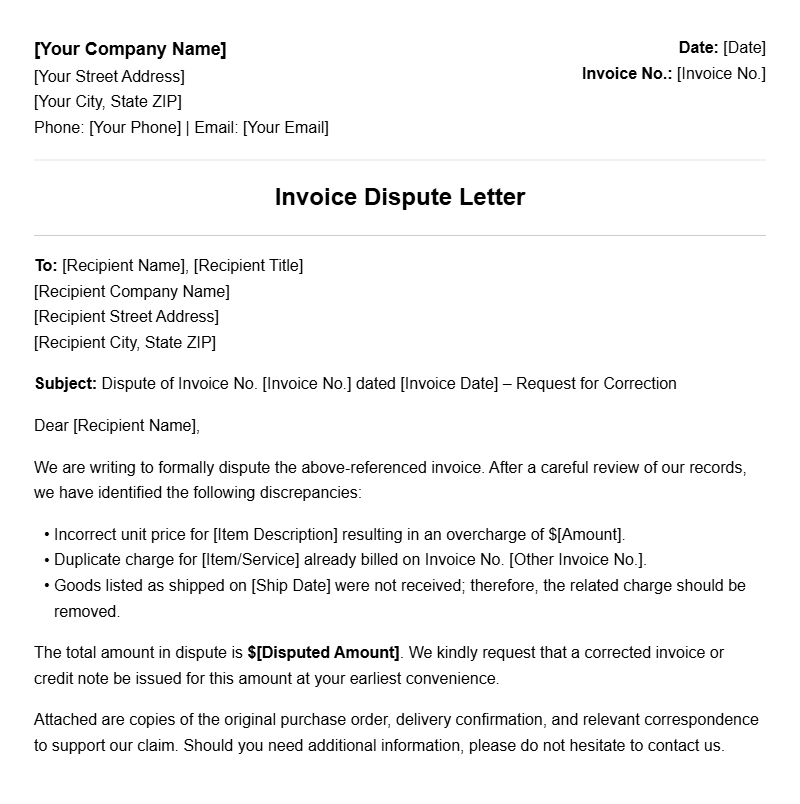
Invoice Dispute Letter Samples
- ,
- , , , , .
We’ll need to embed a table? Possibly. But we can just use bullet lists. Use bullet lists for components and steps.
We need to include “Examples/templates”. Could show snippet:
Here’s a basic template you can copy and edit:
but we cannot use tag maybe allowed? The list of allowed tags includes only
,
,
,
- ,
- , , , , . No or . We can embed a snippet in
with line breaks maybe use
but we cannot use
? The allowed tags don’t include
. We can simply write as text but with spacing. Use indentation or separate paragraphs.Better to show as:
Template snippet:
[Your Company Name]
[Address]
City, State ZIPDate: [Month Day, Year]
To: [Vendor Name]
[Vendor Address]Subject: Invoice Dispute – Invoice #[123456]
Dear [Vendor Contact Name],
I am writing to dispute invoice #[123456] dated [date] in the amount of $[amount] for the following reasons: …
Attached are supporting documents: [list].
I kindly request a review and correction of this invoice at your earliest convenience. Please confirm receipt of this letter by [deadline].
Thank you,
[Your Name]
[Your Title]Make sure line breaks are represented as
if allowed?
is not in the allowed tag list. So cannot use
. Might need to separate with separatetags for each line. That’s okay.
Thus snippet will be multiple
tags, each with a line.
Ok.
Now ensure “Common mistakes to avoid” is a heading with bullet list.
Now “Tips for customization”.
Now “Short actionable closing paragraph”.
Ok.
Now produce HTML.
We need to output only clean HTML fragment suitable for static HTML page body. No markdown.
Make sure to include internal links. Use anchor tags with proper href attributes.
We need to ensure not to place links as standalone or appended phrases. So embed in sentence.
Now generate.
—
Potential article skeleton:
When a vendor sends you an invoice that doesn’t match the work you received …
What an Invoice Dispute Letter Is (and When to Use One)
…definition… When you receive an invoice that is overcharged, duplicated, or for services not rendered, you should write a dispute letter promptly.
Key Sections Every Invoice Dispute Letter Must Include
- list of sections
Example of a Clear Subject Line
Step‑by‑Step Guide to Writing Your Letter
- list of steps
Editable Template Snippets You Can Copy Right Now
template snippet with paragraphs
Real‑World Example: Disputing a Duplicate Charge
example scenario…
Common Mistakes to Avoid
- list
Tips for Customizing the Letter for Your Business
Tips…
closing paragraph…
Add internal links somewhere appropriate.
For example:
If you also need to handle a department transfer letter sample for internal moves, we’ve compiled a set that works for many industries.
And similar.
Let’s think about semantic variations: “billing dispute notice”, “payment discrepancy letter”, “invoice correction request”. Use these.
Now write content.
—-
Need to think about formatting for readability: short paragraphs, bullet lists.
Ok.
Will now write the article.
—-
First paragraph, as above.
Second heading.
We need to avoid filler transitions.
—-
Let’s start drafting.
— Write:
When a vendor sends you an invoice that doesn’t match the work you received, it can throw a wrench in your cash flow and vendor relationship. A well‑crafted invoice dispute letter gives you a clear, professional way to flag the problem, provide evidence, and request a fair resolution. Below is a practical guide with real‑world examples, editable snippets, and common pitfalls so you can write a dispute letter that gets noticed and acted on.
What an Invoice Dispute Letter Is (and When to Use One)
An invoice dispute letter is a formal note that informs a vendor you believe a billed amount is incorrect, duplicate, or not justified. You’ll send this type of letter when you spot an overcharge, a duplicate billing entry, a charge for a service never delivered, or a pricing error on an invoice you’ve received. Acting quickly—preferably within the payment terms—helps keep the relationship intact and prevents unnecessary late fees.
If you also need to handle an internal move, our department transfer letter samples show how to structure clear, factual correspondence.
Key Sections Every Invoice Dispute Letter Must Include
Even though you’re writing a short document, several parts make the letter credible and easy to act on:
- Header with your company info – name, address, phone, email.
- Vendor’s contact details – who you’re addressing and their address.
- Date of the letter – keeps a timeline.
- Subject line that spells out the issue – e.g., “Invoice #123456 – Dispute for Duplicate Charge”.
- Salutation – a respectful “Dear [Name],” works best.
- Body explaining the dispute – invoice number, amount billed, what’s wrong, and why.
- List of attached proof – contracts, screenshots, previous emails.
- Requested outcome – whether you want a credit, a revised invoice, or a refund.
- Closing with a deadline – “Please respond by [date].”
- Signature – name, title, and contact information.
Subject Line That Works
“Subject: Invoice #987654 – Request for Correction Due to Overbilling” tells the vendor instantly what the letter is about, which increases the chance it lands in the right inbox quickly.
Step‑by‑Step Guide to Writing Your Letter
- Gather all related documents. Pull the original invoice, purchase order, contract, and any emails that clarify the agreed price or scope.
- Identify the exact problem. Is it a line‑item error, a duplicated charge, or a service that wasn’t delivered? Write a one‑sentence summary of the issue.
- Draft the header and subject line. Put your company name at the top, then the vendor’s details, followed by a clear subject that includes the invoice number.
- Write the opening paragraph. State that you are writing to dispute a specific invoice and give the invoice number and date.
- Explain the dispute in factual language. Describe what’s wrong, why it’s wrong, and include any numbers that support your claim. Keep the tone neutral—avoid blaming language.
- Attach supporting evidence. List the documents you’re enclosing, such as “Copy of PO #456789” or “Screenshot of delivery confirmation”.
- State the requested resolution. Do you want a credit memo, a revised invoice, or a refund? Be specific.
- Add a deadline and thank‑you line. “Please let me know how you intend to resolve this by [date] so we can keep our accounts current.”
- Proofread. Check for typos, missing invoice numbers, and ensure the tone stays professional.
Editable Template Snippets You Can Copy Right Now
Use the blocks below as a starting point. Replace the bracketed placeholders with your details.
[Your Company Name]
[Street Address]
[City, State ZIP]Date: [Month Day, Year]
To: [Vendor Name]
[Vendor Street Address]
[City, State ZIP]Subject: Invoice Dispute – Invoice #[Invoice Number]
Dear [Vendor Contact Name],
I am writing to dispute invoice #[Invoice Number] dated [Invoice Date] in the amount of $[Amount] for the following reasons:
[Bullet or paragraph describing the problem – e.g., “The amount billed exceeds the agreed price of $X as per contract #123 dated [date].”]
Attached are supporting documents that confirm my claim:
- Copy of Purchase Order #[PO Number]
- Email chain showing agreed pricing
- Screenshot of delivery confirmation
I kindly request that you review the matter and either issue a corrected invoice, apply a credit, or provide a refund of $[Disputed Amount]. Please confirm receipt of this letter by [Response Deadline] so we can resolve the discrepancy promptly.
Thank you for your attention to this matter.
Sincerely,
[Your Name]
[Your Title]
[Phone Number]
[Email Address]Real‑World Example: Disputing a Duplicate Charge
Imagine you received an invoice for $1,250 that includes two line items for the same consulting hours. You have a contract that shows the rate is $125 per hour, so only $1,000 should be billed. Here’s how the body of the letter could read:
“Our records show that invoice #876543 dated March 5, 2024, contains a duplicate charge for consulting services. According to the service agreement signed on February 20, 2024, the agreed rate is $125 per hour, and the total for 8 hours is $1,000. The invoice, however, lists two separate entries of $625 each, totaling $1,250. I have attached the signed agreement and the original email confirming the scope of work. Please issue a revised invoice for $1,000 or apply a $250 credit to our next billing cycle.”
Notice the letter stays factual, references a concrete document, and spells out the exact amount to be corrected.
Common Mistakes to Avoid
- Sending a vague request – “There’s a problem with the bill” can be ignored. Always include the invoice number and specific discrepancy.
- Missing deadlines – If you wait beyond the payment terms, the vendor may assume the invoice is correct.
- Forgetting to attach proof – Your claim will be weaker without supporting documents.
- Using aggressive tone – “You overcharged me” sounds accusatory. Keep the language neutral and professional.
- Overloading the letter with irrelevant detail – Stick to the facts that directly support the dispute.
If you also need to coordinate an event, our event invitation letter templates can help you communicate clearly with attendees.
Tips for Customizing the Letter for Your Business
- Match the vendor’s communication style. If you normally send brief emails, keep the dispute letter concise; if you work with formal contracts, add full legal references.
- Include a direct contact name – Addressing the letter to the accounts‑payable manager rather than a generic “To Whom It May Concern” speeds up processing.
- Set a reasonable deadline – Typically 10‑15 business days gives the vendor enough time to investigate without disrupting your payment schedule.
- Specify the desired outcome – “Please issue a corrected invoice for $950” is clearer than “please fix the error.”
- Keep a copy for your records – Document the sent date and delivery method (email read receipt, certified mail) in case you need to follow up.
For broader partnership communications, you might also review our affiliate partnership letter templates to maintain consistency across business correspondence.
If you ever need a personal touch for family notes, our mother‑to‑daughter letter samples offer a range of tone and format ideas.
When reaching out to a faith‑based community, our
Invoice Dispute Letter Samples
- ,
- , , , , . No or . We can embed a snippet in
- ,