When you need to communicate with a hospital on behalf of a patient, having a well-crafted letter can make a significant difference. Whether you’re a concerned family member, a caregiver, or even the patient themselves, using a patient to hospital letter template can streamline the process of conveying important information. This article will guide you through what these templates are, when you might need them, and how to write one effectively.
What Is a Patient to Hospital Letter Template?
A patient to hospital letter template is a pre-formatted document designed to assist individuals in communicating specific requests or information to a hospital. This could include requesting medical records, clarifying treatment plans, or addressing concerns about care. Templates provide a clear structure, making it easier to convey your message without missing crucial details.
When Is It Used?
These letters are typically used in various situations, such as:
- Requesting medical records for personal use or to share with another healthcare provider.
- Inquiring about treatment options or care plans.
- Addressing concerns or complaints about the care received.
- Notifying the hospital of a change in insurance or financial information.
Key Components or Sections
A well-structured letter should include the following components:
- Your contact information: Name, address, phone number, and email.
- Date: The date when the letter is written.
- Hospital’s contact information: Name of the hospital, department, and relevant contact person if known.
- Salutation: A polite greeting, such as “Dear [Doctor’s Name or Hospital Administrator].”
- Body: Clear and concise explanation of the purpose of the letter.
- Closing: A polite sign-off, such as “Sincerely” or “Best regards,” followed by your name.
Step-by-Step Writing Guide
Follow these steps to create an effective patient to hospital letter:
- Identify the purpose: Know exactly what you want to communicate.
- Gather necessary information: Ensure you have all relevant details, like patient ID, and specific dates.
- Use a clear and respectful tone: Be straightforward but polite.
- Keep it concise: Stick to the point to avoid confusion.
- Proofread: Check for spelling or grammar errors before sending.
Realistic Examples/Templates
Here are a couple of editable snippets to help you get started:
Example 1: Requesting Medical Records
[Your Name]
[Your Address]
[City, State, Zip]
[Your Email]
[Your Phone Number]
[Date]
[Hospital Name]
[Department/Office]
[Hospital Address]
[City, State, Zip]
Dear [Recipient’s Name],
I am writing to request copies of my medical records from [date range or specific treatment]. My patient ID is [Patient ID]. Please send the records to my address listed above or to my email if possible.
Thank you for your assistance.
Sincerely,
[Your Name]
Example 2: Addressing a Concern
[Your Name]
[Your Address]
[City, State, Zip]
[Your Email]
[Your Phone Number]
[Date]
[Hospital Name]
[Department/Office]
[Hospital Address]
[City, State, Zip]
Dear [Recipient’s Name],
I hope this message finds you well. I am writing to express my concern regarding the treatment my [relation, e.g., father] received during his recent stay from [start date] to [end date]. I would appreciate it if we could discuss this matter further at your earliest convenience.
Thank you for your attention to this issue.
Best regards,
[Your Name]
Common Mistakes to Avoid
When writing your letter, keep these common pitfalls in mind:
- Being too vague about your request.
- Using overly technical language that may not be clear to the recipient.
- Neglecting to include necessary details like patient ID or specific dates.
- Failing to proofread for errors before sending.
Tips for Customization
Each letter should be tailored to your specific situation:
- Use the patient’s full name and details to avoid confusion.
- Adjust the tone based on your relationship with the recipient; more formal for administrators, more casual for doctors you know.
- Include specific dates and references to treatments or appointments for clarity.
Writing a patient to hospital letter can feel daunting, but with the right template and a clear purpose, you can communicate your needs effectively. Whether you’re seeking information or addressing a concern, these guidelines will help you navigate the process with confidence.
Editable Document Format Examples
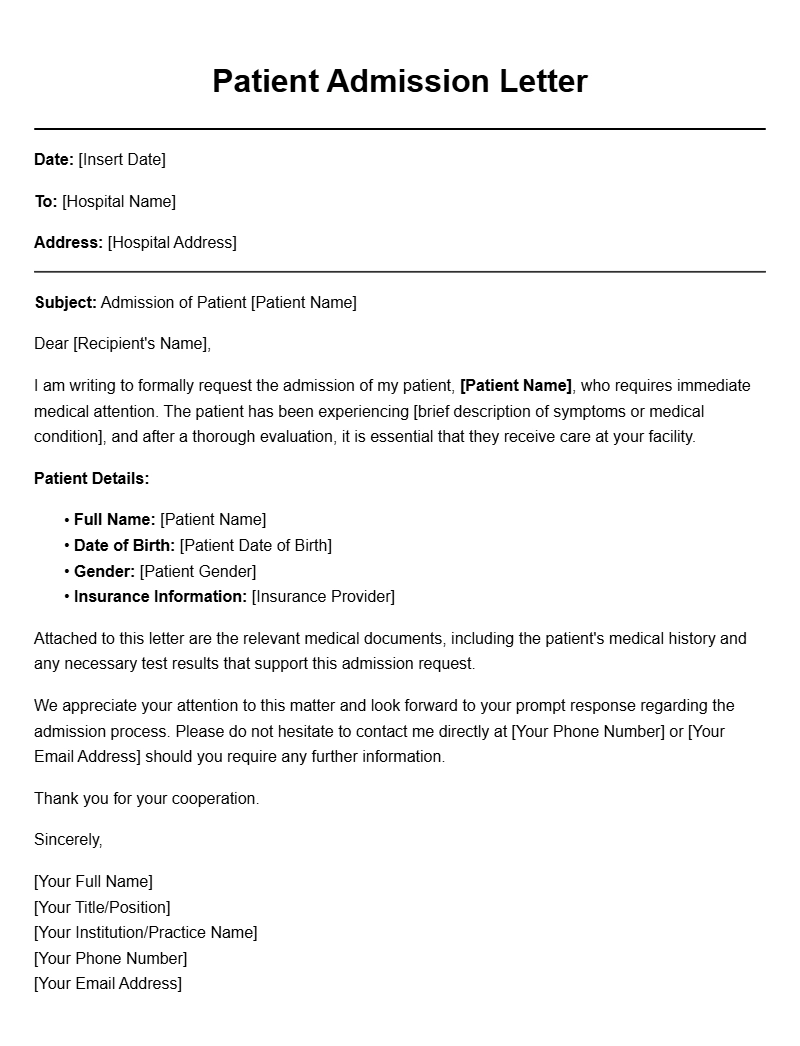
Admission Request Letter
To Whom It May Concern,
I am writing to formally request the admission of [Patient’s Name] to [Hospital Name] for treatment. The patient has been diagnosed with [Diagnosis] and requires immediate medical attention.
Please find attached the relevant medical reports and documents from their primary physician, [Doctor’s Name].
Thank you for your assistance in this matter. I look forward to your prompt response.
Sincerely,
[Your Name]
[Your Contact Information]
Transfer Letter to Specialist
Dear [Receiving Doctor’s Name],
I am writing to refer my patient, [Patient’s Name], for specialized treatment at your facility. The patient has been experiencing [Specific Symptoms], and I believe your expertise in [Specialty] would be beneficial.
Attached are the medical records and a summary of the patient’s condition for your review.
Thank you for your attention to this matter.
Best regards,
[Your Name]
[Your Contact Information]
Follow-Up Appointment Request
Dear [Hospital Name],
I hope this message finds you well. I am writing to schedule a follow-up appointment for my patient, [Patient’s Name], who was recently treated for [Condition].
We would appreciate an appointment at your earliest convenience, ideally within the next week. Please let us know your available dates and times.
Thank you for your continued care.
Warm regards,
[Your Name]
[Your Contact Information]
Request for Medical Records
To the Medical Records Department,
I am writing to request the medical records of my patient, [Patient’s Name], who has been treated at your facility from [Start Date] to [End Date].
The records are needed for further treatment planning and should include:
- Consultation notes
- Test results
- Imaging reports
Please let me know if you require any forms or identification to process this request.
Thank you for your assistance.
Sincerely,
[Your Name]
[Your Contact Information]
Discharge Summary Request
Dear [Hospital Name],
I am requesting a discharge summary for my patient, [Patient’s Name], who was discharged on [Discharge Date]. This summary is essential for continuity of care as the patient transitions back to their primary care provider.
Could you please provide the summary at your earliest convenience? Thank you for your cooperation.
Best,
[Your Name]
[Your Contact Information]
Patient Consent for Treatment
To Whom It May Concern,
This letter serves to confirm that [Patient’s Name] has provided consent for their treatment at [Hospital Name] under the care of [Doctor’s Name].
The patient understands the nature of their condition and the proposed treatment plan, including any risks involved.
Thank you for your attention to this matter.
Sincerely,
[Your Name]
[Your Contact Information]
Insurance Verification Request
Dear [Insurance Company Name],
I am writing to request verification of insurance coverage for my patient, [Patient’s Name], who is scheduled for treatment at [Hospital Name].
Details of coverage are needed to ensure that the patient receives the appropriate care without financial interruptions. Please confirm the following:
- Policy number
- Coverage limits
- Co-pay amounts
Thank you for your prompt response.
Best regards,
[Your Name]
[Your Contact Information]
Notification of Admission
To Whom It May Concern,
This letter is to inform you that [Patient’s Name] has been admitted to [Hospital Name] as of [Admission Date] for treatment of [Condition].
Please contact me if you require further information or documentation regarding the patient’s condition or treatment plan.
Thank you for your cooperation.
Sincerely,
[Your Name]
[Your Contact Information]
Request for Patient Transportation
Dear [Transportation Service],
I am writing to request transportation services for my patient, [Patient’s Name], who requires transport to [Hospital Name] for their scheduled appointment on [Date].
The patient has mobility issues and will need assistance during transit.
Thank you for your help in ensuring the patient’s safe arrival.
Best,
[Your Name]
[Your Contact Information]
Pre-Admission Information Request
Dear [Hospital Name],
I am writing to request pre-admission information for my patient, [Patient’s Name], who is scheduled to undergo [Procedure] on [Date].
Specifically, we are looking for details on:
- Pre-operative instructions
- Required documentation
- Estimated duration of hospital stay
Your assistance in this matter is greatly appreciated.
Thank you,
[Your Name]
[Your Contact Information]