Writing a letter to your therapist can feel daunting, but it’s a powerful way to express your feelings, share your progress, or discuss any concerns. Whether you’re a new patient wanting to introduce yourself or someone who has been in therapy for a while and wants to clarify your goals, having a template can help guide your thoughts and make the process easier.
What is a Patient to Therapist Letter Template?
A patient to therapist letter template is a structured format that helps you articulate your thoughts, feelings, and experiences to your therapist. It serves as a starting point for your communication, ensuring you cover important topics while also allowing for personal touches. This template can be tailored to your situation, whether it’s for a general update, a specific issue, or a reflection on your therapeutic journey.
When to Use a Patient to Therapist Letter
There are several scenarios where writing a letter to your therapist can be beneficial:
- To introduce yourself and share your background if you’re a new patient.
- To discuss specific issues that may be difficult to bring up during sessions.
- To summarize your progress and set new goals for therapy.
- To express gratitude or feedback about your therapeutic experience.
Key Components of the Letter
When crafting your letter, consider including the following sections:
- Introduction: Briefly introduce yourself and state the purpose of the letter.
- Current Feelings or Issues: Share your thoughts, feelings, and any challenges you’re facing.
- Progress Reflection: Discuss any progress you’ve made since beginning therapy.
- Goals: Outline what you hope to achieve in your future sessions.
- Closing: End with a positive note or an expression of gratitude.
Step-by-Step Writing Guide
Here’s a simple process to help you write your letter:
- Start with a warm greeting, addressing your therapist by name.
- Clearly state the letter’s purpose in the first few sentences.
- Share your current feelings or experiences. Be honest and specific.
- Reflect on your progress, mentioning any breakthroughs or insights.
- Set clear goals for what you want to focus on in therapy going forward.
- Conclude with a respectful closing, thanking your therapist for their support.
Editable Template Snippet
Here’s a basic template you can customize:
Dear [Therapist’s Name],
I hope this letter finds you well. I wanted to take a moment to share some of my thoughts and feelings with you.
Currently, I have been feeling [describe your current emotions or challenges]. It’s been a bit overwhelming at times, especially when [provide specific examples].
Reflecting on my journey, I realize I have made some progress, such as [mention any improvements or insights]. I appreciate your guidance in helping me reach this point.
Looking ahead, I would like to focus on [set specific goals or topics for future sessions].
Thank you for your continued support.
Sincerely,
[Your Name]
Common Mistakes to Avoid
When writing your letter, be mindful of these pitfalls:
- Being too vague. Specificity helps your therapist understand your situation better.
- Overloading the letter with too many topics. Focus on one or two main points.
- Neglecting to proofread. Errors can distract from your message.
Tips for Customization
To make your letter more personal and effective, consider these suggestions:
- Use your own voice. Write as if you’re speaking to your therapist directly.
- Include personal anecdotes or examples to illustrate your feelings.
- Adjust the tone to match your relationship with your therapist; it can be formal or casual.
Taking the time to write a letter can enhance your therapeutic experience. It allows for deeper reflection and clearer communication. Remember, your thoughts and feelings are valuable, and sharing them can lead to meaningful discussions in your sessions.
Template Variations & Sample Formats
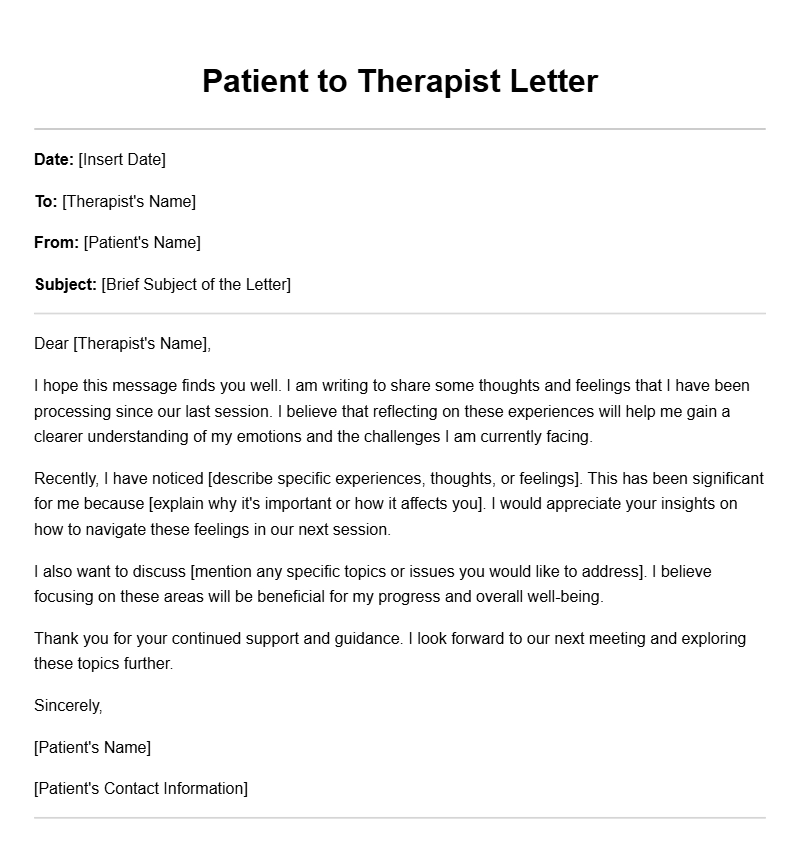
Introduction Letter to Therapist
Dear [Therapist’s Name],
I hope this letter finds you well. My name is [Your Name], and I am reaching out to seek your professional assistance. After considering various options, I believe that your expertise aligns perfectly with my needs.
I have been experiencing [briefly describe your situation or feelings], and I am eager to explore these issues in a supportive environment. I am hopeful that through our sessions, I can develop better coping strategies and gain deeper insights into my experiences.
Thank you for considering my request. I look forward to the possibility of working together.
Sincerely,
[Your Name]
Request for Appointment
Dear [Therapist’s Name],
I am writing to request an appointment for therapy sessions. I have been feeling [describe your feelings briefly], and I believe that professional support would be beneficial.
Please let me know your availability for the upcoming weeks. I am flexible with timings and can adjust according to your schedule.
Thank you for your attention. I look forward to your response.
Best regards,
[Your Name]
Follow-Up Letter
Dear [Therapist’s Name],
I hope this message finds you well. I wanted to take a moment to express my gratitude for our last session. It was enlightening, and I have been reflecting on the insights we discussed.
I would like to follow up on [specific topic or issue discussed]. I feel that further exploration could help me achieve a better understanding and progress.
Thank you for your ongoing support. I look forward to our next appointment.
Warm regards,
[Your Name]
Feedback on Therapy Sessions
Dear [Therapist’s Name],
I wanted to share some feedback on our therapy sessions. I appreciate your approach and the safe space you have created for me to express my thoughts and feelings.
Specifically, I found our discussion on [mention a specific topic] particularly helpful. I have noticed [describe any changes or benefits].
Thank you for your guidance and support. I look forward to continuing our work together.
Best wishes,
[Your Name]
Letter of Commitment
Dear [Therapist’s Name],
I am writing to express my commitment to the therapy process. I understand that growth takes time and effort, and I am dedicated to actively participating in our sessions.
I am particularly interested in addressing [specific issues or goals]. I believe that with your help, I can make significant progress.
Thank you for your support. I am looking forward to our journey together.
Sincerely,
[Your Name]
Apology for Missed Appointment
Dear [Therapist’s Name],
I hope this message finds you well. I am writing to sincerely apologize for missing our scheduled appointment on [date]. Unfortunately, [brief explanation of why you missed it].
I value our time together and would appreciate the opportunity to reschedule. Please let me know your availability.
Thank you for your understanding.
Best regards,
[Your Name]
Request for Referral
Dear [Therapist’s Name],
I hope you are doing well. I wanted to discuss the possibility of a referral to a specialist for [specific issue]. I believe that additional support could aid my progress.
If you have any recommendations, I would greatly appreciate it. Thank you for your guidance and support.
Sincerely,
[Your Name]
Sharing Progress Updates
Dear [Therapist’s Name],
I wanted to share some updates on my progress since our last session. I have been working on [specific skill or strategy discussed], and I have noticed [describe any positive changes or challenges].
Thank you for your support as I navigate this journey. I look forward to discussing these updates in our next session.
Warm regards,
[Your Name]
Expressing Gratitude
Dear [Therapist’s Name],
I am writing to express my heartfelt gratitude for the support you have provided during our sessions. Your insights and guidance have been invaluable as I navigate through my challenges.
Thank you for creating a safe and supportive environment. I feel more empowered and hopeful about my journey ahead.
Looking forward to our continued work together.
Sincerely,
[Your Name]
Inquiry About Therapy Techniques
Dear [Therapist’s Name],
I hope you are well. I wanted to inquire about the techniques we are using in therapy, specifically regarding [specific technique or approach].
I am interested in understanding how these methods can further assist my progress and how I can engage more actively in the process.
Thank you for your guidance. I look forward to our next session.
Best regards,
[Your Name]