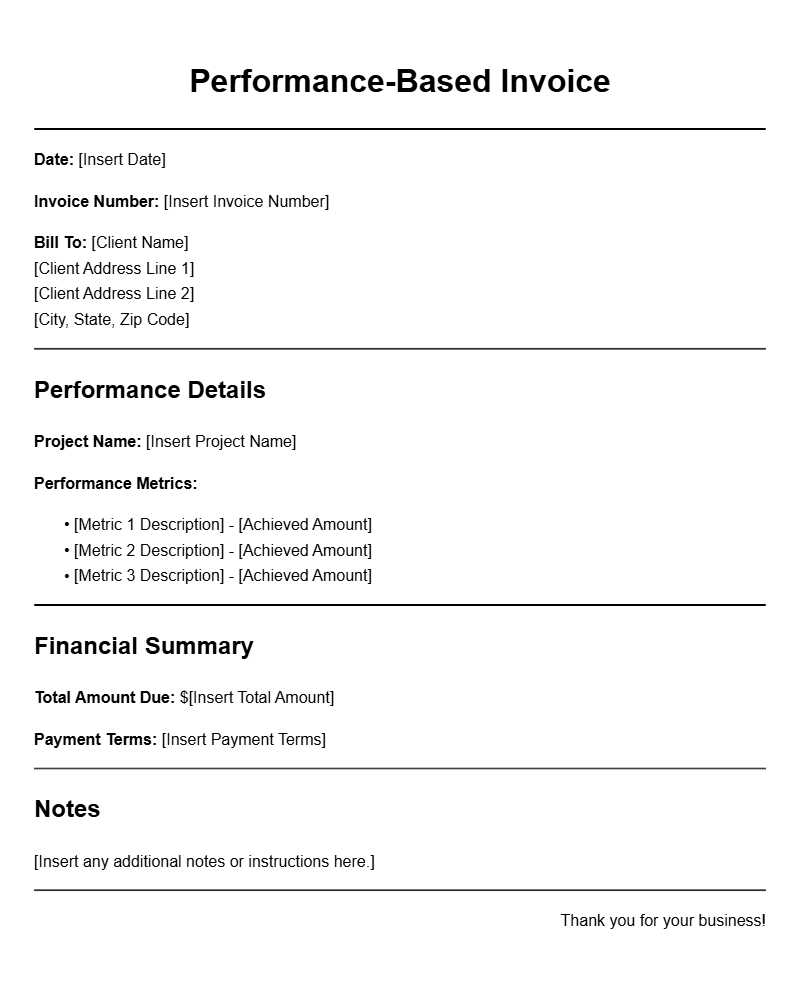
When you’re in a service-based industry, tracking your performance and ensuring you get paid accurately can sometimes feel like a juggling act. Performance-based invoice templates can simplify this process. These templates help you bill clients based on the results you deliver rather than just time spent. Let’s explore how to use these templates effectively, the key components they should include, and practical tips for customization.
WHAT IS A PERFORMANCE-BASED INVOICE TEMPLATE?
A performance-based invoice template is a structured document you use to bill clients based on specific results or milestones achieved rather than hourly work. For example, if you’re a freelance graphic designer, you might charge a flat fee for a completed project rather than billing hourly. This approach aligns your payment with the value you provide, making it clearer for both you and your client.
WHEN TO USE PERFORMANCE-BASED INVOICES
These invoices are particularly useful in situations where the outcome is measurable. Here are a few scenarios:
- Marketing campaigns: If you run a campaign for a client, you might charge based on leads generated or sales made.
- Consulting services: Charge based on the implementation of strategies that lead to measurable improvements.
- Project-based work: For web design or development, you can invoice upon completion of specific phases.
KEY COMPONENTS OF A PERFORMANCE-BASED INVOICE
To create an effective performance-based invoice, include the following sections:
- Header: Your business name, logo, and contact information.
- Client details: Include the client’s name and contact information.
- Invoice number: Unique identifier for tracking.
- Date: The invoice issue date.
- Description of services: Clearly outline what services you provided and the performance metrics used for billing.
- Payment terms: Specify when payment is due and any late fees.
STEP-BY-STEP GUIDE TO WRITING A PERFORMANCE-BASED INVOICE
- Gather client information: Make sure you have accurate contact details for your client.
- Define the performance metrics: Clearly outline how you will measure success (e.g., number of leads, completed tasks).
- Create a template: Use a word processor or spreadsheet software to design your invoice layout.
- Fill in the details: Include all the key components mentioned above.
- Review and send: Double-check for accuracy before sending it to your client.
REALISTIC EXAMPLES OF PERFORMANCE-BASED INVOICES
Here’s a basic template snippet to get you started:
Invoice Number: 001
Date: [Insert Date]
Client: [Client’s Name]
Services Provided:
– Project: Website Redesign
– Performance Metric: 20% increase in page views
– Fee: $2,000 upon completion
Payment Terms: Due within 30 days
COMMON MISTAKES TO AVOID
- Vague descriptions: Avoid unclear language about what you’re billing for; be specific.
- Ignoring payment terms: Always include clear payment terms to avoid confusion.
- Failing to document results: Keep records of how you measured performance to back up your invoice.
TIPS FOR CUSTOMIZATION
Your performance-based invoice should reflect your brand and be easy to understand. Consider these tips:
- Use professional colors and fonts that match your brand.
- Include your logo prominently at the top.
- Make sure it’s easy to read and navigate, with clear headings and bullet points.
Creating a performance-based invoice tailored to your services can streamline your billing process and enhance client relationships. By focusing on measurable results, you not only clarify the value of your work but also simplify the payment process. Start by crafting your template today, and watch how it transforms the way you handle invoicing.
Standard Format & Layout Reference