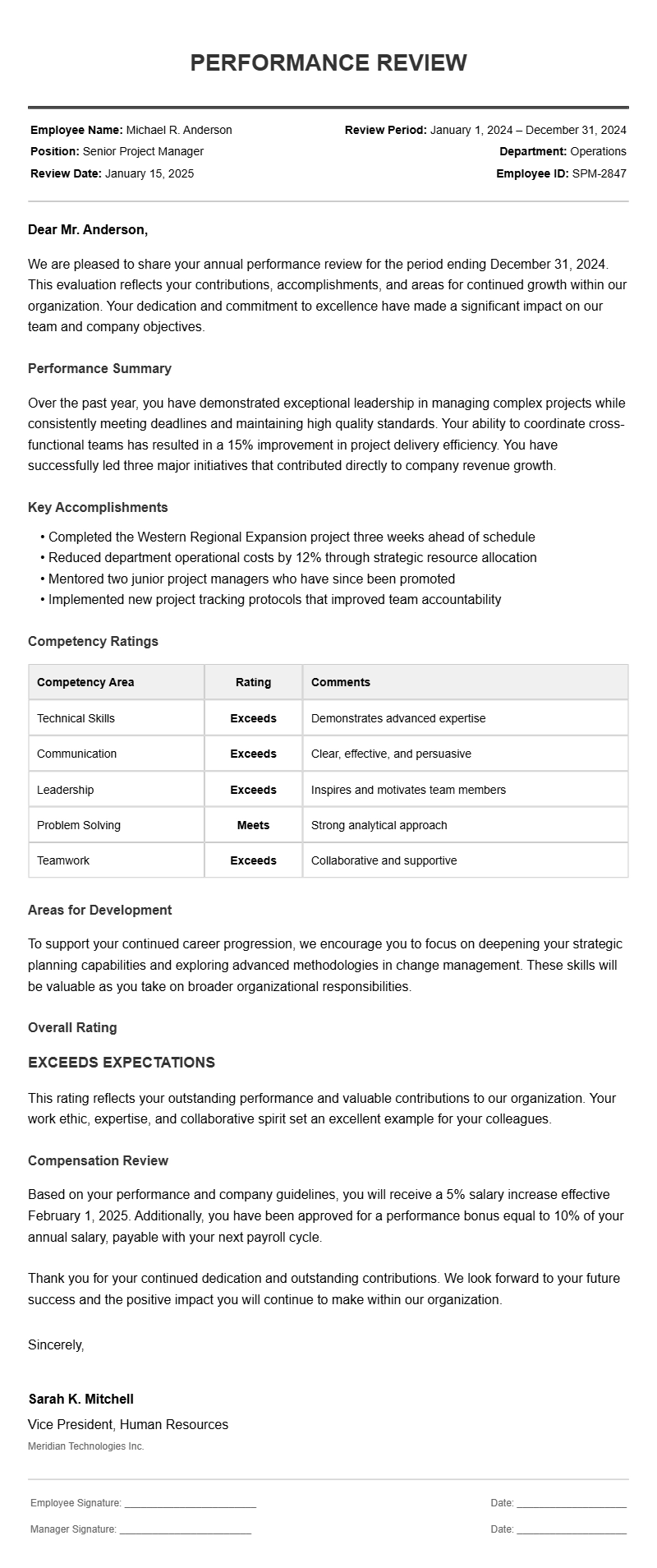
Finding a solid performance review letter sample can feel like a scavenger hunt. You need something clear enough to copy, adaptable enough to fit your company’s style, and specific enough to give employees real insight. This guide walks you through what makes a good performance review letter, when you should use one, and how to tailor a template to your situation.
What Is a Performance Review Letter?
A performance review letter is a written summary that documents an employee’s performance over a specific period. It typically covers achievements, areas for growth, and concrete next steps. Unlike a scorecard or a dashboard, a letter gives context, tone, and narrative that help the employee understand the “why” behind the rating.
Many managers use this document as a formal record for HR, while also using it as a personal checkpoint with the employee. If you want a quick way to capture the review conversation in writing, a letter works better than a one‑page checklist because it lets you include examples and recommendations.
When Do You Use a Performance Review Letter?
Most organizations trigger these letters during annual or semi‑annual review cycles. But you can also use one in situations like:
- After completing a major project to recognize strong results.
- When starting a performance improvement plan.
- When recommending a promotion or salary increase.
- When documenting concerns that need a paper trail.
If the review ties into a leave extension, you might want to cross‑reference the language with our parental leave extension letter samples to ensure consistency.
Core Components of a Performance Review Letter
A balanced letter usually includes these sections:
- Header – employee name, job title, review period, and date.
- Summary statement – a one‑sentence overall impression (positive, neutral, or developmental).
- Strengths – two to three specific examples of what the employee did well.
- Areas for improvement – targeted feedback with concrete examples.
- Goals and next steps – measurable objectives for the next review cycle.
- Manager signature and contact info – optional but adds accountability.
For a quick checklist, you can think of it as “intro‑strength‑grow‑plan‑sign.” That shorthand keeps you from leaving out any part.
Step‑by‑Step Guide to Writing a Performance Review Letter
Follow these steps to draft a clear, useful letter without spending hours on it.
- Gather specifics – Pull data from the past review period: project outcomes, peer feedback, metrics, and any notes from one‑on‑ones. Concrete numbers beat vague praise.
- Choose the tone – Match the tone to the relationship. A peer‑to‑peer feel works for creative teams, while a more formal tone fits manufacturing or finance roles. If you’re unsure, err on the side of respectful clarity.
- Outline the sections – Jot down bullet points for each component. This sketch prevents you from writing a giant paragraph and forgetting key points.
- Draft in first person – Write as the manager, using “I observed…” or “The team noticed…” This makes feedback feel personal, not corporate.
- Add concrete examples – Replace “good work” with “you reduced the defect rate by 12 % in Q2.” Specifics show you paid attention.
- Review for balance – Make sure strengths and growth areas are roughly equal in length. Too much praise can sound insincere; too much criticism can feel punitive.
- Proofread – Run a quick spell‑check and read it aloud. If a sentence feels stiff, rewrite it.
Sample Performance Review Letter Templates
The following snippets show two common variations. Feel free to copy the structure and replace the placeholders with your own details.
Positive Review Letter (Strong Performance)
Date: [Insert Date]
Employee: [Employee Name] – [Job Title]
Review Period: [Start Date] – [End Date]
Overall Impression: [Employee] demonstrated exceptional results across key projects and consistently exceeded expectations.
Key Achievements:
- Led the rollout of the new customer portal, cutting user onboarding time by 30 %.
- Mentored two junior team members, raising their project completion rates by 15 %.
- Delivered the Q3 marketing campaign ahead of schedule, generating a 12 % increase in leads.
Growth Areas: Continue building expertise in data analytics to support more data‑driven decisions.
Goals for Next Cycle:
- Complete the advanced Excel course by [Month].
- Develop a standard operating procedure for campaign tracking.
Next Steps: Schedule a 30‑day check‑in to discuss progress on the analytics training. Feel free to reach out at [Manager Email].
Manager Signature: [Manager Name]
Constructive Feedback Letter (Development Needed)
Date: [Insert Date]
Employee: [Employee Name
Standard Format & Layout Reference