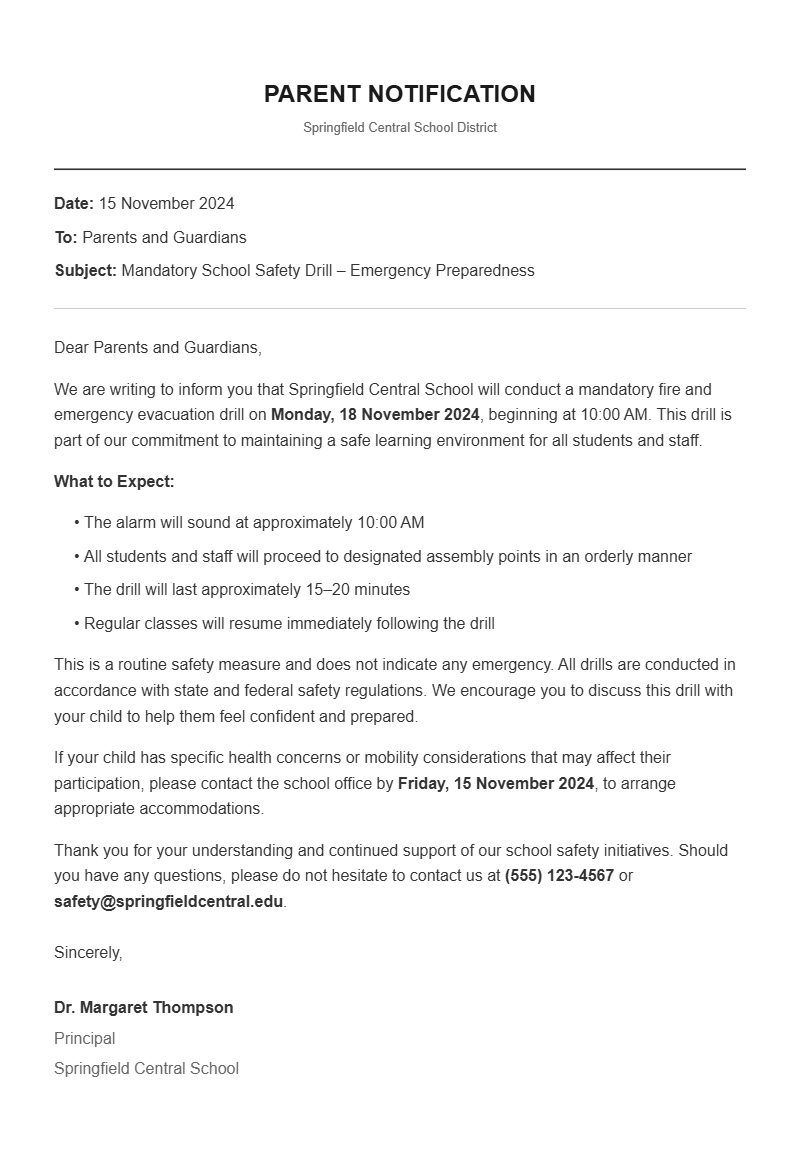
If you’re a parent, you’ve probably received—or needed to send—a school notice letter at some point. Maybe your child’s teacher wanted to inform you about an upcoming field trip, or the school administration needed to notify families about a policy change. These letters are one of the main ways schools communicate with parents, and knowing how to write one clearly and professionally makes a real difference.
Whether you’re a parent drafting a letter to the school or a teacher preparing one for families, having a solid template saves time and ensures nothing important gets left out. This guide walks you through what these letters are, when you’d use them, and gives you practical examples you can adapt for your own situation.
What Is A School Parent Notice Letter?
A school parent notice letter is formal written communication between a school (or parent) and a family. Schools use these to inform parents about events, policy changes, behavioral concerns, academic progress, or administrative updates. Parents sometimes write them too—to request accommodations, explain absences, or address concerns with the school.
These letters differ from casual emails or texts because they create a paper trail and signal that the information is important or official. They’re typically brief, direct, and include specific details like dates, times, or required actions.
The tone matters. A notice letter isn’t a casual conversation—it’s professional but not cold. It should be easy to understand and leave no room for confusion about what’s being communicated or what’s expected.
When Schools And Parents Use Notice Letters
Notice letters get used in a lot of different situations. Here are the most common ones:
- Field trips and special events: Teachers notify parents about upcoming outings, permission slip deadlines, and what students should bring.
- Behavioral or academic concerns: Schools alert parents when a student needs support in specific areas or when behavior needs to improve.
- Policy or schedule changes: Administration informs families about new rules, early dismissals, or calendar adjustments.
- Absence or attendance issues: Schools document patterns of missed days or request explanations.
- Health and safety updates: Notifications about illness outbreaks, safety drills, or required health forms.
- Tuition or fee notices: Private schools use these to remind families about payment deadlines.
- Disciplinary actions: Formal notice when a student faces suspension, detention, or other consequences.
- Parent-initiated requests: Families write letters requesting accommodations, schedule changes, or addressing concerns with staff.
Key Components Of A School Notice Letter
Most effective school notice letters include these elements in roughly this order:
Header: School name, address, and date at the top. If it’s from a parent, include your name and contact information.
Recipient line: Who the letter is addressed to (the principal, teacher, or “Dear Parent/Guardian”).
Clear subject line: Optional but helpful. Something like “Permission Slip Deadline” or “Attendance Notice” tells the reader immediately what the letter is about.
Opening statement: State the purpose in the first sentence or two. Don’t make people guess why they’re reading this.
Relevant details: Include dates, times, locations, deadlines, or specific information the recipient needs to know.
Required actions: If the recipient needs to do something (sign a form, pay a fee, respond by a date), make this crystal clear.
Contact information: How to reach you with questions. Include a phone number and email.
Professional closing: “Sincerely,” “Best regards,” or “Respectfully” followed by a signature.
How To Write A School Notice Letter Step By Step
Step 1: Decide on your format. Most schools use a standard template with letterhead. If you’re writing as a parent, use a simple business letter format. Single space within paragraphs, double space between them.
Step 2: Open with purpose. The reader should understand the letter’s reason in the first sentence. “We are writing to inform you of a change to our school’s dismissal procedures” is better than starting with background information.
Step 3: Provide specific details. Vague letters create confusion. Instead of “sometime next month,” write “Tuesday, November 14th at 2:00 PM.” Instead of “bring supplies,” list exactly what’s needed.
Step 4: Explain the “why” if needed. If you’re implementing a policy change or requesting something unusual, a brief explanation helps families understand the reasoning. This builds trust and reduces pushback.
Step 5: State any required response. If parents need to sign something, return a form, or confirm attendance, say so explicitly. Include the deadline.
Step 6: Offer a way to get help. End with contact details and an invitation for questions. “If you have questions, please contact me at [email] or [phone]” is simple and effective.
Step 7: Proofread before sending. Typos and errors make the letter look careless. Read it aloud to catch awkward phrasing.
School Notice Letter Templates And Examples
Here are working templates you can adapt for common situations.
Field Trip Permission Slip Notice
Use this when notifying parents about an upcoming field trip.
Dear Families,
We are excited to announce that [Grade/Class Name] will be taking a field trip to [Location] on [Date] from [Start Time] to [End Time].
Trip Details:
- Destination: [Location and address]
- Purpose: [Brief explanation of educational value]
- Transportation: [Bus/car/walking]
- Cost: [Amount, or “No cost” if free]
- What to bring: [Lunch, water bottle, comfortable shoes, etc.]
A permission slip is attached to this letter. Please sign and return it by [Deadline Date]. Students without a signed permission slip will not be able to attend.
If you have questions or your child has dietary restrictions or accessibility needs, please contact me at [email] or [phone number].
Thank you,
[Teacher Name]
Attendance Notice From School
Use this when documenting patterns of absences or tardiness.
Dear [Parent/Guardian Name],
This letter is to notify you that [Student Name] has accumulated [number] absences/late arrivals in the past [time period].
Regular attendance is essential for academic success. Students who miss class frequently fall behind on assignments and classroom instruction. We want to support [Student Name] in being present and engaged.
If there are circumstances affecting attendance—such as illness, transportation issues, or other challenges—please reach out so we can discuss possible solutions. We may be able to connect you with school resources or adjust schedules if needed.
Please contact me within [5-7 days] to discuss this. Our goal is to work together to improve attendance.
Sincerely,
[School Administrator or Teacher Name]
[Title]
[Contact Information]
Behavioral Concern Notice
Use this to alert parents to behavior issues before they escalate.
Dear [Parent/Guardian Name],
I am writing to inform you of some behavioral concerns with [Student Name] in class.
What has been observed:
- [Specific behavior—not general statements like “being disruptive”]
- [When it’s happening—during lessons, transitions, group work, etc.]
- [How frequently it occurs]
I have already [implemented a strategy: moved seating, given reminders, etc.]. We want to support [Student Name] in making better choices and being successful in class.
I’d like to meet with you to discuss this and develop a plan together. Please let me know your availability for a brief meeting in the next week or two.
In the meantime, if you have insights into what might be triggering this behavior or strategies that work at home, I’d appreciate hearing about them.
Thank you,
[Teacher Name]
[Contact Information]
School Policy Or Schedule Change Notice
Use this to inform families of administrative updates.
Dear Parents and Guardians,
Effective [Date], [School Name] will implement the following change: [Describe the change clearly].
What’s changing: [Explain what’s different]
Why: [Brief explanation of reasoning]
How it affects your family: [Specific impact—new pickup time, different schedule, etc.]
What you need to do: [Any required action, if applicable]
We understand that changes can feel disruptive. We’re committed to making this transition as smooth as possible. Please review the attached FAQ document or visit [website link] for more details.
If you have questions, contact [Name] at [email] or [phone].
Thank you for your flexibility and partnership,
[Administrator Name]
[Title]
Parent-Initiated Letter Requesting Accommodation
Use this when you need to request something from the school on behalf of your child.
Dear [Teacher/Administrator Name],
I am writing to request [specific accommodation—early dismissal, modified assignment, schedule adjustment, etc.] for my child, [Student Name], in your class.
Reason for request: [Brief, honest explanation]
Duration: [Temporary—from [date] to [date], or ongoing]
Details: [Specific information about what you’re asking for and how it would work]
I believe this will help [Student Name] [succeed academically/manage stress/address a challenge]. I’m happy to discuss this further and work with you to make sure it’s implemented smoothly.
Thank you for considering this request. Please let me know if you need any additional information.
Best regards,
[Your Name]
[Contact Information]
Common Mistakes To Avoid
Being too vague. “We need to talk about your child’s progress” leaves parents confused. Say what you mean: “Your child is struggling with reading comprehension and we’d like to set up a meeting to discuss support.”
Using accusatory language. Phrases like “Your child refuses to listen” or “You haven’t signed the permission slip” put people on the defensive. Try: “We’ve noticed [behavior] and want to work together to address it” or “We haven’t yet received the signed permission slip.”
Forgetting the deadline. If you need something from the recipient, state exactly when you need it. “Please return by Friday, November 17th” beats “Please return soon.”
Making it too long. School notice letters should be one page, maximum. People skim them. Keep it focused and cut unnecessary details.
Skipping contact info. Always include a way to reach you. Don’t assume parents know your email or phone number.
Forgetting to proofread. A letter with typos looks unprofessional and makes the recipient question your attention to detail. Read it twice before sending.
Being impersonal. Use the student’s name. Reference specific situations. Generic form letters feel cold and can come across as dismissive.
Tips For Customizing Templates
These templates are starting points. Adapt them to fit your school’s tone and your specific situation.
Match your school’s voice. If your school is formal, keep the letter formal. If it’s more casual and community-focused, you can be a bit warmer. Look at other letters the school has sent to get a sense of the tone.
Be specific to your situation. Don’t just fill in blanks. If you’re writing about a behavioral concern, describe what actually happened, not generic misbehavior. If it’s a field trip, mention why that specific place matters for learning.
Include relevant details without overdoing it. Parents need to know dates, times, costs, and what to bring. They don’t need your life story or a lengthy explanation of educational theory. Respect their time.
Adjust the tone based on urgency. A routine permission slip notice can be straightforward. A letter addressing a serious concern should be respectful and collaborative, not punitive.
Add context if it helps. If you’re implementing a new policy, a sentence or two about why can reduce confusion and resistance. “We’re adjusting pickup procedures to improve safety and reduce congestion” explains the reasoning.
Consider your audience’s perspective. Parents get a lot of mail from school. Make yours easy to scan and understand. Use bullet points for lists. Bold key information. Keep paragraphs short.
Formatting Tips For Readability
How a letter looks affects whether people actually read it. Use these formatting strategies:
- Use a readable font (Arial, Calibri, or Times New Roman) at 11 or 12 point size.
- Leave at least one-inch margins on all sides.
- Use bold text for section headers and key information, not for emphasis throughout.
- Break up long paragraphs into shorter ones—three to four sentences per paragraph is usually good.
- Use bullet points for lists instead of dense paragraphs.
- Include white space. A crowded page feels overwhelming.
- If sending digitally, use a professional email format and paste the letter into the body or attach as a PDF to avoid formatting issues.
When To Send Notice Letters And How
Timing matters. Send notice letters early enough that people have time to act. A field trip permission slip needs at least two weeks’ notice. An attendance concern should be addressed before it becomes serious.
For routine notices, email works fine if your school has good email contact lists. For important matters—especially behavioral or academic concerns—print copies and send them home in backpacks or folders. Some families miss emails. A physical letter ensures they get it.
Consider sending urgent notices both ways: print and email. This covers your bases and shows you’re taking it seriously.
If you’re a parent writing to the school, email is usually appropriate. Include your phone number in case they need to reach you quickly. If it’s something that needs to be on record, you might also print and hand-deliver or mail it.
Adapting This For Different School Levels
Elementary schools, middle schools, and high schools have different communication styles. Adjust your approach:
Elementary: Parents are more involved day-to-day. Letters can be a bit more personal and warm. Teachers often include encouraging language alongside concerns. “We love having [Student] in class and want to support them in [area]” works well.
Middle school: Students are becoming more independent, but parents still need clear communication. Letters might address both the student and parent. Tone is professional but not overly formal.
High school: Many schools send notices to students directly with a copy to parents. Letters tend to be more formal. Expectations are clearer about student responsibility.
Regardless of level, clarity and respect are universal. Every parent wants to understand what’s being communicated and feel heard.
Related Letter Templates You Might Need
School communication isn’t the only type of formal letter you might need to write. If you’re working on professional correspondence, you might also find templates for other situations useful. For instance, if you’re managing business relationships, you could reference client to business owner letter templates for guidance on professional tone. Similarly, if you’re involved in real estate matters, realtor to buyer letter samples show how to communicate clearly about important transactions. For ongoing business communication, monthly business report letter templates demonstrate how to structure regular updates. If you’re communicating in a sales or negotiation context, buyer to seller letter templates provide examples of persuasive, professional writing. And if you need to communicate changes in living situations, downsizing notice letter samples show how to handle sensitive transitions professionally.
Final Thoughts
Writing a school notice letter doesn’t have to be stressful. Start with a clear purpose, include the specific details people need, and proofread before sending. Whether you’re a teacher notifying families about a field trip or a parent requesting an accommodation, these templates give you a solid foundation. Customize them for your situation, keep them concise, and remember that the goal is clear communication that builds trust between families and schools. The better you communicate, the smoother things run for everyone involved.
Standard Format & Layout Reference