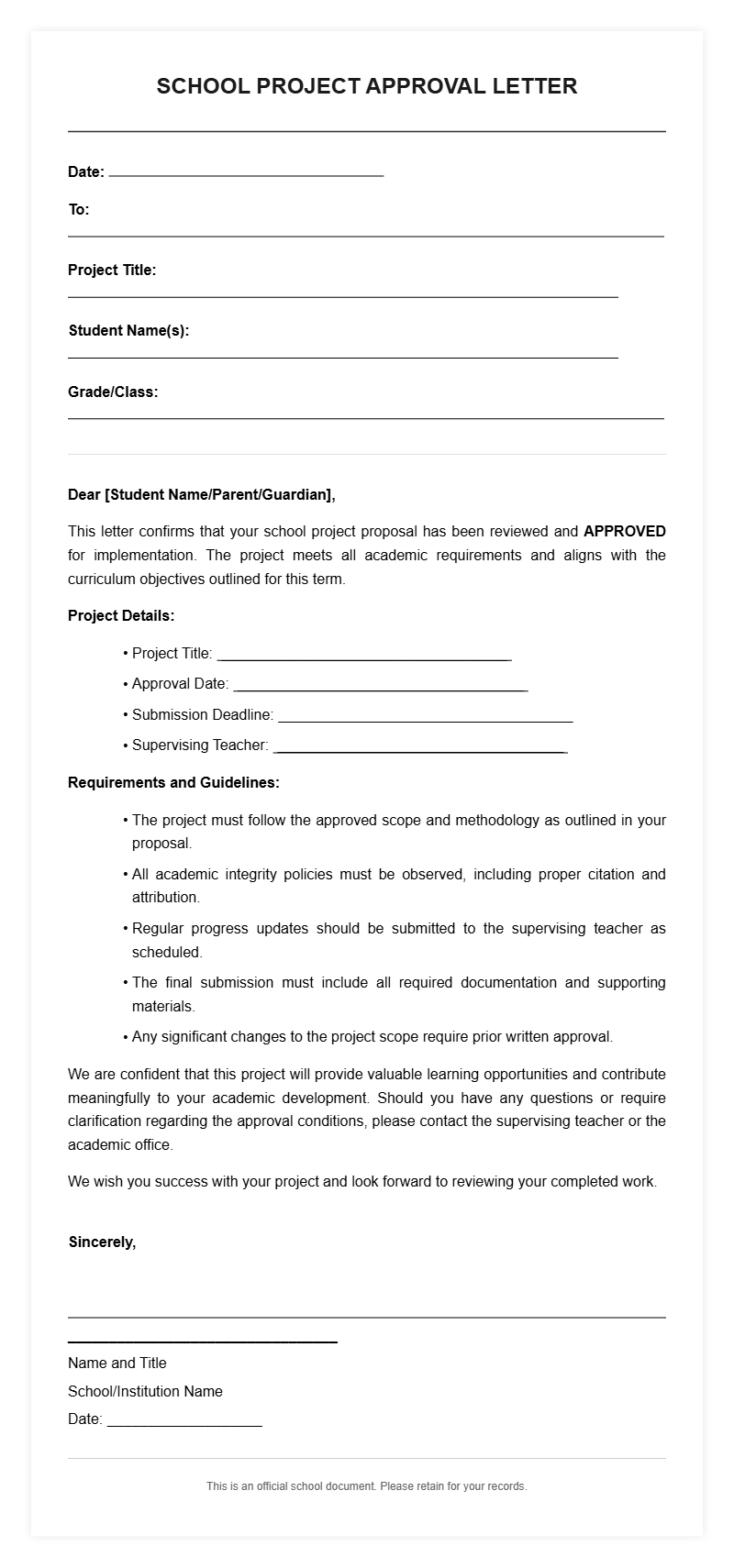
If you’re running a school project and need official sign-off from administration, parents, or stakeholders, a project approval letter template saves you time and keeps things professional. These templates work for everything from science fairs to field trips, budget requests to curriculum changes. Instead of starting from scratch, you get a structured format that covers what matters most: what you’re proposing, why it matters, and what you need approved.
The challenge most people face is knowing what to include and how to phrase requests formally without sounding stiff. This guide walks through real templates you can customize, common pitfalls to avoid, and practical tips for getting your projects approved faster.
What Is A School Project Approval Letter Template
A school project approval letter is a formal document that requests permission to move forward with a specific initiative. It outlines the project details, explains its purpose, and asks for explicit authorization from the appropriate decision-maker. Templates provide the framework—you fill in specifics relevant to your situation.
These letters work in multiple contexts. Teachers use them to propose new classroom activities or field trips. Students request approval for capstone projects or independent studies. Administrators seek board sign-off on program changes. Parent groups propose fundraising events. The structure remains similar across all these scenarios, which is why templates are so useful.
The letter creates a paper trail. It shows that you’ve thought through your project, considered logistics, and followed proper channels. Schools value this documentation because it protects everyone involved and demonstrates responsible planning.
When You Actually Need An Approval Letter
Not every school activity requires a formal approval letter. Understanding when one is necessary helps you avoid unnecessary bureaucracy while ensuring you cover your bases when it matters.
You need an approval letter when:
- The project involves budget spending or resource allocation
- Students will leave school grounds for educational purposes
- The initiative changes standard curriculum or classroom procedures
- External partners or community members are involved
- The project carries any safety or liability considerations
- You’re requesting administrative support or staff time
- Parent or guardian consent is required for student participation
You typically don’t need one for routine classroom activities that fall within your normal teaching scope. A lesson plan change or small group project usually doesn’t require formal approval. But if you’re unsure, checking with your principal or department head takes five minutes and prevents headaches later.
Key Components Every Approval Letter Should Include
Whether you’re writing about a school science fair or requesting approval for a new mentorship program, certain elements make the letter work.
Project title and overview: State clearly what you’re proposing. One sentence should tell the reader exactly what this is about. “Request for approval to conduct a three-day outdoor education program for 7th grade science classes” works better than vague language.
Purpose and educational value: Explain why this project matters. What skills will students develop? How does it connect to learning objectives? Schools care about academic alignment, so frame your project in those terms.
Timeline and logistics: Include specific dates, duration, and any relevant scheduling details. If students are leaving campus, specify departure and return times. If the project spans weeks, break down the phases.
Budget and resources: If money is involved, provide a breakdown. Schools need to know costs upfront. Include where funding comes from—student fees, grants, the school budget, parent donations.
Participant details: Who’s involved? How many students? Which grade levels? Are there any special accommodations or prerequisites?
Safety and risk management: Address potential concerns head-on. If it’s a field trip, mention transportation and supervision. If it involves equipment, explain safety protocols. This reassures administrators you’ve thought things through.
Required approvals and sign-offs: Be clear about who needs to approve this. Is it just the principal, or do you need board approval? Do parents need to sign consent forms?
Contact information and next steps: Make it easy for the approver to reach you with questions. Include when you need a decision and what happens after approval.
How To Write Your School Project Approval Letter Step By Step
Start with proper formatting. Use standard business letter format with your school’s letterhead if available. Include the date, recipient’s name and title, and their address. Single space the body, but add space between paragraphs for readability.
Open with a clear request. Don’t bury your ask. The opening sentence should state what you want approved. “I am writing to request approval for [specific project]” works. You can be direct without being blunt.
Provide context in the next paragraph. Why are you proposing this? What problem does it solve or what opportunity does it create? Keep this to 3-4 sentences. Administrators read dozens of requests; respect their time.
Detail the specifics. This is where you include all the information from the components section above. Use short paragraphs or bullet points so the letter is scannable. Dense text gets skimmed, and important details get missed.
Address potential concerns preemptively. If there’s anything that might raise questions—cost, logistics, time commitment—bring it up yourself with solutions. “Some might wonder about transportation costs. We’ve secured a district bus at no additional expense” shows you’ve done your homework.
Specify what you need and when. “I need approval by March 15th to finalize vendor contracts” gives a clear deadline. Vague timelines get deprioritized.
Close professionally. Thank them for considering your request. Offer to answer questions. Include your phone number and email. Keep the closing brief—one or two sentences.
Proofread before submitting. Typos make your request look careless. Read it aloud to catch awkward phrasing. Have a colleague look it over if possible.
School Project Approval Letter Template Examples
Example 1: Field Trip Request
[Your School Letterhead]
[Date]
[Principal Name]
[School Name]
[School Address]
Dear [Principal Name],
I am requesting approval for a field trip to the State Museum of Natural History on April 22, 2024, for my 5th grade science classes (approximately 85 students across three class periods).
This trip directly supports our current unit on paleontology and geological time periods. Students will participate in a guided tour of the fossil exhibit and a hands-on workshop where they’ll examine rock samples and learn about dating methods used by paleontologists. This experience reinforces concepts from our textbook and provides real-world context for their upcoming research projects.
Logistics:
Departure: 9:00 AM from school parking lot
Return: 2:30 PM
Transportation: Three district buses (pre-arranged with Transportation Department)
Supervision: Five staff members (myself plus four parent volunteers who have completed background checks)
Cost: $8 per student for museum admission; $6 per student for bus transportation. Total cost: $1,190. Funding approved through PTA educational grants.
All students will have signed parental consent forms before the trip date. I’ve attached our field trip safety procedures and emergency contact information. The museum has confirmed accessibility accommodations for our two students with mobility needs.
I need your approval by April 5th to confirm final headcount with the museum. Please let me know if you have any questions or need additional information.
Thank you for your consideration.
Sincerely,
[Your Name]
[Your Title]
[Phone Number]
[Email Address]
Example 2: New Program or Curriculum Change
[Your School Letterhead]
[Date]
[Superintendent/Curriculum Director Name]
[District Office Address]
Dear [Name],
I am requesting approval to implement a peer mentoring program for 9th grade students beginning in the fall semester. This initiative pairs struggling readers with advanced readers in structured, 30-minute sessions twice per week during designated study hall periods.
Research shows peer mentoring improves reading comprehension and builds social-emotional skills for both mentors and mentees. Our school currently has a 12% gap between proficient and struggling readers in grades 9-10. This program addresses that gap while developing leadership skills in our advanced readers.
Program Details:
Duration: August through May
Participants: 40 students (20 mentors, 20 mentees) selected by reading level and teacher recommendation
Time commitment: 1 hour per week per student during existing study halls—no schedule changes needed
Training: I will provide two 45-minute training sessions for mentors before launch and monthly check-ins throughout the year
Materials: $300 budget for reading materials and mentor resources (covered by literacy grant funds already approved)
Assessment: Pre- and post-reading assessments to measure impact; program evaluation survey for participants
No additional staff time is required beyond my coordination. The program uses existing resources and time slots. I’ve attached detailed implementation plans, reading assessment data, and letters of support from three teachers who piloted a similar model.
I can begin immediately with board approval. Please let me know what additional information you need to move forward.
Respectfully,
[Your Name]
[Your Title]
[Phone Number]
[Email Address]
Example 3: Budget or Resource Request
[Your School Letterhead]
[Date]
[Budget Committee Chair/Principal Name]
[School Name]
[School Address]
Dear [Name],
I am requesting approval and budget allocation for STEM lab equipment to support our expanded robotics program. The total request is $4,500 for the 2024-2025 school year.
Our robotics program has grown from 12 to 45 students in two years. Current equipment is insufficient for class size. This expansion will allow us to field two competitive teams and offer robotics as an elective course for grades 9-12.
Budget Breakdown:
Robot kits (6 units): $2,400
Programming software licenses: $800
Sensors and components: $900
Storage and organization: $400
These items are essential for the program to function at current participation levels. We have secured a $2,000 matching grant from the local engineering firm, leaving a school contribution of $2,500. I’ve attached the grant agreement and vendor quotes.
This investment directly supports district goals around STEM career pathways and college readiness. Robotics participants have a 95% college enrollment rate, significantly above school average.
I need a decision by June 1st to order equipment before summer break. Thank you for considering this request.
Sincerely,
[Your Name]
[Your Title]
[Phone Number]
[Email Address]
Common Mistakes That Derail Approval Requests
Being vague about costs. If budget is involved, provide exact numbers. “Around $500” doesn’t work. “$487.50” shows you’ve done the math and thought carefully about the request. Vagueness makes administrators nervous.
Forgetting to address safety. Even low-risk projects benefit from a brief safety statement. “All participants will wear helmets” or “Activities comply with district safety guidelines” reassures decision-makers. Ignoring safety concerns makes your request look incomplete.
Submitting without proofreading. Spelling errors and typos undermine your credibility. Take two minutes to read it over. Use spell-check. Read it aloud. Fresh eyes catch mistakes.
Asking for approval at the last minute. Submitting a request two weeks before you need approval puts administrators in a bind. They may deny it simply because there’s no time to evaluate properly. Aim for at least three weeks’ notice whenever possible.
Burying important information. Don’t hide budget, timeline, or logistics in dense paragraphs. Use short sentences and bullet points. Administrators skim requests, so make key details easy to spot.
Not specifying who needs to approve. Is this just your principal, or does it need board approval? Does it require parent consent? Clarity prevents delays. “This requires principal approval and parental consent forms” tells people exactly what happens next.
Ignoring potential objections. If your project has any aspect that might raise concerns, address it proactively. “Some might worry about cost, but we’ve secured full funding through grants” shows you’ve thought it through. Silence on potential problems makes administrators assume you haven’t.
Tips For Customizing Templates To Your Situation
Templates are starting points, not fill-in-the-blank forms. Your specific project needs a personalized approach.
Match the tone to your recipient. A formal letter to a superintendent differs from a note to your department head. Both should be professional, but the superintendent version is more structured. Know your audience and adjust accordingly.
Emphasize what matters to your decision-maker. Principals care about liability and budget. Teachers care about curriculum alignment. Parents care about safety and their child’s experience. Lead with what resonates for your specific approver.
Include relevant data or evidence. If you’re proposing something new, attach research that supports it. If you’re requesting budget, show how it aligns with school priorities. Evidence makes requests harder to dismiss.
Adjust detail level based on project complexity. A simple classroom activity needs fewer details than a three-day trip. Don’t over-explain routine requests, but don’t under-explain complex ones either. Match detail to complexity.
Use your school’s language and priorities. If your school emphasizes equity, frame your project around equitable access. If they focus on college readiness, emphasize that angle. Alignment with school values strengthens your case.
Keep it to one page when possible. Administrators are busy. A concise, well-organized letter gets read. Anything longer needs a compelling reason. If you need more space, use an attachment for detailed information.
Related Templates And Documents You Might Need
Approval letters often work alongside other documents. Depending on your project, you might also need a volunteer appreciation letter if community members help. For projects involving maintenance or facility use, a maintenance request letter coordinates with facilities. If you’re requesting supplies or equipment, a purchase approval letter handles procurement separately from project approval.
For collaborative projects, an agreement confirmation letter documents what partners have committed to. If your project involves fundraising or community support, a donation letter can help secure resources.
These documents often reference each other. An approval letter might mention that purchase orders will follow separately. A donation letter might reference an approved project. Understanding how they connect helps you prepare the full documentation package.
Getting Your Approval Faster
Timing and presentation matter. Submit your request well in advance—three weeks minimum, more if board approval is needed. Send it to the right person. If you’re unsure who decides, ask your principal or department head before drafting.
Make yourself available for questions. Include your contact information and offer to meet if they need clarification. Responsive communication speeds up approval.
Follow up appropriately. If you haven’t heard back after two weeks, send a polite reminder. “I wanted to check on the status of my field trip request from March 10th. Please let me know if you need any additional information.” This keeps your request on their radar without being pushy.
Once approved, say thank you. A brief email acknowledging the approval and confirming next steps leaves a positive impression and makes future requests easier.
Start with a clear template, customize it to your specific situation, and submit it early with all necessary details. Most approval requests succeed because they’re thorough, professional, and show you’ve thought through logistics. Use the examples here as your framework, adjust for your context, and you’ll have what you need to move your project forward.
Ready-to-Use Document Samples