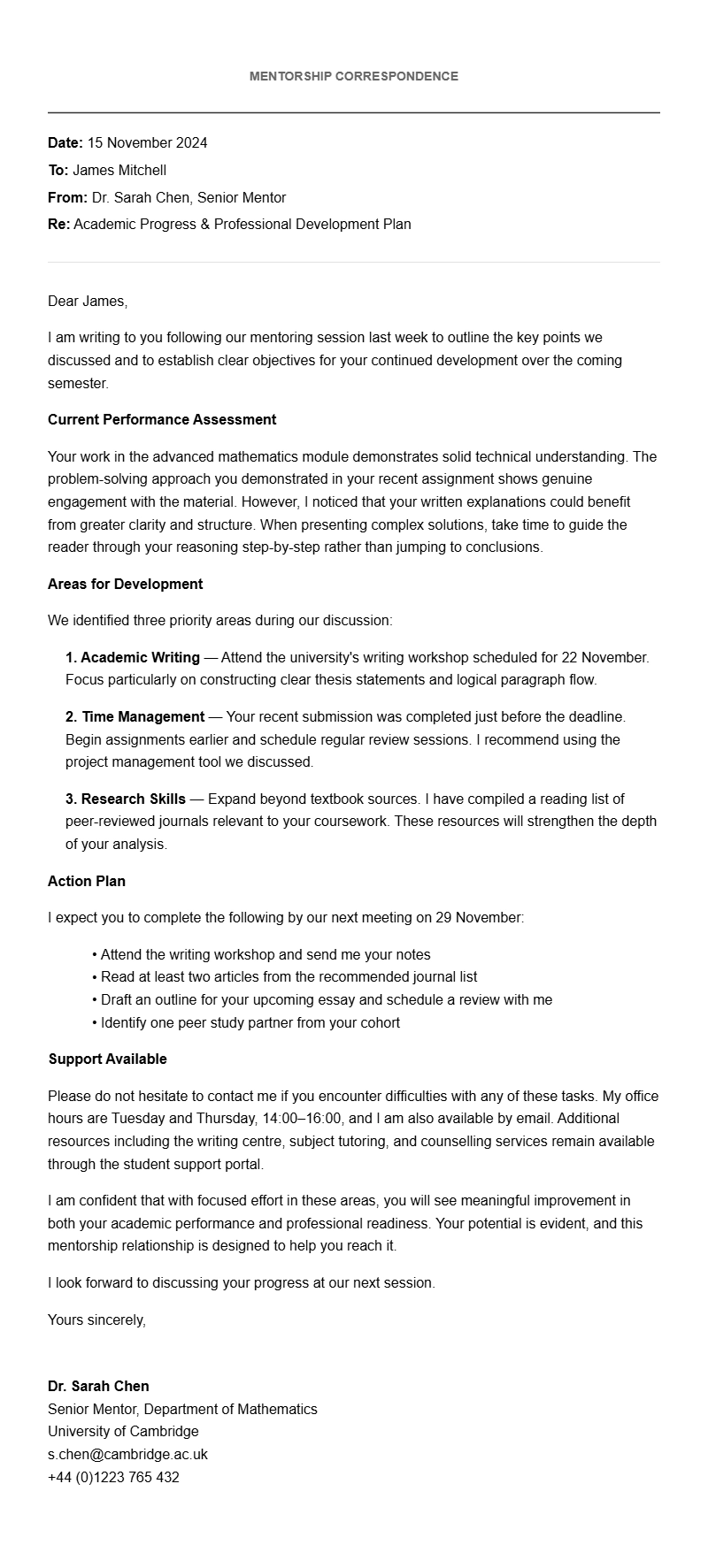
You’re sitting down to write a mentoring letter for a student, and you’re not quite sure where to start. Maybe it’s for a scholarship application, a college recommendation, or a formal mentoring program. The blank page feels intimidating because you want to say something meaningful without sounding like every other letter they’ve probably received.
A student mentoring letter is a formal document where a mentor, teacher, employer, or supervisor writes about a student’s character, abilities, and potential. It’s meant to support a specific purpose—getting into a program, earning a scholarship, joining an internship, or progressing through an academic challenge. Unlike a casual reference, a mentoring letter carries weight because it comes from someone in a position to observe and evaluate the student’s growth.
The difference between a good mentoring letter and a forgettable one comes down to specificity. Generic praise doesn’t stick with admissions committees or scholarship reviewers. They read hundreds of letters saying “this student is hardworking and dedicated.” What they remember is the letter that shows exactly how the student demonstrated those qualities through real examples.
WHEN YOU’D WRITE A STUDENT MENTORING LETTER
These letters come up in several situations. A student might ask you to write one for a college application, especially if you’ve worked with them over time. Scholarship committees often require mentoring letters to understand how a student thinks and grows. Some academic programs ask for letters when a student is applying for internships, graduate school, or leadership positions. You might also write one if a student is facing academic challenges and needs advocacy—similar to how institutions handle academic probation letter templates—or if they’re returning from a leave and need documentation of their commitment to getting back on track, like what you’d find in return from leave letter templates.
The timing matters. You should write the letter while you still have clear memories of specific moments that demonstrate the student’s strengths. Don’t wait six months after they’ve left your classroom or program.
WHAT GOES INTO A STUDENT MENTORING LETTER
A strong mentoring letter has five main components:
- Your credibility and relationship to the student. How long have you known them? In what capacity? This establishes why your opinion matters.
- Specific examples of their abilities or character. Not “they’re a good problem-solver” but “when the project deadline shifted, they reorganized the team’s approach and delivered early.”
- How they compare to peers. Where do they rank among other students you’ve mentored? Are they in the top 10%? Be honest but fair.
- Evidence of growth or potential. What have you seen them improve at? How do they respond to feedback or failure?
- Your recommendation or endorsement. A clear statement that you believe in them for the opportunity they’re pursuing.
The letter typically runs 250 to 400 words—long enough to be substantial, short enough that busy reviewers will actually read it all the way through.
HOW TO WRITE YOUR MENTORING LETTER STEP BY STEP
Start with the header and formal opening. Include your name, title, organization, contact information, and the date. Address the letter to a specific person or committee if you know who’s reading it. If you don’t have a name, “To Whom It May Concern” or “Dear Admissions Committee” works fine. Skip the generic “I am writing to recommend…” and get straight to introducing your relationship with the student.
Open with context, not flattery. Tell the reader who you are and why you’re qualified to write this letter. Example: “I’ve had the privilege of mentoring Marcus in our engineering apprenticeship program for the past two years, where I’ve watched him tackle increasingly complex projects.” This is more useful than “I am delighted to recommend Sarah, an exceptional student.”
Build your case with concrete examples. Pick two or three specific moments that illustrate the student’s strengths. Don’t just tell the reader they’re resilient—show them. Describe a time they faced a setback and how they responded. Did they ask for help? Adjust their strategy? Keep pushing? That’s what matters.
Address the student’s growth trajectory. Mentoring is about development. Where did the student start with you, and where are they now? What did they struggle with initially, and how have they improved? This shows that you’ve actually spent time observing them, not just giving a surface-level evaluation.
Be honest about limitations. You don’t need to pretend the student is perfect. If they struggled in one area but improved, say so. If they’re not the strongest in math but excel in creativity, acknowledge both. Honesty makes your positive comments more credible.
Wrap up with a strong closing statement. Reiterate your confidence in them for the specific opportunity. “I believe Marcus has the technical skills and collaborative mindset your internship program is looking for” is stronger than “I recommend this student.”
STUDENT MENTORING LETTER TEMPLATE
Here’s a practical template you can adapt:
[Your Name]
[Your Title]
[Organization]
[Contact Information]
[Date]
Dear [Recipient/Committee],
I have had the opportunity to mentor [Student Name] over the past [timeframe] in [context—your program, class, organization]. During this time, I’ve observed [him/her/them] grow as both a [professional/student/team member], and I’m writing to strongly recommend [him/her/them] for [specific opportunity].
When [Student Name] first [joined the program/started in my class/began the internship], [he/she/they] showed promise but also faced challenges in [specific area]. What impressed me was [his/her/their] willingness to [concrete action—ask for feedback, seek resources, practice repeatedly]. By [timeframe], [he/she/they] had [specific improvement or achievement]. This demonstrates not just ability, but the resilience and self-awareness that I believe will serve [him/her/them] well in [the program/role/opportunity they’re pursuing].
One example stands out: [brief story showing character, problem-solving, or growth]. This situation revealed [Student Name]’s capacity for [specific strength relevant to the opportunity].
Among the [number] students I’ve mentored, [Student Name] ranks in the [top tier/upper range], particularly for [specific skill or quality]. [He/She/They] consistently [specific behavior or habit—meets deadlines, collaborates effectively, takes initiative].
I believe [Student Name] is an excellent fit for [the program/opportunity] and will contribute meaningfully. I’m happy to discuss [his/her/their] qualifications further if needed.
Sincerely,
[Your Name]
REAL-WORLD EXAMPLES
For a scholarship application:
“I’ve mentored Priya through our STEM mentorship program for eighteen months. She arrived uncertain about pursuing engineering, but after completing a robotics project where she led her team through a complete redesign when their initial approach failed, she gained the confidence to pursue a mechanical engineering degree. She’s now my strongest recommendation for the [Scholarship Name], and I believe she’ll bring both technical skill and the collaborative leadership your program values.”
For a college application:
“James joined my debate club as a junior with no prior experience. He was nervous about public speaking, but he committed to attending every practice. By senior year, he placed in our regional tournament and helped coach newer members. More importantly, he learned how to take constructive criticism—something he initially struggled with—and use it to improve. That growth mindset is what will serve him well at your university.”
For an internship recommendation:
“During her summer in our program, Keisha took on a project to streamline our client intake process. She didn’t just complete the task; she interviewed team members, identified bottlenecks, and proposed a solution that saved us five hours per week. She’s detail-oriented, asks smart questions, and follows through. I’d trust her with responsibility from day one.”
MISTAKES THAT WEAKEN YOUR LETTER
Being too general. “She’s a great student” tells the reader nothing. Replace it with specifics: “She earned an A on the capstone project that only three students completed ahead of schedule.”
Over-praising without evidence. Calling someone “exceptional” or “outstanding” repeatedly without examples makes the letter feel insincere. Readers can tell the difference between genuine support and inflated language.
Focusing on grades alone. Grades matter, but mentoring letters should highlight character, growth, problem-solving, collaboration, and resilience. These are the qualities that distinguish one strong student from another.
Making it about you. The letter should center the student’s achievements and potential, not your teaching philosophy or program accomplishments. You’re a supporting character in their story.
Contradicting yourself. Don’t say the student is independent and then describe them as overly reliant on guidance. If there’s a contradiction in your observations, resolve it or acknowledge the context.
Writing it too late or from memory. If you’re writing six months after the student left, your details will be fuzzy. Write while you remember specific moments, or ask the student to remind you of key projects or achievements.
HOW TO PERSONALIZE YOUR LETTER
A template is a starting point, not a formula. Here’s how to make your letter feel authentic:
Use the student’s actual voice and personality in your examples. If they’re funny, let that come through. If they’re intense and driven, show that. Avoid making every student sound the same.
Reference the specific opportunity. Tailor your letter to what they’re applying for. If it’s a leadership program, highlight their leadership growth. If it’s a technical role, emphasize their technical skills. Generic letters that could apply to anyone feel lazy.
Include details only you would know. What did this student say or do that stuck with you? What habit did you notice? These small details make the letter memorable and credible.
Adjust your tone to match the context. A letter for a competitive scholarship might be more formal than one for a community program. A letter for an academic program might emphasize intellectual curiosity, while one for a workplace might emphasize reliability and teamwork.
Be honest about your relationship. If you’ve only known the student for a semester, say so. If you’ve worked with them over years, that carries more weight. Readers respect transparency about the depth of your knowledge.
WHAT STUDENTS SHOULD PROVIDE YOU
Before you write, ask the student for context. What are they applying for? What are the key qualifications or values the program is looking for? What would they want you to emphasize? You don’t need to write what they ask for verbatim, but understanding their goals helps you write a more targeted letter.
Also ask for a deadline—well in advance. Don’t write a rushed letter the night before it’s due. And if you’re uncomfortable recommending the student, it’s okay to say no. A lukewarm letter does them no favors, and it damages your credibility as a mentor.
If you’re in a situation where you need to address a student’s challenges—like if they’re appealing an academic decision—you might also want to reference how manager complaint letter templates handle difficult situations with professionalism, even though your mentoring letter will take a different tone. The principle is the same: be specific, fair, and focused on what comes next.
FORMATTING AND DELIVERY
Use professional formatting: standard font (Arial, Calibri, or Times New Roman), 10 or 12 point size, single-spaced, with your letterhead or name at the top. Keep margins around one inch. Save it as a PDF before sending to prevent formatting changes.
If the student is submitting it as part of an application, ask how they want you to deliver it. Some programs want it sent directly from you; others want the student to submit it. Follow their instructions exactly. If you’re emailing it to a specific person, include a brief professional note explaining who you are and why you’re sending the letter.
Sign the physical copy if you’re printing it, or use a digital signature if you’re sending a PDF. Unsigned letters look incomplete.
SAMPLE LETTER FOR DIFFERENT SCENARIOS
For a student facing academic challenges:
“I’m writing to support [Student Name]’s request to [appeal/return/continue in the program]. I’ve mentored [him/her/them] for [timeframe], and while [he/she/they] faced significant challenges last semester, I’ve observed [specific evidence of commitment to improvement—attending tutoring, revising work, adjusting study habits]. [He/She/They] has the ability to succeed, and I believe [he/she/they] deserves the opportunity to demonstrate that moving forward. I’m committed to continuing to support [his/her/their] progress.”
For a student applying to a competitive program:
“Among the hundreds of students I’ve mentored over my [timeframe] career, [Student Name] stands out for [specific quality]. [He/She/They] combines [strength 1] with [strength 2], which is rare. More importantly, [he/she/they] has demonstrated [specific achievement or growth] that shows [he/she/they] will thrive in your program. I strongly recommend [him/her/them].”
For a student transitioning to a new role or environment:
“[Student Name] has the skills and mindset to succeed in [new role/program]. During [his/her/their] time with me, [he/she/they] showed [evidence of adaptability, learning ability, relevant skills]. I’m confident [he/she/they] will make a positive contribution to your [team/program/organization].”
FINAL THOUGHTS
The best mentoring letters come from genuine observation and care about the student’s future. You don’t need flowery language or exaggeration. You need clarity, specificity, and honesty. Write about what you’ve actually seen, support it with examples, and make clear why you believe in this student. That’s what makes a letter that admissions committees, scholarship reviewers, and hiring managers actually remember and trust.
If you’re helping a student navigate a difficult transition or need to address their strengths in a more sensitive context, you might also find it useful to understand how to communicate professionally in challenging situations—similar to what you’d see in employee to coworker letter samples or even wife to husband letter samples, which demonstrate how to balance honesty with respect in different relationship contexts.
Start writing today. Pick a student you know well, recall a specific moment that shows their character, and build your letter from there. The rest will follow naturally.
Standard Format & Layout Reference