Working in student affairs, I’ve seen how a poorly written warning letter can turn a teachable moment into a confrontation. Conversely, a well-crafted one gives students a clear understanding of what went wrong and what they need to do next. Whether you’re a school counselor, department head, or academic advisor, this guide walks you through creating a student warning letter template that actually works in practice.
What Is a Student Warning Letter Template?
A student warning letter template is a pre-structured document that educators and administrators use to formally notify a student about academic or behavioral concerns. It serves as an official record that the institution communicated expectations clearly, which matters if issues escalate later.
These templates typically include spaces for the student’s information, the specific issue being addressed, expected improvements, and follow-up actions. Having a consistent format saves time and ensures nothing critical gets overlooked during busy periods like midterms or final reviews.
When Do Schools Use Warning Letters?
Most institutions trigger warning letters for patterns rather than single incidents. Here’s where they commonly appear:
- Declining grades—typically when a student’s GPA drops below probation thresholds
- Repeated absences or tardiness that violate attendance policies
- Academic integrity violations, including plagiarism or cheating on a first offense
- Behavioral issues that disrupt the learning environment
- Failure to meet conditions of an existing academic plan
Administrators often pair these letters with support resources. If you’re building related correspondence, you might also look at parent-to-principal letter templates for cases requiring family notification.
Key Components of an Effective Warning Letter
Cutting straight to what matters, a functional student warning letter contains these sections:
- Header information—Date, institution name, student ID, and your contact details
- Student identification—Full name, program/year, and current academic standing
- Statement of concern—Specific, factual description of the issue without editorializing
- Policy reference—Citation to the handbook or code of conduct clause being referenced
- Expected outcomes—Clear, measurable behaviors the student must demonstrate
- Support resources—Names of tutoring, counseling, or advising services available
- Follow-up timeline—When the student must respond or meet
- Signature block—Your name, title, and space for student acknowledgment
Missing any of these pieces tends to create ambiguity. Students shouldn’t have to guess what the letter is asking of them.
Step-by-Step: Writing the Letter
This process assumes you’ve already documented the incidents and have met with the student. Follow these steps to draft the letter:
Step 1: Gather Information Before You Write
Pull the student’s file, recent grade reports, and any prior correspondence. If previous warnings exist, reference them specifically. Vague letters get ignored; specific ones get taken seriously.
Step 2: Lead with the Purpose Immediately
Open with a direct statement: “This letter serves as a formal warning regarding [specific issue].” Don’t bury the intent in bureaucratic filler. Students often skim—make the core message unmissable.
Step 3: Describe the Issue Factually
State what happened, when it occurred, and what evidence exists. Avoid emotionally charged language. Compare these two openings:
“I’m concerned about your recent behavior in my class.”
“Your grade in BIOL 201 dropped from 78% to 54% between the midterm and final exam, and you have four unexcused absences recorded since October.”
The second version is harder to dispute and easier to address.
Step 4: State Expectations Precisely
Rather than “improve your performance,” specify the target: “Achieve a minimum 2.0 GPA in spring semester courses” or “Attend all remaining classes and submit the final project by December 15.”
Step 5: Include Resources and Next Steps
This is where institution-specific resources come in. Name the office or person directly. A student struggling academically needs to know exactly where to go for help—which is why pairing the warning with support often improves outcomes.
Step 6: Set a Follow-Up Appointment
Specify a date when the student must meet with you or their advisor. This creates accountability and gives you a checkpoint to assess improvement.
Editable Template Examples
Academic Performance Warning Template
[Institution Name]
[Your Name]
[Title]
[Date]
Dear [Student Full Name],
This letter serves as a formal academic warning. Our records indicate that your cumulative GPA has fallen to [current GPA], placing you below the [minimum requirement] required for Good Academic Standing.
Specific Concerns:
– Course [Name]: Current grade [percentage/letter]
– Course [Name]: Current grade [percentage/letter]
– Missing assignments totaling [number] credits
Required actions:
1. Schedule a meeting with your academic advisor by [date].
2. Develop an academic improvement plan and submit it by [date].
3. Utilize tutoring services at [location] for [specific courses].
4. Achieve a minimum [target GPA] by the end of the current semester.
A follow-up meeting is scheduled for [date and time]. Please contact me at [email/phone] to confirm or reschedule.
Sincerely,
[Your Name]
[Title]
_[Student Signature]__[Date]_
Attendance Warning Template
[Institution Name]
[Date]
Dear [Student Name],
This letter officially notifies you that your attendance in [Course Name, Section] does not meet institutional requirements. As of [date], you have accumulated [number] absences in a [number]-day course term.
Recorded absences:
[Date] – [Reason if known]
[Date] – Unexcused
[Date] – Unexcused
Policy reference: Per the Student Handbook, Section 4.2, excessive absences may result in course failure or further disciplinary action.
Expectations:
– Maintain regular attendance for the remainder of the term.
– Provide documentation for any absences within 48 hours.
– Meet with me by [date] to discuss your situation.
Please reach out to the Student Support Office at [contact] if you are facing challenges outside your control.
[Your Name]
[Title]
_[Student Signature]__[Date]_
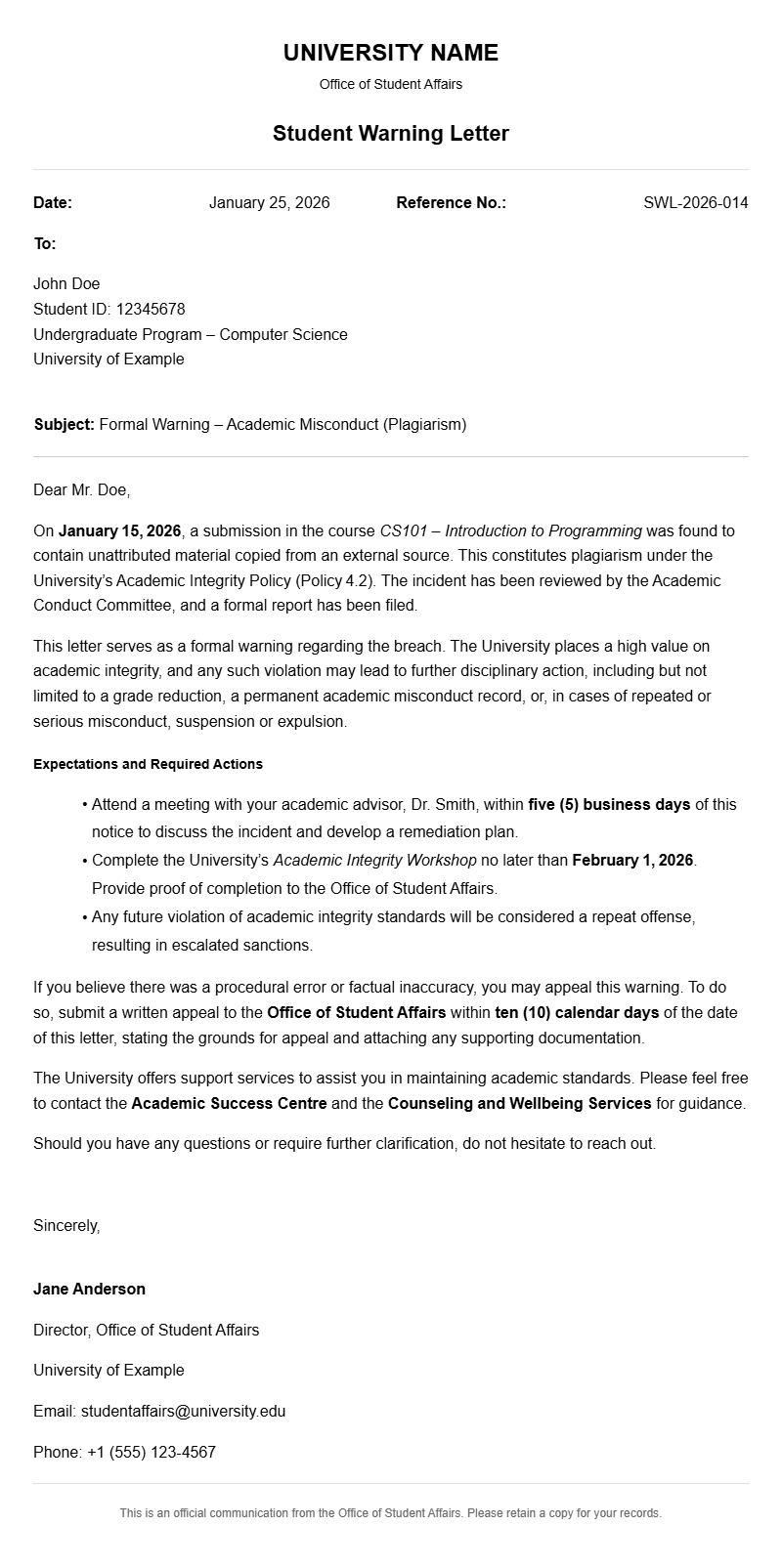
Academic Integrity Warning Template
[Institution Name]
[Date]
Dear [Student Name],
This letter addresses an academic integrity concern documented on [date] in [Course Name]. Our academic integrity review committee found that [description of violation, e.g., “a portion of your research paper exhibited unattributed content from external sources”].
Documentation on file:
[Specific reference to evidence: assignment rubric, plagiarism detection report, etc.]
Policy reference: This matter falls under the Academic Integrity Policy ([handbook section]), which identifies consequences ranging from a failing grade on the assignment to dismissal from the program.
Required steps:
1. Meet with [designated office] by [date] to review the allegations.
2. Complete the academic integrity tutorial by [date].
3. Submit a written response to the committee by [date].
I recognize this is stressful. The Office of Student Conduct ([contact]) can explain the process and your options. A subsequent meeting to discuss academic expectations is scheduled for [date].
[Your Name]
[Title]
_[Student Signature]__[Date]_
Common Mistakes to Avoid
Having reviewed hundreds of these letters over the years, here are the traps I see most often:
- Dating the letter too late—Once grades are posted or incidents are old, a warning feels like an afterthought. Issue it while the issue is fresh.
- Using vague language—”Your performance is concerning” leaves too much interpretation. State exact numbers and dates.
- Threatening consequences without follow-through—If you write that a second offense results in dismissal, you must follow through. Otherwise, the letter loses all weight.
- Forgetting to include resources—Warning without support looks punitive. Most boards and review committees expect to see that you connected the student with help.
- Not keeping a copy—Always date-stamp and file the signed copy. This protects you and the institution if the matter escalates.
Customization Tips for Different Scenarios
No single template fits every situation. Adjust based on these factors:
Graduate vs. Undergraduate Students
Graduate students often have stricter contractual obligations tied to funding or assistantships. Your letter may need to reference specific program handbooks or committee requirements. For professional programs, you might check similar student scholarship approval letter samples for tone calibration.
International Students
Immigration status adds complexity. These students often face additional consequences that require sensitivity. Consult with your international student office before finalizing language that could be misinterpreted.
Online or Hybrid Courses
Attendance documentation looks different in virtual environments. Reference login records, discussion participation, or submitted assignment timestamps instead of physical presence.
Students with Documented Disabilities
If an issue stems from an undisclosed or inadequately accommodated disability, loop in your disability services office before issuing the warning. The language and expected timeline may need adjustment under accessibility laws.
Parents or Guardians
For dependent students under 18, parents may need notification depending on your FERPA stance and institutional policy. You might find relevant frameworks in parent-to-principal letter templates for structuring that communication.
Fine-Tuning Tone and Language
The difference between a letter that reads as supportive versus one that reads as aggressive often comes down to word choice and structure:
- Use “we” when discussing support: “We want to help you succeed in this program”
- Avoid blame-shaming language: Say “The grade report shows” rather than “You failed to complete”
- Keep sentences short—one action per sentence works best
- Leave white space—this makes the letter less intimidating at first glance
If you’re also corresponding with clients or professionals in other fields, you’ll find that adjusting tone applies across contexts. Developers communicating technical expectations, for example, often work from similar developer-to-client letter samples to maintain clarity.
A Quick Reference Checklist
Before sending any student warning letter, run through this list:
- ✓ Student name, ID, and program verified
- ✓ Specific dates and incidents cited
- ✓ Policy clause referenced accurately
- ✓ Measurable expectations clearly stated
- ✓ Support resources named with contact info
- ✓ Follow-up meeting scheduled with date/time
- ✓ Signature line and student acknowledgment included
- ✓ Copy filed in student record
This checklist prevents the most common errors and creates a paper trail that holds up under scrutiny.
Moving Forward After the Warning
The letter itself is only half the process. What happens after matters more. Follow up on time, acknowledge improvements verbally, and document the progress conversations. A student who receives a warning and never hears back from anyone may disengage entirely. One who receives structured support often recovers.
If you need similar correspondence structures for financial or approval contexts, institutional teams frequently adapt frameworks from credit request letter templates when working with students on payment plans or funding letters.
Good warning letters are firm but fair. They protect the institution, guide the student, and keep communication channels open. Use these templates as starting points, adapt them to your specific policies, and always consult your legal counsel for compliance-sensitive situations.
Editable Document Format Examples