Writing a sympathy letter is one of those tasks that feels much harder than it should. You’re trying to express care and support during someone’s most difficult moments, and yet the right words often feel out of reach. Whether you’ve stared at a blank page for twenty minutes or you’re unsure if you’re even the right person to write, this guide will help you create something meaningful—using ready-to-adapt sympathy letter templates that fit different situations.
What Is a Sympathy Letter?
A sympathy letter is a written message of condolence sent to someone who has experienced loss—typically the death of a loved one, but also including serious illness, accident, or other life-altering tragedies. Unlike a sympathy card with a pre-printed message, a personal letter shows the recipient that you took time to think about them specifically. It acknowledges their grief and offers genuine support without trying to fix or rush their pain.
These letters are different from formal letters you might write in professional settings. They’re personal, heartfelt communications that prioritize human connection over structure.
When Should You Send a Sympathy Letter?
You should send a sympathy letter when you want to express care but can’t be there in person. This includes situations where:
- You learned about a loss through mutual acquaintances or social media
- You want to reach out but live far away
- The relationship is meaningful but not so close that a casual text feels appropriate
- You want to provide something the recipient can re-read during harder moments
A handwritten note almost always feels more personal than an email or text message. If you have a close relationship with the recipient, consider writing by hand on quality notepaper—this small choice signals that you prioritized them with your time.
Core Parts of a Sympathy Letter
Every effective sympathy letter includes these key elements:
- Opening that names the loss – Acknowledging what happened directly shows you didn’t misunderstand or avoid the situation
- Expression of care for the recipient – Your concern for their wellbeing matters more than elaborate language
- Specific memory or genuine comment about the deceased – If you knew them, sharing a brief, positive recollection personalizes your message
- Offer of practical help – General offers often go unanswered; specific ones are harder to refuse
- Respectful closing – Keep it simple and warm without trying to wrap up grief neatly
How to Write a Sympathy Letter: Step by Step
Step 1: Start With the Loss Itself
Don’t dance around what happened. A simple opening like “I was so sorry to hear about your father” or “My heart broke when I learned about Sarah’s passing” immediately shows you understand the situation.
Step 2: Share How You Feel About It
Express your own reaction authentically. You might say “I can’t imagine how painful this must be” or “The news left me in shock—I keep thinking about all the stories you shared about your mom.”
Step 3: Add Something Personal About the Person Who Died
If you knew them, include a specific memory or quality you appreciated. “I’ll always remember how David made everyone feel welcome in any room he entered” or “Your grandmother’s laugh was infectious—I only met her a few times but it stayed with me.”
Step 4: Offer Real Support
Skip vague offers like “let me know if you need anything.” Instead, suggest specific actions: “I’m going to bring dinner by next Thursday—does that work?” or “I can watch the kids next weekend so you have time to handle things.”
Step 5: Close Gently
End with something warm but not presumptuous. “I’m here whenever you want to talk or just sit in silence” or “Thinking of you and your family during this time.”
Sympathy Letter Templates You Can Use and Adapt
These templates give you starting points. Read through them, pick elements that feel right for your situation, and adjust the language to match how you actually speak.
Template 1: For a Close Friend or Family Member
Dear [Name],
I still can’t believe [Name]’s gone. When I heard the news, I had to sit down because it hit me so hard.
You and [Name] were so much more than partners/friends/siblings—you were a team. I’ll never forget [specific memory or quality]. That says everything about who [he/she/they] was.
I know you’re surrounded by a lot of people right now, but I want you to know I’m here for you specifically. Would it help if I [specific offer—picked up groceries, watched kids, drove you to appointments]? I mean it—don’t hesitate to ask.
There’s no timeline on grief, and I don’t expect you to “be okay” anytime soon. Just know I’m thinking about you and I’ll keep checking in, even if you don’t respond.
With all my love,
[Your Name]
Template 2: For a Colleague or Acquaintance
Dear [Name],
I was saddened to hear about the loss of [Name]. While we didn’t know each other well, I wanted you to know that [he/she/they] made an impression on me when we [brief specific encounter].
Please accept my deepest condolences. I can only imagine how difficult this time must be.
If there’s anything I can do to help during this period—whether it’s covering some of your workload or simply being someone you can vent to—I’m available.
Sending you strength and peace,
[Your Name]
Template 3: For the Loss of a Child
Dear [Name],
There are no words that feel adequate right now. I am heartbroken for you.
[Child’s Name] was lucky to be loved so fiercely, and you were lucky to be [his/her/their] parent. That love doesn’t disappear—it lives on in every memory, every photo, every moment you carry forward.
I’m not going to pretend to understand what you’re going through. I just want you to know I’m here. I can [specific offer] whenever you’re ready. And if you’re not ready for months, that’s okay too.
Holding you and your family in my heart,
[Your Name]
Template 4: For Loss Due to Suicide or Tragic Circumstances
Dear [Name],
I just learned about [Name], and I’m so deeply sorry. Nothing about this feels fair, and I know you’re facing questions that may never have answers.
Please know that what happened is not your fault. Grief is complicated enough without guilt—you don’t need to carry that.
I want to be present for you however you need, even if that means just sitting nearby while you process. I’m available to [specific offer] when you’re ready, or simply to listen whenever you want to talk—or not talk at all.
With love and concern for you,
[Your Name]
Common Mistakes to Avoid
- Using clichés without context – Phrases like “they’re in a better place” or “time heals all wounds” can feel dismissive to someone in acute grief
- Making it about you – Keep the focus on the recipient. Don’t launch into your own stories of loss unless they specifically ask
- Offering unsolicited advice – Don’t suggest how they should grieve or tell them to “move on”
- Being too formal – A sympathy letter shouldn’t read like a business letter. Warmth matters more than proper structure
- Forgetting to send it – If you’re going to reach out, follow through. Grieving people notice who showed up
Tips for Making Your Letter Feel Genuine
The best sympathy letters aren’t the most eloquent—they’re the most honest. Here’s how to make yours feel authentic rather than performative:
- Write like you’re talking to them – Pretend you’re sitting across from them, having a conversation
- Don’t overwrite – A shorter, genuine letter often means more than a long, polished one
- Include humor carefully – If you shared funny moments with the person who died, a gentle, respectful reference to their sense of humor can be comforting
- Be specific – Generic praise for the deceased is less meaningful than a specific trait or memory you want them to know you noticed
- Handwrite when possible – It takes longer, but it shows you prioritized them
How to Adapt Templates for Different Relationships
The relationship between you and the recipient should shape your tone and content. Use these adjustments as guidelines:
- Very close relationship – Be more vulnerable, share longer memories, offer more specific help, use warmer closings
- Moderately close – Balance warmth with respect for their space, acknowledge the limits of your relationship while still being present
- Professional or casual – Keep it shorter, focus on the loss rather than deep personal connection, avoid overly intimate language
- Religious context – If you know their faith, gentle references can be comforting—but only if they feel natural and you’re sure it’s appropriate
Final Thoughts
A sympathy letter doesn’t need to be perfect. It needs to be real. Most people who receive one years later can’t remember the exact wording, but they remember feeling seen and supported. If you’re struggling to write one, remember that showing up matters more than getting it right.
Whether you use one of these templates as-is or adapt it completely, what matters most is that you acknowledged their loss, expressed genuine care, and offered real support. Sometimes that’s all someone needs to know—that they’re not alone.
Template Variations & Sample Formats
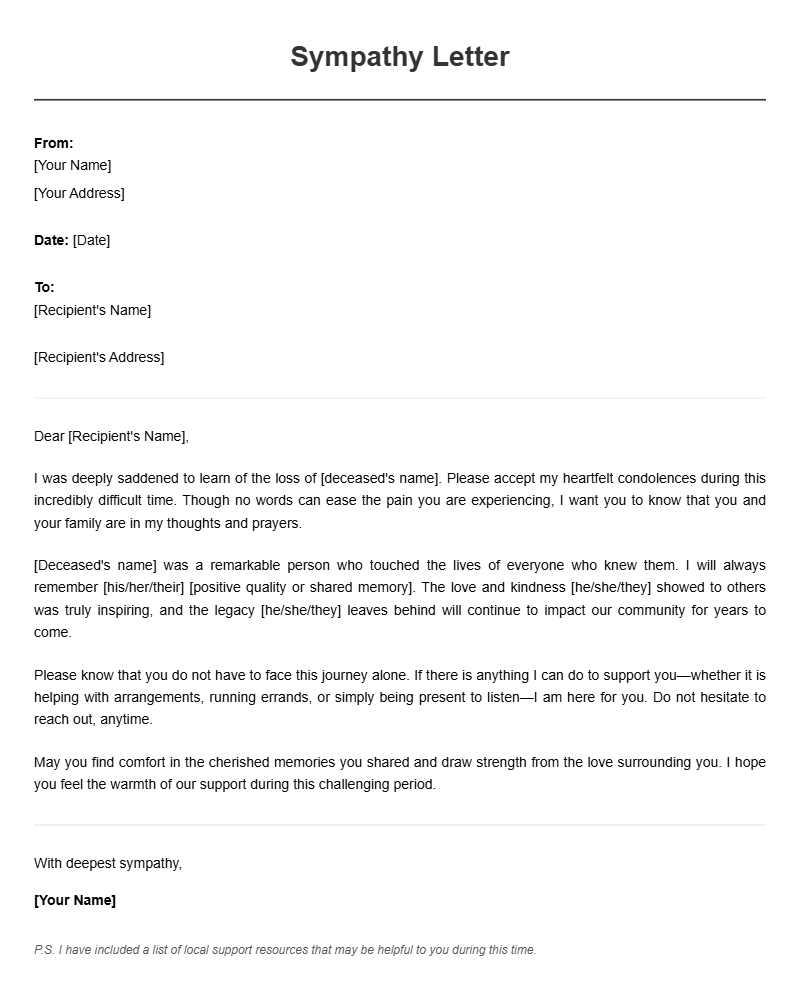
Condolence Letter for Loss of a Parent
Dear [Recipient],
I was saddened to learn of the passing of your [father/mother]. …
…
Condolence Letter for Loss of a Parent
Dear [Recipient],
I was truly sorry to hear of the passing of your [father/mother]. The news reached me recently, and I wanted to extend my heartfelt sympathy during this painful time.
Your [father/mother] was a remarkable person whose kindness, wisdom, and unwavering support touched many lives, including mine. The memories we shared—whether a warm conversation or a simple gesture—remain vivid and comforting. I know how deeply you cherished him/her, and I hope you find solace in the love that surrounds you.
If there is anything I can do to ease your burden, please do not hesitate to reach out. Whether it is a listening ear, a helping hand, or simply sharing a quiet moment, I am here for you.
May the love and memories you hold be a source of strength in the days ahead. My thoughts and prayers are with you and your family.
With deepest sympathy,
[Your Name]
Sympathy Letter for Loss of a Spouse
Dear [Recipient],
It is with profound sorrow that I learned of the loss of your beloved spouse. The void left by his/her passing is felt deeply by all who knew the warmth and love he/she brought into every room.
I recall the countless times we shared stories and laughter, and I will always cherish the kindness he/she showed to me and to so many others. The bond you both shared was an inspiration, and the strength you displayed in the face of adversity is a testament to the depth of your love.
During this period of grief, please know that my thoughts are with you. If you need a companion to talk to, a helping hand with daily tasks, or simply someone to sit with in silence, I am here for you.
May you find comfort in the cherished memories and may the support of friends and family help you through the days ahead.
Sincerely,
[Your Name]
Letter of Sympathy for Loss of a Child
Dear [Recipient],
Words cannot capture the depth of my sadness upon hearing of the passing of your dear child. The grief you and your family are experiencing is immeasurable, and I want you to know that my heart goes out to you during this unimaginable time.
Your child’s brief life was filled with light, joy, and a spirit that touched everyone who was fortunate enough to know him/her. The memories of his/her laughter and the love he/she brought into your home will forever be a source of comfort.
Please do not hesitate to lean on me for any assistance—whether you need someone to run errands, a listening ear, or simply a quiet presence. I am here to help in any way I can.
May the love and support of those around you bring you solace, and may you find peace in the knowledge that your child will be forever remembered.
With deepest sympathy,
[Your Name]
Sympathy Letter for Loss of a Friend
Dear [Recipient],
I was deeply saddened to hear about the loss of your friend. The news came as a shock, and I know how painful it can be to say goodbye to someone who was so integral to your life.
Our friendship was enriched by the many moments we spent together, and I will always remember the laughter, the shared dreams, and the unwavering support that defined our bond. The void left by his/her absence is profound, but the memories we created together will continue to inspire us.
In this time of sorrow, please remember that you are not alone. If you need a shoulder to lean on, a helping hand, or simply someone to share a quiet cup of tea, I am here for you.
May the love and cherished memories guide you through the days ahead. My thoughts are with you and your family.
Warmly,
[Your Name]