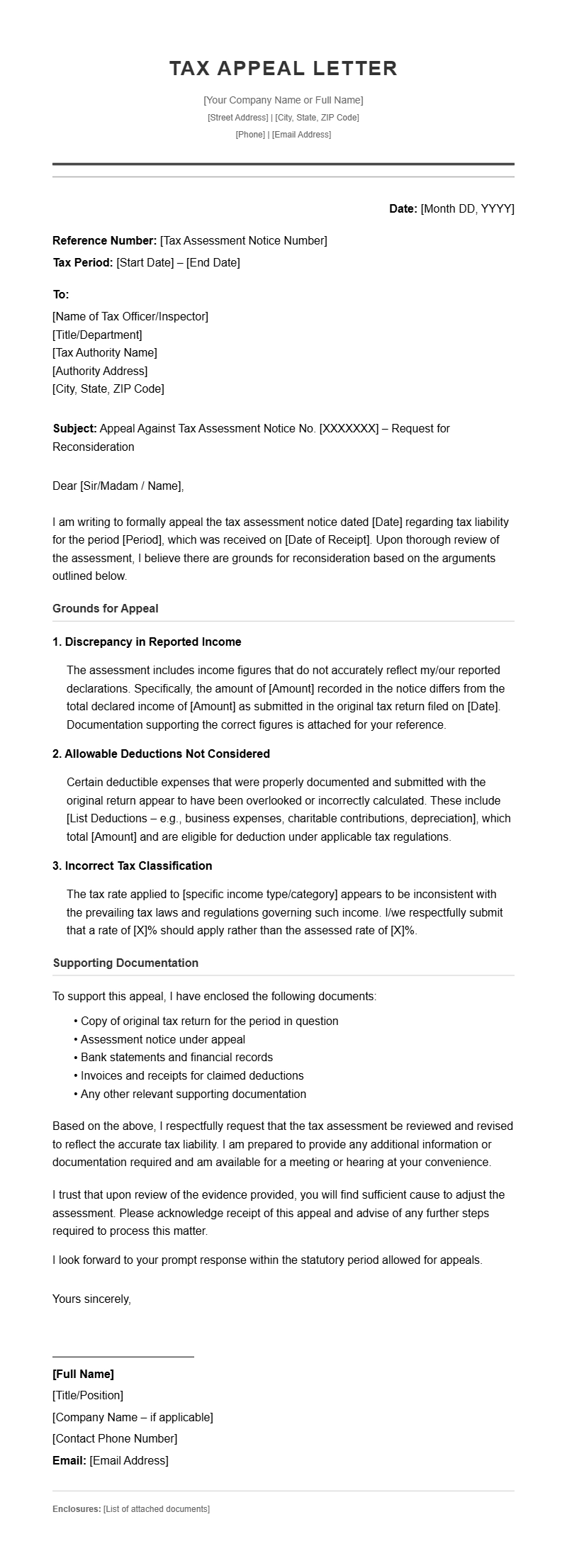
Getting a property tax assessment that feels way off can be frustrating. You’ve looked at your home, compared it to similar properties nearby, and you know the number doesn’t match reality. The good news is you can challenge it — and a well-written tax appeal letter is often the first step. Below, I’ll walk you through everything you need to build a strong case, including practical templates you can adapt to your specific situation.
What Is a Tax Appeal Letter?
A tax appeal letter is a formal written request to your local assessor’s office or tax board asking them to reconsider your property’s assessed value. It lays out your argument for why the current assessment is inaccurate and requests a specific correction. Think of it as your opening statement in a conversation with the taxing authority — you want to present facts clearly and persuasively without sounding aggressive or emotional.
These letters matter because they trigger the official review process. Without a properly submitted appeal, you typically cannot move to higher levels like a hearing or board review. A solid letter doesn’t guarantee success, but a weak or incomplete one almost certainly dooms your case before it starts.
When Should You File a Tax Appeal?
Most people consider appealing when their assessment jumps significantly from one year to the next. But you might also have grounds to appeal if your property was assessed higher than comparable homes in your neighborhood, if there’s a factual error in the assessment records (wrong square footage, incorrect lot size, etc.), or if your property’s condition has deteriorated in ways the assessor hasn’t accounted for.
Timing matters enormously. Assessment appeal deadlines vary by jurisdiction but are often tight — sometimes just 30 to 45 days after you receive your assessment notice. Missing that window typically means waiting another year, so mark your calendar the moment you get official notice.
Key Components of a Strong Tax Appeal Letter
Before diving into templates, let’s cover the essential elements your letter needs. Skipping these is where most appeals fall apart.
Your Contact Information and Property Details
The letter should clearly state who you are, where the property is located, and your assessment account number if one was provided. This sounds basic, but assessors handle thousands of cases — making their job easy by being precise speeds up processing.
A Clear Statement of Purpose
Open with a direct sentence stating you are formally appealing your property tax assessment for the tax year in question. Don’t bury the lead or wrap it in excessive formality.
Specific Comparable Sales Data
This is the backbone of any successful appeal. You need to cite actual sales of similar properties in your area that sold for less than your current assessment suggests your property is worth. Use recent sales — generally within the past year — and include addresses, sale prices, and dates. If you have a real estate license or access to multiple listing data, great. If not, sites like Zillow, Redfin, or your county recorder’s website often have public records you can cite.
Identification of Assessment Errors
If the assessor has incorrect information (wrong bedroom count, inaccurate lot size, outdated property condition), point that out explicitly with documentation attached. Errors give you an obvious foundation for correction.
A Proposed Correction
Don’t just complain — state what you believe the correct assessed value should be and why. Base this on your comparable sales analysis. This shows you’ve done your homework and gives the assessor something concrete to evaluate.
Attached Supporting Documentation
List what you’re enclosing: comparable sales records, photos of your property, recent appraisal if you have one, or any correspondence showing assessment errors. Attachments back up your claims and make your letter harder to dismiss.
Step-by-Step Guide to Writing Your Appeal Letter
Here’s how to approach the writing process step by step.
First, gather your documents. Before writing anything, collect your assessment notice, recent comparable sales data, photos of your property (especially any damage or deferred maintenance), and any prior correspondence with the assessor’s office.
Second, research comparables. Look for homes similar to yours in size, age, and location that sold in the past six to twelve months. Focus on those that sold for less than your current assessment. Ideally, find three to five strong comparables that support your case.
Third, draft your opening paragraph. Keep it simple: who you are, where the property is located, that you’re appealing your assessment, and what outcome you’re requesting.
Fourth, build your argument with specifics. For each comparable, include the address, sale price, date, and why it’s comparable to your property. If there are errors in your assessment records, note those explicitly with the correct information.
Fifth, state your proposed value clearly and explain how you reached it. Reference your comparables as the basis for this number.
Sixth, close with a call to action. Request a review of your case and mention you’re available to provide additional information or discuss the matter further.
Finally, proofread carefully. Typos and formatting issues can make your letter look unprofessional and may cause it to be set aside. Double-check all numbers, addresses, and dates.
Tax Appeal Letter Template (Basic Version)
Below is a straightforward template you can customize for your situation. Replace the bracketed sections with your specific information.
[Your Name]
[Your Address]
[City, State ZIP]
[Phone Number]
[Email Address]
[Date]
[Assessor’s Name or Title]
[Assessor’s Office Name]
[Office Address]
[City, State ZIP]
Re: Appeal of Property Tax Assessment
Property Address: [Your Property Address]
Assessment Account Number: [Account Number]
Tax Year: [Year]
Dear [Assessor’s Name or Title],
I am writing to formally appeal the property tax assessment for the property located at [Your Property Address], identified under account number [Account Number] for tax year [Year]. Based on my review of comparable sales and available market data, I believe the current assessed value of $[Current Assessment] does not accurately reflect the fair market value of this property.
After researching recent sales of similar properties in my neighborhood, I identified the following comparable sales that support a lower assessed value:
[Comparable 1 Address]: Sold on [Date] for $[Sale Price]. This property features [brief description of similarities to your home, e.g., “2 bedrooms, 1,200 square feet, same neighborhood”].
[Comparable 2 Address]: Sold on [Date] for $[Sale Price]. [Brief similarity description].
[Comparable 3 Address]: Sold on [Date] for $[Sale Price]. [Brief similarity description].
Based on this analysis, I respectfully request that my property’s assessed value be corrected to $[Your Proposed Value], which aligns with current market conditions and comparable sales data.
I have attached supporting documentation including comparable sales records, photographs of the subject property, and [any other relevant materials]. Please review this information and contact me at your earliest convenience to discuss this matter.
Thank you for your consideration.
Sincerely,
[Your Signature]
[Your Printed Name]
Tax Appeal Letter Template (With Identified Errors)
If your appeal is based partly on factual errors in the assessor’s records, use this variation that calls out specific discrepancies.
[Your Name]
[Your Address]
[City, State ZIP]
[Phone Number]
[Email]
[Date]
[Assessor’s Name or Title]
[Assessor’s Office]
[Office Address]
Re: Appeal of Property Tax Assessment — Errors in Current Records
Property: [Address]
Account Number: [Number]
Tax Year: [Year]
Dear [Name or Title],
I am requesting a review and correction of my property tax assessment for [Property Address] for tax year [Year]. Upon reviewing my assessment notice and county records, I discovered several factual inaccuracies that have resulted in an inflated valuation.
The current assessment lists the property as having [incorrect detail, e.g., “3,200 square feet”]. However, county records and my own measurements confirm the living area is [correct detail, e.g., “2,850 square feet”]. This [difference amount] square foot discrepancy accounts for a significant portion of the overvaluation.
Additionally, the assessor’s records indicate [another error, e.g., “four bedrooms”] when the actual count is [correct number, e.g., “three bedrooms”]. The property also shows no mention of [specific issue, e.g., “a deteriorating foundation that requires repair”], which visibly affects both livability and market value.
Supporting this appeal, I have attached photographs documenting the property’s current condition, a copy of the deed confirming accurate square footage, and a recent appraisal estimating fair market value at $[Appraised Amount]. Based on both the identified errors and current market comparables, I request that my assessment be reduced to $[Proposed Value].
I am prepared to provide additional documentation or discuss this matter further at your convenience. Please contact me at [phone] or [email].
Sincerely,
[Signature]
[Printed Name]
Common Mistakes to Avoid
Many appeal letters fail not because the case is weak but because the presentation is poor. Here’s what trips people up most often.
Submitting without comparable sales data is the biggest error. Saying “I think my assessment is too high” without evidence rarely succeeds. The assessor needs numbers they can evaluate. Your job is to provide them.
Using only online estimates without real sales data can backfire. Zestimate-style numbers from automated valuation models carry little weight with assessors. Actual arm’s-length transactions are what matter, ideally sourced from multiple listing service records or county recorder filings.
Missing deadlines is painfully common. jurisdictions set strict windows and don’t extend them for forgotten mail or busy schedules. If your notice says you have 30 days, treat it as 30 days — not “a few weeks.”
Focusing on emotions rather than facts also weakens appeals. It’s natural to feel frustrated, but letters that emphasize how unfair the situation feels without grounding complaints in data rarely succeed. Assessors deal with hundreds of appeals; they respond better to spreadsheets than sentiment.
Forgetting to include attachments is another avoidable mistake. If you mention documentation in your letter, actually include it. A letter that says “see enclosed photos” with nothing enclosed creates confusion and delays.
Tips for Customizing Your Appeal Letter
Generic letters get generic responses. Here’s how to make yours more effective.
Reference local conditions if relevant. If your neighborhood has experienced a downturn, high vacancy rates, or specific environmental issues affecting property values, mention those contextually. They help the assessor understand why your comparables are relevant.
Adjust tone based on your relationship with the office. If you’ve previously communicated with the assessor and had a constructive exchange, you can be slightly warmer in your letter. If this is your first contact, keep it professional and matter-of-fact.
Include your methodology briefly. Don’t just list comparables — briefly explain why you chose them. “This home sold three blocks away, has the same bedroom count, and was built in the same decade” tells the assessor you made thoughtful choices rather than cherry-picking data.
Follow submission instructions precisely. Some jurisdictions require appeals to go to specific addresses, include specific forms, or use particular submission methods. Ignoring these requirements can mean your appeal is rejected without being reviewed on its merits.
If you’re handling other formal correspondence, similar principles apply. Just as a school transportation request letter needs clear specifics and proper format, tax appeals demand the same precision to be taken seriously.
What Happens After You Submit?
Once your appeal is received, the assessor’s office will typically acknowledge it and begin reviewing your information. This can take weeks or even months depending on the jurisdiction and volume of appeals received. During this period, stay responsive if they request additional documentation.
If the assessor agrees with your position, you’ll receive a corrected assessment notice. If they deny the appeal or only offer a partial reduction, you may have the option to escalate — often to a county board of review, an independent appeals board, or even a local court. Each escalation typically requires additional steps and sometimes additional fees.
Keep copies of everything you submit and track confirmation numbers if your jurisdiction provides them. Documentation protects you if disputes arise later.
Final Thoughts
A tax appeal letter won’t automatically win your case, but a well-prepared one gives you the best possible shot. Focus on concrete data, clear organization, and professional presentation. The more work you put into building your case upfront, the less time you’ll spend fighting uphill battles later.
If your assessment is significantly off, the money you save from a successful appeal can be substantial — and worth the effort involved. Start gathering your comparables now, give yourself time to draft carefully, and hit that deadline with confidence.
Common Document Templates & Previews