If you’ve ever had to write a teacher disciplinary letter, you know how delicate those situations can be. Clear, respectful communication is key when addressing misconduct or performance issues. Having a solid template or sample can help you craft a professional letter that conveys your concerns effectively while maintaining a respectful tone. This article offers practical guidance on creating disciplinary letters for teachers, including sample templates and tips for customizing them to fit your specific situation.
What Is a Teacher Disciplinary Letter and When Is It Used?
A teacher disciplinary letter is a formal document used by school administrators or supervisors to address specific issues related to a teacher’s conduct or performance. It typically serves as an official record of the concern, outlines expectations for improvement, and may specify consequences if the issue isn’t resolved.
This type of letter is commonly used in situations such as:
- Repeated absenteeism or tardiness
- Violation of school policies or code of conduct
- Inappropriate behavior with students or staff
- Performance deficiencies in teaching or classroom management
Having a well-structured disciplinary letter can help keep communication professional and clear, reducing misunderstandings or unnecessary conflict.
Key Components of a Disciplinary Letter to a Teacher
Effective disciplinary letters typically include these sections:
- Header with date and recipient details – Clearly specify who the letter is addressed to and the date it was written.
- Introduction – State the purpose of the letter briefly.
- Description of the issue – Detail the specific behavior or performance concern, referencing dates or incidents if possible.
- Expected behavior or improvement plan – Clearly outline what changes are needed and any support offered.
- Consequences or next steps – Explain potential consequences if the issue persists, such as further disciplinary action or review.
- Closing statement – Offer support or open the door for discussion.
- Signature and contact information – Sign off with your details for follow-up.
Step-by-Step Guide to Writing a Disciplinary Letter
- Start with a professional tone: Keep your language respectful and objective.
- Be specific about the issue: Instead of vague statements, cite particular incidents or behaviors with dates if possible.
- State the impact: Explain how the behavior affects students, colleagues, or the school environment.
- Outline expectations: Clearly describe what changes are expected and set a timeline if applicable.
- Offer support or resources: If appropriate, mention training, counseling, or mentorship options.
- Conclude professionally: Reinforce your willingness to support improvement and invite dialogue if needed.
Sample Template for a Teacher Disciplinary Letter
Here’s an example you can adapt to your needs:
[Your Name]
[Your Position]
[School Name]
[Date]
[Teacher’s Name]
[Teacher’s Position]
[School Name]
Dear [Teacher’s Name],
I am writing to address concerns regarding your recent attendance and classroom management. On [specific date], you were absent without prior notice, which impacted your students’ learning and placed additional burden on your colleagues.
It is important that all staff adhere to the school’s attendance policy and maintain professional conduct. Moving forward, I expect you to inform the administration of absences at least [notice period], and to ensure that your classroom is managed effectively during your absence.
Please consider this letter as a formal reminder. Continued issues may lead to further disciplinary measures, including a review of your employment status. We are committed to supporting you in meeting these expectations, and I encourage you to reach out if you need assistance or clarification.
Thank you for your prompt attention to this matter.
Sincerely,
[Your Name]
[Your Contact Info]
Common Mistakes to Avoid in Disciplinary Letters
- Using accusatory language: Stick to facts and avoid personal attacks.
- Being vague: Specific incidents and clear expectations are more effective than general statements.
- Failing to document: Keep a record of incidents that support your concerns.
- Overlooking support options: Offer resources or assistance to help the teacher improve.
- Ignoring legal considerations: Ensure your language complies with employment laws and policies.
Tips for Customizing Your Disciplinary Letter
- Reference specific incidents with dates and details to provide clarity.
- Maintain a respectful tone, even when addressing serious issues.
- Adjust the language based on the severity of the misconduct or performance issue.
- Include actionable steps and timelines to encourage improvement.
- Consider attaching relevant policies or previous warnings for context.
Quick Actionable Advice
Always review your letter carefully before sending. Make sure it’s clear, respectful, and factual. If you’re unsure about the tone or content, consult a colleague or legal advisor. Keep a copy for your records, and follow up as needed to support the teacher’s improvement.
For instances of formal communication with staff, you might find useful templates in related areas, such as student transfer approval letters or office relocation notices.
Practical Document Examples
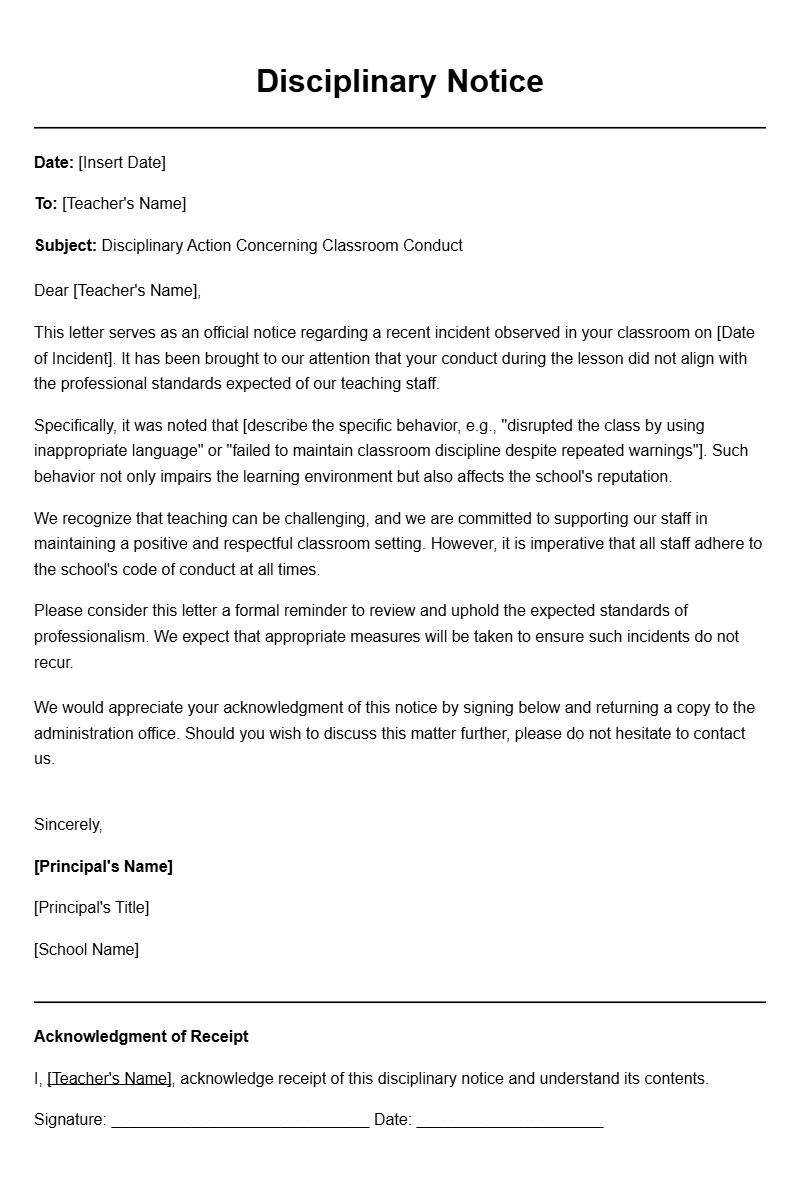
Formal Disciplinary Action Notification
Dear [Teacher’s Name],
We are writing to inform you that following a review of recent conduct, a formal disciplinary action has been deemed necessary. This action pertains to the incident reported on [date], which involves [brief description of the incident].
As per our institutional policies, you are hereby issued a warning and are expected to adhere strictly to the established code of conduct moving forward. Please be advised that any recurrence of such behavior may result in further disciplinary measures, including suspension or termination of employment.
We encourage you to meet with the administration at your earliest convenience to discuss this matter.
Sincerely,
Principal/Head of School
[Institution Name]
Warning Letter for Policy Violation
Dear [Teacher’s Name],
This letter serves as a formal warning regarding your recent violation of school policies, specifically [describe policy, e.g., punctuality, classroom behavior]. Our records indicate that on [date], you [describe the violation].
Maintaining professional standards is crucial for the effective functioning of our institution. We expect immediate corrective action and improved adherence to policies. Continued violations may lead to further disciplinary measures, including suspension or termination.
Please acknowledge receipt of this letter and contact the administration if you wish to discuss this matter further.
Sincerely,
HR Department
[Institution Name]
Disciplinary Hearing Invitation
Dear [Teacher’s Name],
You are hereby invited to attend a disciplinary hearing scheduled for [date] at [time], located at [venue]. This hearing concerns allegations related to [brief description of incident or misconduct].
Please prepare any documentation or evidence you wish to present. Your participation is important, and you have the right to bring a representative if desired.
We look forward to resolving this matter constructively.
Sincerely,
School Administrator
[Institution Name]
Final Warning for Misconduct
Dear [Teacher’s Name],
This letter constitutes a final warning regarding your conduct, specifically in relation to [describe misconduct]. Despite previous discussions and warnings, the behavior has persisted or reoccurred on [date].
Any further misconduct will result in immediate disciplinary action, up to and including termination of employment. We urge you to reflect on your actions and adhere strictly to the professional standards expected.
Please sign and return this letter to acknowledge receipt.
Sincerely,
Head of HR
[Institution Name]
Disciplinary Dismissal Notice
Dear [Teacher’s Name],
Following a thorough review and disciplinary procedures, we regret to inform you that your employment has been terminated effective immediately as of [date]. This decision was made due to [specific reasons, e.g., misconduct, breach of policies].
We appreciate your contributions during your tenure and wish you the best in your future endeavors. Please contact the HR department to discuss final settlements and return of property.
Sincerely,
School Principal
[Institution Name]
Apology and Reinstatement Offer
Dear [Teacher’s Name],
We acknowledge your recent apology regarding the incident on [date] and appreciate your willingness to address the matter. After careful consideration, we are offering reinstatement, contingent upon your commitment to adhere strictly to our conduct policies.
Please confirm your acceptance of this offer by signing and returning the attached document. We look forward to working together to maintain a professional and respectful environment.
Sincerely,
Principal/Head of School
[Institution Name]
Performance Improvement Plan
Dear [Teacher’s Name],
This letter outlines a Performance Improvement Plan (PIP) intended to support your professional development following recent concerns regarding [specific issues, e.g., classroom management, punctuality].
The plan includes specific targets, timelines, and support measures, including:
- Weekly mentorship sessions
- Attendance at professional development workshops
- Monthly progress reviews
We are committed to assisting you in achieving the standards expected and expect your full cooperation.
Sincerely,
Department Head
[Institution Name]
Acknowledgment of Disciplinary Action
Dear [Teacher’s Name],
This letter confirms that you have been informed of the disciplinary action taken against you on [date], regarding [specific incident]. Your acknowledgment of this action is appreciated.
Please retain this document for your records. If you have any questions or wish to appeal, contact the HR department within [timeframe].
We trust that you will take the necessary steps to prevent recurrence.
Sincerely,
HR Department
[Institution Name]
Appeal Process for Disciplinary Decision
Dear [Teacher’s Name],
If you wish to appeal the disciplinary decision issued on [date], you are invited to submit a formal appeal in writing within [number] days. Your appeal should include the reasons for disagreement and any supporting evidence.
Once received, your appeal will be reviewed by an independent panel, and a response will be provided within [timeframe].
We encourage transparency and fairness in addressing all concerns.
Sincerely,
Disciplinary Committee Chair
[Institution Name]