Starting a new teacher at your school involves more than just showing them to a classroom. The first few weeks set the tone for how quickly they’ll settle in, how connected they’ll feel to the team, and ultimately how effective they’ll be in front of students. A well-written onboarding letter does real work: it welcomes them personally, outlines what they need to know, and removes confusion about logistics, expectations, and culture.
If you’re a school administrator, HR coordinator, or principal tasked with bringing new teachers on board, a structured onboarding letter template saves time and ensures nothing important gets overlooked. This guide walks you through what these letters contain, how to write one that actually feels welcoming (not just procedural), and how to customize it for your specific school context.
What Is A Teacher Onboarding Letter?
A teacher onboarding letter is a formal welcome document sent to a newly hired educator before or shortly after their start date. It serves multiple purposes at once. It confirms employment details, introduces the school’s culture and values, outlines first-day logistics, and provides essential information about policies, schedules, and key contacts.
Unlike a generic offer letter, which focuses on salary and position, an onboarding letter is relationship-building. It’s the school’s chance to make a new hire feel genuinely wanted and prepared. Many schools send this letter 2-4 weeks before the teacher’s first day, giving them time to review materials and ask questions.
The best onboarding letters balance professionalism with warmth. They’re detailed enough to be useful but not so dense that the new teacher feels overwhelmed before they even arrive.
When Do You Send A Teacher Onboarding Letter?
Timing matters. Most schools send the onboarding letter after the offer has been accepted and signed but well before the first day. This typically means 2-4 weeks in advance, depending on your school calendar and how much preparation the new teacher needs to do.
Some schools send a brief welcome email immediately after hire confirmation, then follow up with a more detailed onboarding packet a week or two later. Others combine everything into one comprehensive letter. The approach depends on your school’s size and structure.
You might also send updated onboarding information if there are significant changes—like a shift in start date, changes to the schedule, or new policy updates—before they arrive.
Key Sections Your Onboarding Letter Should Include
A strong teacher onboarding letter covers these essential areas:
- Welcome and warm greeting — Sets a positive, personal tone from the principal or hiring manager
- Role confirmation — Position title, grade level or subject, and department
- Start date and first-day logistics — What time to arrive, where to park, who to check in with, what to bring
- Key contacts — Names and emails of the principal, department head, HR coordinator, and a peer mentor if applicable
- School mission and values — A brief overview of what the school stands for and what you expect from teachers
- Classroom and resources — Information about their classroom location, available technology, curriculum materials, and how to request supplies
- Schedule overview — Daily schedule, planning periods, staff meetings, professional development days
- Policies and procedures — Attendance, dress code, mandatory reporting, parent communication expectations, discipline procedures
- Orientation timeline — What happens during their first week, when they’ll meet with leadership, professional development sessions
- Pre-arrival tasks — Documents to complete, background check status, any reading or preparation materials
- Encouragement and next steps — An invitation to reach out with questions, contact information for the HR department
How To Write A Teacher Onboarding Letter Step By Step
Step 1: Start With A Personal, Genuine Welcome
Open with the teacher’s name and a sincere greeting from the principal or head of school. Avoid generic corporate language. Something like “We’re thrilled to welcome you to our community” works better than “We look forward to your contributions to our organization.”
This is your chance to set the emotional tone. A teacher who reads a warm, personal opening feels valued before they’ve even walked through the door.
Step 2: Confirm The Role And Employment Details
Be specific. Don’t just say “teacher.” State the exact position: “5th grade mathematics teacher,” “high school English and drama,” or “special education resource specialist.” Include the department, reporting line (who they report to), and any special responsibilities or roles they’ll have.
Confirm start date, contract type (full-time, part-time, contract length), and salary or hourly rate if it hasn’t been finalized yet.
Step 3: Provide Concrete First-Day Information
New employees have a thousand questions about the first day. Answer them preemptively. Include:
- Exact start time (e.g., “Please arrive by 8:00 AM”)
- Where to go first (e.g., “Check in at the main office with Maria in HR”)
- Parking information and where to park
- What to bring (ID, signed forms, emergency contact information)
- What to expect (orientation meeting, classroom walkthrough, team lunch)
- Whether anyone will be meeting them or if they should find their own way
Step 4: List Key Contacts With Their Roles
Create a simple contact list. Include the principal’s name, email, and phone. Add the department head, HR coordinator, and ideally a peer mentor or buddy who’ll help them navigate the first week. Include a brief note about what each person handles so the new teacher knows who to approach with different questions.
Step 5: Briefly Communicate School Culture And Expectations
Describe what makes your school different. Are you project-based? Focused on social-emotional learning? A classical education model? Parent-involved? This helps the new teacher understand the environment they’re entering.
Also touch on what you value in teachers: collaboration, innovation, responsiveness to student needs, professional growth. Be honest about expectations without being overwhelming.
Step 6: Outline The First Week And Beyond
Walk them through what happens when. For example:
- Monday morning: orientation and classroom setup
- Monday afternoon: meet with department head to review curriculum
- Tuesday: attend staff meeting and tour the building
- Wednesday: professional development on your student information system
- Thursday-Friday: observe classes or co-teach with a mentor
This removes ambiguity and helps them mentally prepare.
Step 7: Cover Important Policies And Logistics
Include information about:
- School hours and bell schedule
- Attendance and leave policies
- Dress code
- Technology access and passwords
- Lunch arrangements and staff room access
- Parking and building security procedures
- Mandatory reporting requirements if applicable
You don’t need to include every policy—that’s what the employee handbook is for—but cover the immediate, practical items.
Step 8: End With Encouragement And Clear Next Steps
Close by inviting questions and providing a direct way to reach out. Something like: “If you have any questions before your start date, please don’t hesitate to email me or call the main office.” Include a phone number and email.
Reinforce that you’re excited to have them on the team and that you’re here to support their transition.
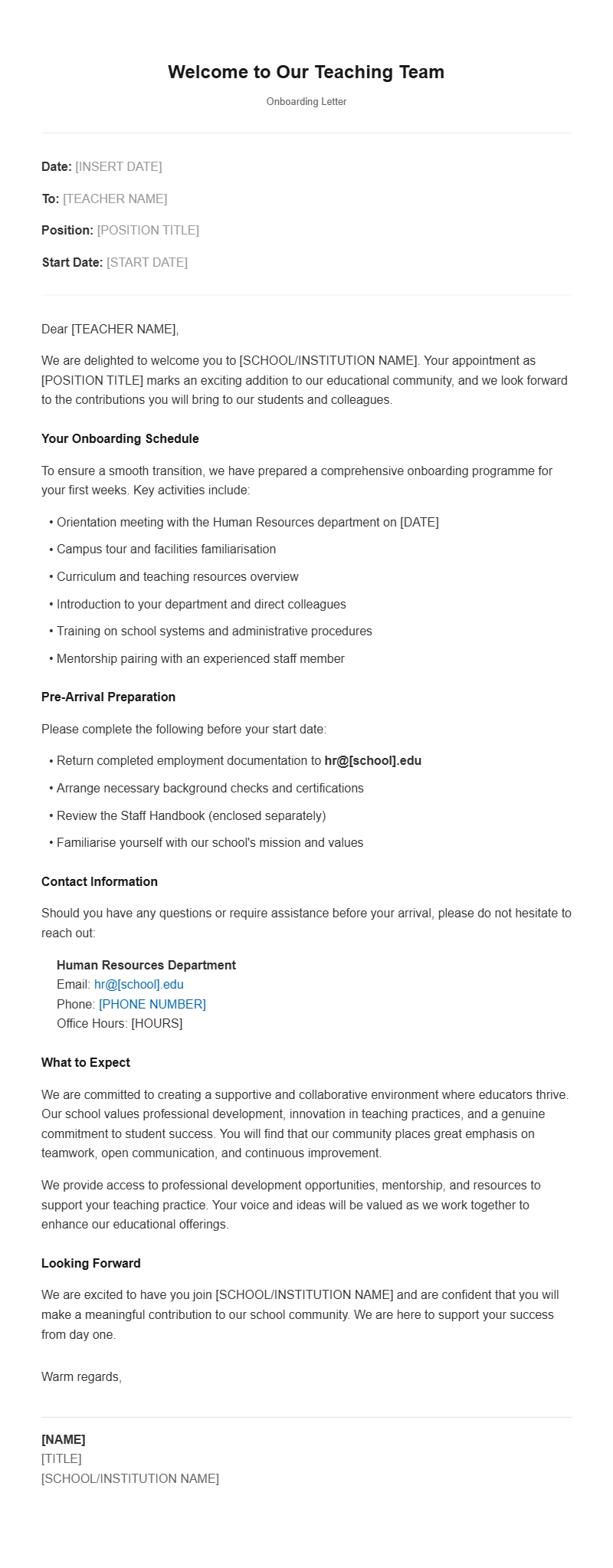
Teacher Onboarding Letter Template
Here’s a customizable template you can adapt for your school:
Dear [Teacher Name],
We’re delighted to welcome you to [School Name]. We’re excited to have you join our team as [Position Title] in the [Department/Grade Level]. Your experience and perspective will be valuable to our students and our community.
ROLE AND START DATE
Your position as [specific title] begins on [date] at [time]. You’ll be working in [location/building], reporting to [supervisor name]. Your contract is [type and length].
FIRST DAY DETAILS
Please plan to arrive at [time] on [date]. Here’s what to expect:
• Arrive at the [main office/designated entrance]
• Check in with [name] in the HR office
• Parking is available in [location]
• Bring: [list items—ID, signed forms, etc.]
• You’ll meet with [name] for a brief orientation, then tour your classroom and the building
• We’ll have lunch together in the [staff room/cafeteria]
KEY CONTACTS
Please save these contacts for your first week:
[Name], Principal — [email] — [phone]
[Name], [Department] Head — [email] — [phone]
[Name], HR Coordinator — [email] — [phone]
[Name], Your Mentor — [email] — [phone]
ABOUT OUR SCHOOL
[School Name] serves [grade levels/age groups] and is committed to [mission/core values]. We believe in [key educational philosophy]. Our community is diverse, collaborative, and focused on [specific goals or approaches].
FIRST WEEK OVERVIEW
Your first week is designed to help you settle in and understand our systems:
Monday: Orientation, classroom setup, department meeting
Tuesday: Staff meeting, building tour, technology training
Wednesday: Curriculum overview with [name]
Thursday: Observation and co-teaching with [mentor name]
Friday: Debrief and planning for week two
IMPORTANT INFORMATION
• School hours: [times]
• Staff meetings: [days and times]
• Planning period: [time]
• Dress code: [brief description]
• Technology: You’ll receive login credentials and passwords on your first day
• Parking: [details]
• Attendance and leave: See the employee handbook for full details
BEFORE YOU ARRIVE
Please complete the following by [date]:
• [Form 1]
• [Form 2]
• Background check confirmation
• Review the attached school calendar and staff handbook
• If you have questions about curriculum, feel free to email [name]
QUESTIONS?
If you have any questions before your start date, please reach out. I’m happy to help you feel prepared and welcomed.
[Name]
[Title]
[Email]
[Phone]
We can’t wait to meet you and work together.
Warmly,
[Principal Name]
Customization Tips For Your School
Add Your School’s Personality
The template above is neutral and professional, but your letter should sound like your school. If your school is casual and innovative, the tone can be more relaxed. If it’s formal and traditional, keep the formality. Read it aloud—does it sound like something your principal would actually say?
Include Specific, Useful Details
Generic onboarding letters feel impersonal. Instead of “parking is available,” say “parking is in Lot B on the west side of the building; use space 47.” Instead of “you’ll receive technology access,” say “you’ll get your laptop and login credentials from IT on Monday morning; your username will be [format].”
Adjust For Different Roles
A new elementary teacher needs different information than a high school teacher or a special education instructor. Adjust the schedule, contacts, and logistics to match the actual role. If you’re onboarding a teacher new to your school but experienced elsewhere, you might skip some basics. If it’s their first teaching job, include more detail.
Link To Resources Rather Than Overwhelming With Attachments
Instead of attaching a 50-page handbook, mention that the full handbook is available on the staff portal and highlight 2-3 key sections they should read before arriving. This feels more manageable.
Make It Mobile-Friendly
Many teachers will read this on their phone. Use short paragraphs, clear sections, and avoid dense blocks of text. If you’re sending it as a PDF, make sure it’s readable on a small screen.
Common Mistakes To Avoid
Being Too Vague About First-Day Logistics
Don’t say “come in early on Monday.” Say “please arrive at 7:45 AM on Monday, August 12th, and check in at the main office.” Specificity reduces anxiety.
Overwhelming Them With Information
An onboarding letter that’s 10 pages long won’t be read. Stick to what they need to know before day one. Save detailed policy information for the handbook or orientation meetings.
Forgetting To Sound Human
Corporate-speak like “we’re committed to leveraging synergies” or “this is a transformational opportunity” makes new teachers cringe. Write like you’re talking to a colleague.
Not Including A Contact For Questions
If a new teacher has questions and doesn’t know who to ask, they’ll feel lost before they even arrive. Make it crystal clear that they can reach out and to whom.
Sending It Too Late
If you send the onboarding letter one day before their start date, it’s not useful for preparation. Aim for 2-4 weeks in advance.
Making It One-Size-Fits-All Without Personalization
A template is a starting point. At minimum, personalize it with the teacher’s name, their specific role, and a note from the principal that feels genuine to them.
Examples Of Onboarding Letter Sections In Action
Example Welcome Section
Good: “We’re thrilled to welcome you to Lincoln Elementary. Your background in project-based learning and your passion for making science accessible to all students align perfectly with our school’s values. We can’t wait to see what you bring to our 4th grade team.”
Avoid: “Welcome to our organization. We look forward to your contributions.”
Example First-Day Details
Good: “On Monday, August 19th, please arrive at 7:45 AM. Park in Lot B (west side of the building), and come directly to the main office where Maria will meet you. Bring your ID and any signed employment forms. You’ll spend the morning setting up your classroom with support from our facilities team, then join us for a welcome coffee at 10 AM in the staff room.”
Avoid: “Come in on Monday morning. Parking is available. Report to the office.”
Example School Culture Section
Good: “Riverside is a collaborative community where teachers work together across grade levels. We use a balanced literacy approach and prioritize student voice in decision-making. We’re not a high-pressure environment, but we are a high-support environment. You’ll find that colleagues are generous with ideas, time, and feedback.”
Avoid: “We’re committed to excellence and continuous improvement.”
How Onboarding Letters Fit Into Your Larger Hiring Process
An onboarding letter is one piece of a larger teacher hiring and retention strategy. Before sending it, you’ve already extended an offer and had it accepted. After sending it, you’ll conduct orientation, assign a mentor, and do regular check-ins during the first 90 days.
You might also consider sending candidate shortlisting letters earlier in your process to keep strong candidates informed as you move through your hiring timeline. And if you’re looking at teacher performance or development, class participation letters can help document observations and feedback throughout the year.
The onboarding letter is your bridge between hiring and integration. It’s the moment when a job offer becomes a real, concrete arrival.
Digital Delivery And Follow-Up
Send the onboarding letter via email or through your HR system, not just printed mail. Email allows the new teacher to forward it to family, save it for reference, and easily reach out with questions.
Follow up a week before their start date with a brief check-in email: “We’re excited to see you on [date]! Do you have any last-minute questions?” This shows you’re organized and thinking about them.
Consider creating a simple pre-arrival checklist or shared document where they can confirm receipt of the letter, ask questions, and note any accessibility needs or concerns.
Making Your Onboarding Letter Stand Out
The difference between an adequate onboarding letter and a great one often comes down to small touches. Include a photo or welcome video from the principal. Mention something specific about the teacher’s background that made them stand out during hiring. Offer to connect them with the team on social media or a staff messaging app before they arrive.
These small gestures signal that the school sees them as individuals and is genuinely invested in their arrival, not just processing paperwork.
If you’re also managing other hiring communications, you might look at how you’re structuring promotion request letters or startup pitch letters for consistency in tone and professionalism across your organization.
Moving Forward
A well-crafted teacher onboarding letter takes 1-2 hours to write but pays dividends in how quickly your new hire settles in and becomes productive. Start with the template provided here, customize it for your school’s voice and context, and test it with your HR team before sending it out.
The goal isn’t to create a document that impresses—it’s to create one that prepares, welcomes, and makes a new teacher feel like they made the right choice joining your school. When a teacher’s first interaction with your administration is clear, warm, and genuinely helpful, they start their job with confidence and goodwill. That matters far more than perfect wording.
Standard Format & Layout Reference