Writing a letter from a therapist to a patient can feel daunting, whether you’re a seasoned professional or just starting out. These letters often serve as a means of communication that can clarify treatment goals, provide encouragement, or address specific issues. Having a solid template can help streamline the process and ensure that you cover all necessary points in a clear and compassionate manner.
WHAT IS A THERAPIST TO PATIENT LETTER?
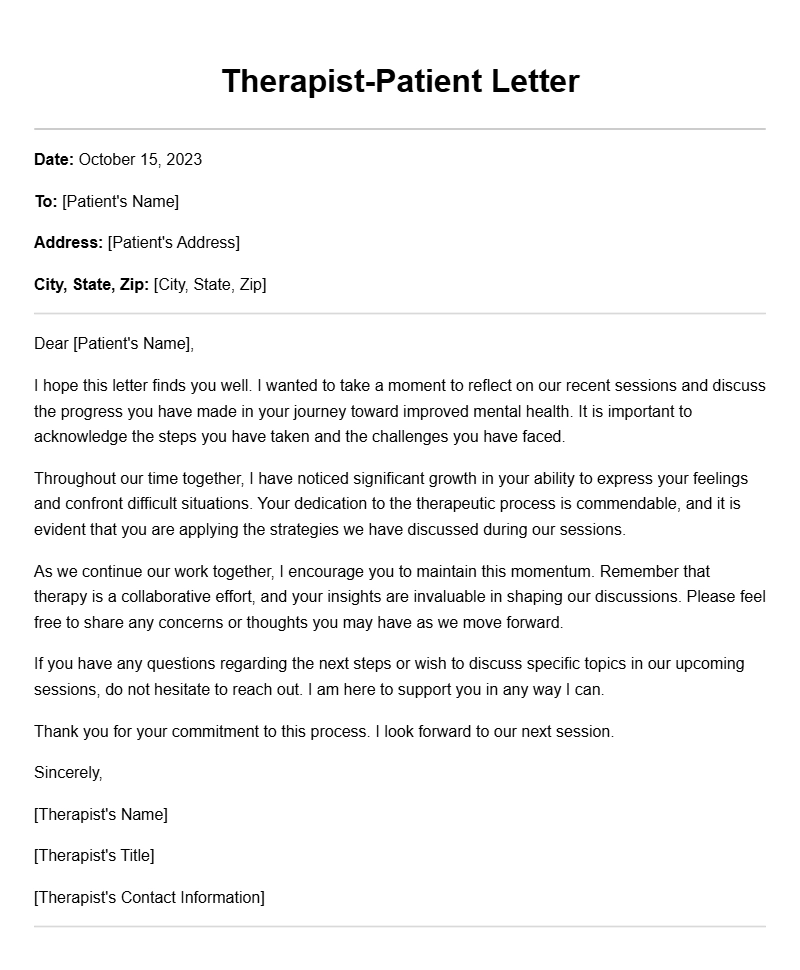
A therapist to patient letter is a written communication that therapists use to convey important information, updates, or reflections regarding therapy sessions. This document can serve various purposes, such as summarizing treatment progress, addressing patient concerns, or outlining next steps in therapy.
WHEN IS IT USED?
These letters can be used in several situations, including:
- After a significant therapy session to recap key points.
- When transitioning a patient to another therapist.
- For providing resources or recommendations based on the patient’s needs.
- To offer encouragement during challenging times.
KEY COMPONENTS OR SECTIONS
A well-structured therapist to patient letter typically includes:
- Greeting: Start with a friendly salutation using the patient’s name.
- Introduction: Briefly state the purpose of the letter.
- Body: Discuss specific topics, such as progress, concerns, or recommendations.
- Conclusion: Encourage the patient and outline any next steps.
- Signature: Close with your name and credentials.
STEP-BY-STEP WRITING GUIDE
- Start with a warm greeting: Use the patient’s preferred name.
- State the purpose: Clearly explain why you’re writing. For example, “I wanted to follow up on our last session and share some thoughts.”
- Discuss key points: Reflect on the patient’s progress, address any concerns, and offer insights or recommendations. Be specific and relatable.
- Encourage the patient: Remind them of their strengths and progress. A few encouraging words can make a big difference.
- Outline next steps: If necessary, provide information on what to expect moving forward.
- Close with your signature: Sign off with your name and credentials to maintain professionalism.
REALISTIC EXAMPLES/TEMPLATES
Here are a few snippets to help you get started:
Example 1: Progress Update
Dear [Patient’s Name],
I hope this letter finds you well. I wanted to take a moment to reflect on our recent sessions. You’ve shown remarkable progress in managing your anxiety, especially when it comes to [specific situation]. Keep up the great work! Let’s continue to build on these strategies in our next session.
Example 2: Transitioning to a New Therapist
Dear [Patient’s Name],
As we discussed in our last meeting, I believe it would be beneficial for you to work with [New Therapist’s Name]. They specialize in [specific area] and can offer you the support you need. I’ve attached some resources to help you with this transition.
COMMON MISTAKES TO AVOID
- Using overly technical language that may confuse the patient.
- Being vague about treatment progress or next steps.
- Failing to personalize the letter to the specific patient’s needs.
TIPS FOR CUSTOMIZATION
Make your letters more effective by:
- Using specific examples relevant to the patient’s experiences.
- Adjusting the tone based on your relationship with the patient.
- Incorporating any feedback or preferences the patient has shared with you.
Writing a therapist to patient letter doesn’t have to be an intimidating task. With a clear structure and some thoughtful content, you can create a meaningful document that supports your patient’s journey. Tailor your message to fit their unique situation, and you’ll make a positive impact on their therapeutic experience.
Common Document Templates & Previews
Initial Consultation Follow-Up Letter
Dear [Patient’s Name],
I hope this letter finds you well. I wanted to take a moment to thank you for attending our initial consultation on [Date]. It was a pleasure to meet you and discuss your concerns.
As we discussed, the next steps in your therapeutic journey include:
- Setting specific goals for our sessions.
- Scheduling our next appointment for [Date].
- Completing the assessment forms I provided.
Please feel free to reach out if you have any questions or need to reschedule. I am here to support you.
Warm regards,
[Your Name]
[Your Title]
[Your Contact Information]
Progress Update Letter
Dear [Patient’s Name],
I wanted to take this opportunity to provide you with an update on your progress since our last session on [Date].
You have made commendable strides in:
- Identifying triggers for anxiety.
- Implementing coping strategies.
- Engaging in self-care activities.
As we continue our work together, I recommend focusing on:
- Deepening your mindfulness practice.
- Exploring past experiences as they relate to current feelings.
Let’s discuss this further during our next session scheduled for [Date].
Sincerely,
[Your Name]
[Your Title]
[Your Contact Information]
Therapy Session Confirmation Letter
Dear [Patient’s Name],
This letter serves as a confirmation of your upcoming therapy session. Here are the details:
| Date | Time | Duration |
|---|---|---|
| [Date] | [Time] | [Duration] |
Please ensure that you arrive 10 minutes early to complete any necessary paperwork. If you need to reschedule, do not hesitate to contact me.
Looking forward to seeing you soon.
Best,
[Your Name]
[Your Title]
[Your Contact Information]
Termination of Therapy Letter
Dear [Patient’s Name],
I wanted to take a moment to address the conclusion of our therapeutic relationship, effective [Date]. This decision was made after careful consideration of your progress and the goals we set together.
Throughout our time, you have shown remarkable growth in:
- Understanding your emotions.
- Developing healthier relationships.
- Implementing effective coping mechanisms.
Should you wish to return to therapy in the future, I will always be here to support you. Please feel free to reach out if you have any questions or need resources moving forward.
Wishing you all the best,
[Your Name]
[Your Title]
[Your Contact Information]
Referral Letter to Another Therapist
Dear [Patient’s Name],
As we discussed in our last session, I believe it would be beneficial for you to explore further support with a specialist. I am writing to provide you with a referral to [Therapist’s Name], who specializes in [specific area].
Here are the details:
- Therapist’s Name: [Therapist’s Name]
- Contact Number: [Phone Number]
- Email: [Email Address]
I believe this transition will offer you additional insights and tools to continue your healing journey. Please let me know if you have any questions or need assistance in this process.
Warm wishes,
[Your Name]
[Your Title]
[Your Contact Information]
Appointment Cancellation Letter
Dear [Patient’s Name],
I am writing to inform you that, unfortunately, I need to cancel our scheduled appointment on [Date]. I apologize for any inconvenience this may cause.
Please contact my office at your earliest convenience to reschedule. Here are my available slots for next week:
- [Date & Time]
- [Date & Time]
- [Date & Time]
I appreciate your understanding and look forward to our next session.
Sincerely,
[Your Name]
[Your Title]
[Your Contact Information]
Therapy Goals Summary Letter
Dear [Patient’s Name],
As we approach the end of this phase of therapy, I wanted to summarize the goals we established at the beginning of our sessions:
- Improve emotional regulation.
- Enhance communication skills.
- Develop a strong support system.
You have made significant progress in these areas, and I am proud of the work you have accomplished. If you wish to continue with therapy, we can set new goals for the next phase. Please let me know your thoughts.
Best regards,
[Your Name]
[Your Title]
[Your Contact Information]
Client Feedback Request Letter
Dear [Patient’s Name],
Your feedback is vital in helping me provide the best service possible. I would greatly appreciate it if you could take a moment to reflect on our sessions and share your thoughts.
Here are a few questions to consider:
- What aspects of therapy have been most helpful to you?
- Are there areas you feel could be improved?
- How would you describe your overall experience?
Please reply to this letter or feel free to discuss your feedback in our next session. Thank you for your time and honesty.
Warmly,
[Your Name]
[Your Title]
[Your Contact Information]
Therapy Re-Engagement Letter
Dear [Patient’s Name],
It has been a while since our last session, and I wanted to reach out to see how you have been doing. If you feel ready to resume therapy, I would be glad to support you once again.
Here are some options for our next steps:
- Schedule a check-in session.
- Discuss any changes in your circumstances.
- Revisit your therapeutic goals.
Please let me know your availability, and we can set up a time that works for you.
Looking forward to hearing from you,
[Your Name]
[Your Title]
[Your Contact Information]