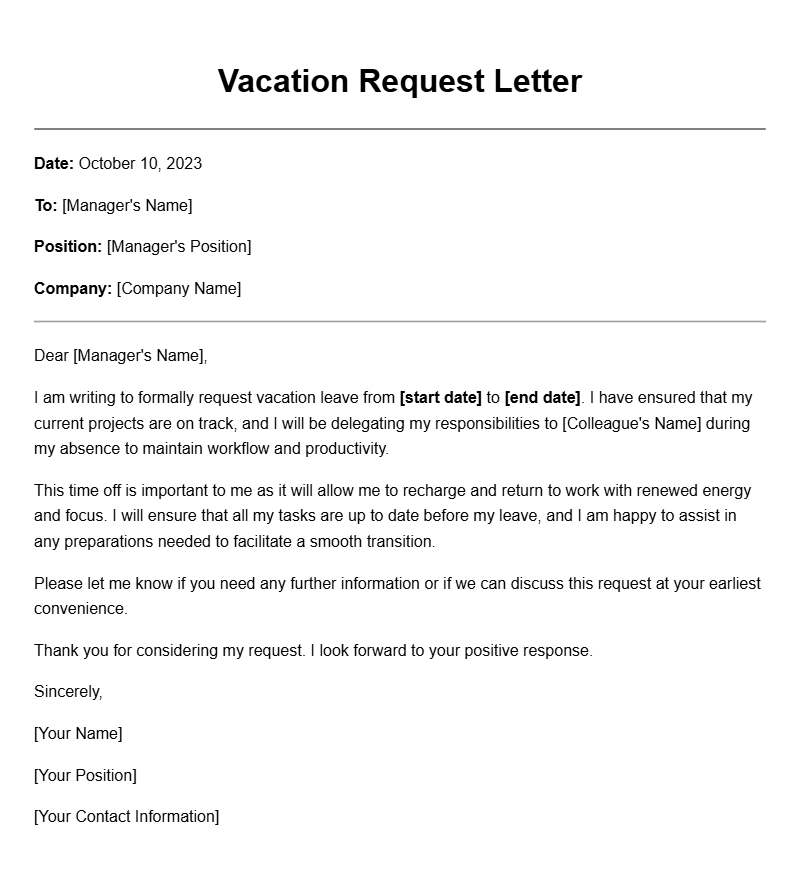
Whether you’re planning a much-needed getaway or a family reunion, drafting a vacation request letter is an essential step. This letter helps you formally notify your employer of your intention to take time off, ensuring that both you and your workplace remain on the same page. In this guide, we’ll break down what a vacation request letter entails, when to use it, and how you can write one that clearly communicates your needs.
WHAT IS A VACATION REQUEST LETTER?
A vacation request letter is a formal document that employees submit to their supervisors or HR departments to request time off for vacation. It typically outlines the dates you plan to be away, the reason for your absence, and any arrangements you’ve made to cover your responsibilities while you’re gone.
WHEN TO USE A VACATION REQUEST LETTER
You’ll want to use a vacation request letter whenever you plan to take time off from work, especially if your company has a formal procedure for requesting leave. This could be for a family trip, a personal retreat, or simply to recharge.
KEY COMPONENTS OF A VACATION REQUEST LETTER
- Date: The date you’re writing the letter.
- Recipient’s Information: The name and title of your supervisor or HR representative.
- Your Information: Your name, job title, and department.
- Subject Line: A brief description of the letter’s purpose (e.g., “Vacation Request”).
- Body: A clear request stating your intended dates off and reason for the leave.
- Closing: A polite sign-off and your contact information.
STEP-BY-STEP WRITING GUIDE
- Choose Your Timing: Submit your request well in advance, ideally several weeks before your intended leave.
- Be Clear and Concise: Clearly state the dates you wish to take off and the reason, if applicable.
- Offer Solutions: If your absence may affect the team, suggest how your responsibilities will be handled.
- Proofread: Check for any spelling or grammar mistakes before sending it off.
REALISTIC EXAMPLES OF VACATION REQUEST LETTERS
Here are a couple of templates you can adapt to suit your needs:
Example 1: Simple Vacation Request
[Your Name]
[Your Job Title]
[Your Department]
[Date]
[Supervisor’s Name]
[Supervisor’s Job Title]
Subject: Vacation Request
Dear [Supervisor’s Name],
I am writing to formally request vacation time from [start date] to [end date]. I have made arrangements to ensure my responsibilities are covered during my absence and will ensure a smooth transition before I leave.
Thank you for considering my request. I look forward to your approval.
Best regards,
[Your Name]
[Your Contact Information]
Example 2: Detailed Vacation Request
[Your Name]
[Your Job Title]
[Your Department]
[Date]
[Supervisor’s Name]
[Supervisor’s Job Title]
Subject: Vacation Request
Dear [Supervisor’s Name],
I hope this message finds you well. I am writing to request vacation leave from [start date] to [end date]. The purpose of this trip is to [briefly explain reason, e.g., spend time with family, attend a wedding].
I have coordinated with [Colleague’s Name] to cover my duties while I am away, ensuring that all responsibilities are managed seamlessly. Please let me know if you need any further information.
Thank you for your consideration.
Sincerely,
[Your Name]
[Your Contact Information]
COMMON MISTAKES TO AVOID
- Not asking in advance: Always submit your request early to allow for planning.
- Being vague: Clearly state your dates and reasons.
- Neglecting to follow up: If you don’t hear back, it’s okay to check in politely.
TIPS FOR CUSTOMIZATION
Make your letter personal by adjusting the tone to match your workplace culture. Add specific details about your workload and how you plan to manage your responsibilities in your absence. If you have a good relationship with your supervisor, a friendly tone may be more appropriate.
Writing a vacation request letter doesn’t have to be daunting. By following the guidelines above, you can create a clear and effective request that helps you secure the time off you need. Don’t forget to check out other helpful letter samples, like bonus announcement letters or promotion request letters for more writing tips!
Standard Format & Layout Reference