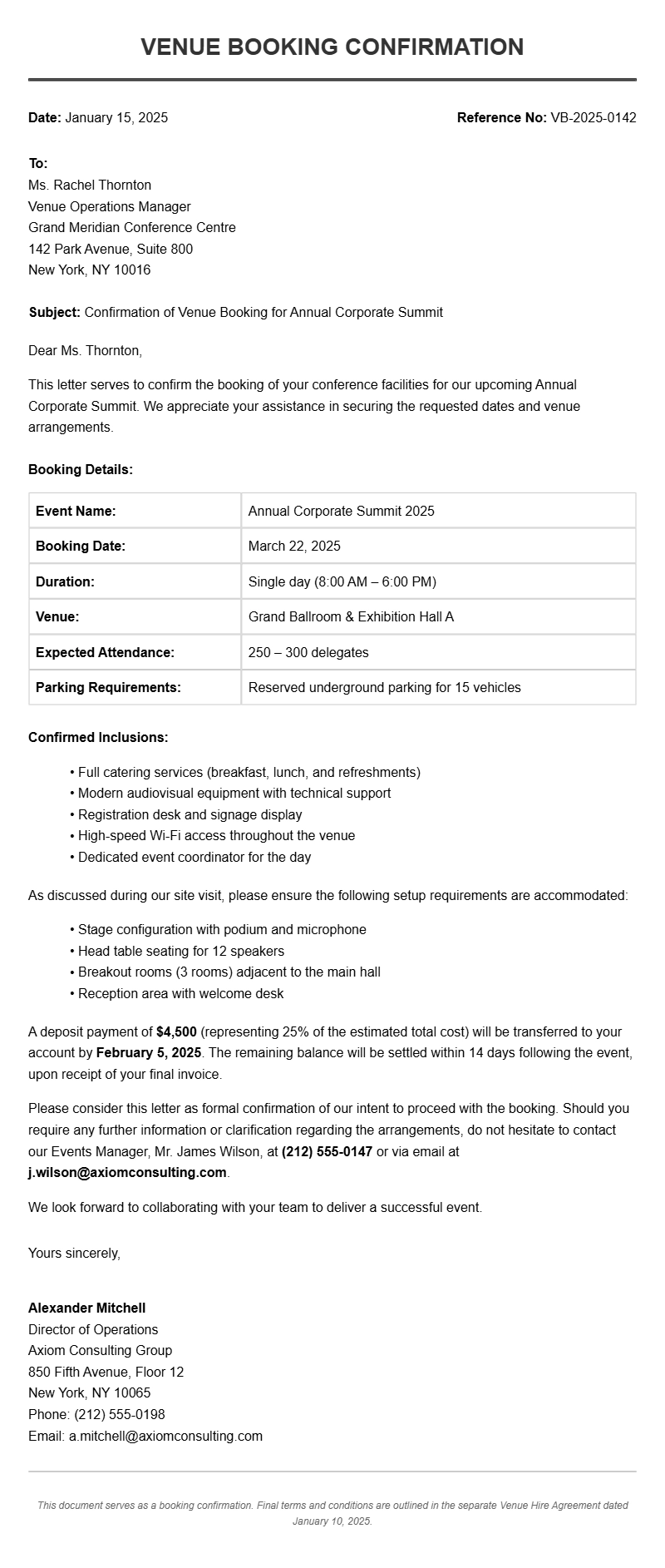
You need to book a venue and you want to do it right the first time. Maybe you’re planning a corporate conference, a wedding reception, or a community workshop, and you’ve realized that sending a proper venue booking letter can make the difference between getting the space you want and losing it to someone who communicates more professionally. This guide walks you through exactly how to write one that works, with copy-and-paste templates you can adapt today.
What Is a Venue Booking Letter?
A venue booking letter is a formal written request sent to a venue manager or owner to reserve a specific space for a specific date and time. It serves as the first official communication between you and the venue, outlining your event needs, expected attendance, and basic logistics before you sign any contract or pay a deposit.
Think of it as your introduction. The venue uses this letter to determine whether they can accommodate your event, provide an accurate quote, and decide if they want to work with you. A well-written venue booking letter shows that you’re organized, serious, and easy to work with—qualities that venue coordinators actively look for when deciding between competing requests.
These letters are different from simple inquiry emails because they include specific details and formal language that signals you’re ready to move forward once terms are agreed upon. If you’ve ever wondered whether you need one, the short answer is yes—anytime you’re requesting a venue that isn’t a walk-in situation, a booking letter establishes clear expectations on both sides.
When Do You Need a Venue Booking Letter?
You need a venue booking letter when the booking process requires formal documentation. This typically happens in these situations:
You’re planning a corporate event that needs AV equipment, catering coordination, or specific room configurations
You’re hosting a wedding or large social gathering at a dedicated event space
You’re organizing a community event, fundraiser, or nonprofit gathering
The venue requires a formal booking process before confirming your date
You need to provide documentation to stakeholders, sponsors, or partners about the venue arrangement
Most hotels, conference centers, and dedicated event spaces have their own booking procedures, but they still appreciate receiving a professional letter that summarizes your request clearly. It gives them everything they need to respond quickly rather than going back and forth with basic questions.
If you’re booking a simpler space—like a community center room or a restaurant for a private dining—still send one. It sets a professional tone and makes you look prepared, even if the venue doesn’t strictly require it.
Key Components of a Venue Booking Letter
A complete venue booking letter includes specific sections that address everything a venue coordinator needs to know. Missing one of these can delay your booking or cause miscommunications later.
Your Organization’s Information
Include your full name (or organization name), address, phone number, and email. This makes it easy for the venue to reach you and establishes who is making the request. If you’re writing on behalf of a company or group, mention that relationship clearly.
Venue Details and Your Preferred Options
Name the specific venue you’re interested in, along with a backup date if you have one. Venue coordinators appreciate knowing you’re flexible on timing but have a clear first choice. Being specific about the venue shows you’ve done your research rather than sending a generic inquiry to multiple locations.
Event Type and Purpose
Describe what kind of event you’re hosting. “Corporate training workshop” tells the venue something different than “networking mixer” or “product launch party.” This information affects everything from the setup they need to prepare to the type of insurance they might require.
Date, Time, and Duration
State your preferred date clearly, along with your expected start and end times. Include setup and breakdown windows if you need them. For example, if your event runs from 2 PM to 5 PM but you need the room set up by noon, mention that upfront. Venues need to know whether they’re blocking off the entire day or just a few hours.
Expected Attendance
Give an accurate guest count estimate. This determines which rooms or spaces work for your event and affects pricing for catering, seating, and equipment. If your count might change significantly, say so and explain the range.
Space Requirements and Setup
List specific needs like theater-style seating, banquet rounds, conference setup, or open mingling space. If you need breakout rooms, a stage, a dance floor, or particular audiovisual equipment, mention it here. The more specific you are, the more accurate the venue’s quote will be.
Services and Amenities
Indicate whether you need catering, bar service, parking, accessibility accommodations, or other amenities. If you’re bringing in outside vendors for food or equipment, clarify that so the venue can address their policies on outside services.
Budget or Cost Expectations
You don’t need to commit to a budget in your initial letter, but mentioning a general range helps the venue tailor their proposal. Something like “We’re working with a budget of approximately $2,000 to $3,000 for venue rental” gives them guidance without being restrictive.
Contact Information and Preferred Response Method
End with your preferred contact details and a reasonable timeframe for response. Something like “I’d appreciate a response within the next week so we can finalize our planning” gives the venue a deadline without being demanding.
How to Write a Venue Booking Letter: Step by Step
Writing this letter is straightforward if you work through it section by section. Here’s the approach I recommend based on writing dozens of these for various clients and events.
Step 1: Research the Venue First
Before you write anything, spend 15 to 20 minutes on the venue’s website. Look for their booking process, capacity limits, available spaces, and any specific requirements they mention. Note the name of the person handling bookings if it’s listed. This research prevents you from asking questions the website already answers and shows in your letter that you understand their space.
Step 2: Open with a Clear Purpose Statement
Your first paragraph should state who you are, what you’re planning, and what you’re requesting. Don’t bury the lead. Something like “I’m writing to formally request the Brown Ballroom at the Riverside Hotel for our annual company conference on March 15, 2024” tells the reader everything they need to know in one sentence.
Step 3: Provide Event Details in Logical Order
Organize the body of your letter by grouping related information together. I find it works best to move from the event itself (what, when, where) to the logistics (guest count, setup needs) to the services (catering, equipment) to the business side (budget, timeline). This mirrors how a venue coordinator thinks about your request.
Step 4: Be Specific About Dates and Flexibility
State your preferred date clearly, then mention backup options. This shows you’re organized and makes the coordinator’s job easier. Instead of “we need a date sometime in April,” try “our preferred date is April 12, though April 19 or 26 would also work if the 12th is unavailable.”
Step 5: Close with a Clear Next Step
End your letter by asking for specific information. Don’t just say “please contact me.” Instead, something like “Could you please send me availability confirmation and a pricing breakdown for the spaces and services I’ve described?” gives the venue a clear action to take.
Venue Booking Letter Templates You Can Use Today
Here are three templates covering the most common scenarios. Copy the one that fits your situation and customize the details. I’ve left brackets [like this] where you need to insert your specific information.
I’m writing on behalf of [Organization Name] to formally request venue availability for our annual [event type, such as “company conference” or “leadership training day”] on [preferred date]. We’re currently finalizing our event schedule and would like to confirm the following details with your team.
Event Overview
Our event will be a [brief description of event purpose]. We expect approximately [number] attendees and are planning for a [duration, such as “full-day program from 8:00 AM to 5:00 PM”].
Space Requirements
We’re looking for a main session room that accommodates [number] people theater-style, along with [number] breakout rooms for小组 discussions. Ideally, the main room would have [specific AV needs, such as “projector, screen, and wireless microphone capability”].
Catering and Hospitality
We would need [describe catering needs, such as “morning coffee and pastries, working lunch, and afternoon beverages”]. Please let us know if your venue provides in-house catering or if outside vendors are permitted.
Budget Guidance
Our venue budget for this event is approximately [$ amount]. If this falls outside your standard packages, please let me know what options you can offer.
I’d appreciate a response by [specific date, typically one week from sending] with availability confirmation, pricing for the spaces and services described, and any additional information about your booking process.
Thank you for your time. I look forward to the possibility of hosting our event at [venue Name].
We’re reaching out to inquire about booking [venue Name] for our [wedding reception / engagement party / anniversary celebration] on [preferred date]. We’re in the early stages of planning and would love to learn more about what your venue can offer.
Event Details
Our celebration would take place from [start time] to approximately [end time], with an expected guest count of [number] people. We’re planning a [brief description, such as “seated dinner with dancing” or “cocktail-style reception”].
Venue Preferences
We’d like to reserve your [specific space name if known, such as “garden terrace” or “grand ballroom”] for the main event, along with access to [any additional spaces needed, such as “a bridal suite for getting ready” or “a quiet room for elderly guests”].
Services We’re Interested In
We’d appreciate information about your in-house catering options, bar service packages, and any rental items included with the venue fee. We’re also curious about your policies on [specific items, such as “outside cake vendors” or “personalized decorations”].
Availability and Next Steps
Could you please let us know if [preferred date] is available, and if so, send us a breakdown of your pricing and package options? We’re planning to make venue decisions within the next [timeframe].
Thank you for considering our request. We’d love to visit the venue and discuss our vision in person if possible.
[Organization Name] is a [brief description, such as “local nonprofit serving families in the county” or “community arts organization”]. We’re writing to request venue space for our upcoming [event name or type], which supports our mission to [brief mission statement].
Event Information
The event will take place on [date] from [start time] to [end time]. We’re expecting approximately [number] participants, primarily [target audience, such as “families with young children” or “local small business owners”]. The program will include [brief description of activities].
Space and Setup Needs
We need a space that accommodates [number] people with [setup type, such as “classroom-style seating for 50” or “open floor plan for a craft fair”]. If possible, we’d appreciate access to [any additional needs, such as “a kitchen for food preparation” or “outdoor space for activities”].
Budget Considerations
As a nonprofit organization, we’re working with limited resources. Our total budget for venue rental is approximately [$ amount]. If your standard rates exceed this, please let us know about any community discounts or sliding scale options you offer for nonprofit events.
Logistics
We may need to set up [number] minutes before the event. Our cleanup will be complete by [time]. We’re happy to provide proof of our nonprofit status and any required insurance documentation.
Please let us know if you’re able to accommodate this request and what the booking process would involve. We appreciate your support of community programming.
Best regards,
[Your Signature]
[Your Name]
[Your Title, Organization Name]
Common Mistakes to Avoid When Writing a Venue Booking Letter
I’ve reviewed enough of these letters to know where people run into trouble. Here are the mistakes that cause delays, miscommunications, or lost opportunities—and how to avoid them.
Being Vague About Dates and Times
Saying “we need space sometime in the fall” doesn’t help anyone. Venue coordinators need specific dates to check availability. Give them a first choice and at least one backup, even if your planning is still flexible. This shows you’re serious and makes it easier for them to work with you.
Forgetting to Mention Guest Count
Guest count affects everything from which room you’re assigned to whether the venue can legally accommodate your event. An accurate estimate—even if it’s a range—is essential. Overestimating by a large margin can result in pricing for a larger space than you actually need, while underestimating can mean your guests don’t fit comfortably.
Not Mentioning Setup Requirements
If you need 150 chairs theater-style and the venue sets up 50 round tables because you didn’t specify, you’ve created a problem. Describe your setup needs clearly upfront. If you’re unsure what setup is best, say “we’re open to recommendations but anticipate needing [general description].”
Ignoring Venue Policies on Outside Vendors
Some venues require you to use their in-house catering or approved vendor list. If you plan to bring in outside food, photography, or decorations without checking first, you might face surprise fees or conflicts after you’ve already committed. Ask about vendor policies in your initial letter.
Failing to Proofread
A letter with typos or unclear sentences makes you look disorganized. This is especially problematic if you’re booking a high-profile corporate event where attention to detail matters. Take five minutes to read through your letter before sending, or have a colleague review it.
Not Following Up
If you don’t hear back within your stated timeframe, follow up once. Venues get busy and emails get lost. A polite follow-up message keeps your request active without being pushy. Similar to how you might check in after sending a job acceptance letter to confirm details, staying in touch shows professionalism.