You’ve probably found yourself staring at a blank screen, wondering how to ask your boss for permission to work from home without sounding like you’re just trying to skip the commute. Whether you’re dealing with a long drive, managing family responsibilities, or recovering from an illness, writing a work from home request letter is often the professional way to formalize what feels like a big ask. The good news is that you don’t need fancy language or corporate buzzwords to get this right. You need a clear structure, honest communication, and a template you can adapt to your situation. That’s exactly what this guide gives you.
What Is a Work From Home Request Letter?
A work from home request letter is a formal document you send to your manager or HR department to propose a remote or hybrid work arrangement. It’s not a demand or an ultimatum—it’s a business proposal that outlines why you’re asking, how you’ll stay productive, and what logistics you’ll put in place.
Think of it as the written version of having a conversation. You probably wouldn’t walk into your manager’s office and say “I want to work from home, deal with it.” You’d explain your situation, address concerns, and show that you’ve thought it through. A written request does the same thing in a format your company can keep on file and review properly.
These letters fall into the broader category of professional request letters, similar to an invoice dispute letter or insurance claim letter, where you’re making a formal request that needs documentation and a clear justification.
When Do You Need This Letter?
You’d write one of these letters in several situations:
- After a temporary arrangement — Maybe your company allowed remote work during construction near your office or a family emergency, and now you want to make it permanent.
- For health reasons — A medical condition that makes commuting difficult, or ongoing treatment that requires flexibility.
- Due to personal circumstances — Caring for a child, an elderly parent, or someone with a disability who needs your presence at home during certain hours.
- To improve productivity — You’ve noticed you do your best work in a quiet home environment and want to propose a trial period.
- As part of a new job offer — You’re negotiating remote work terms before accepting a position.
The letter becomes important whenever you need a formal record of your request, especially if your company’s HR policies require documentation for remote work arrangements.
Key Components of an Effective Request Letter
Your letter needs to hit several points without sounding like you’re filling out a government form. Here’s what to include:
Opening That States Your Request Clearly
Don’t bury the lead. Your first paragraph should say what you want. Something like “I’m writing to formally request permission to work from home two days a week” gives your manager the headline immediately.
Your Reason (Without Over-Sharing)
You need to explain why you’re asking, but you don’t owe your employer your entire medical history or family drama. Give enough context that they understand the situation without oversharing details that aren’t relevant to the business decision.
How You’ll Stay Productive
Managers worry about output, not presence. Address this head-on by explaining how you’ll maintain communication, meet deadlines, and stay available during core hours.
Logistics and Technical Setup
Mention that you have a suitable workspace, reliable internet, and the equipment needed. This shows you’ve thought past the “yes” and considered what makes remote work actually function.
A Proposed Trial Period
Offering to start with a trial—say, 30 or 60 days—removes some of the perceived risk for your manager. It makes the request feel temporary and adjustable rather than permanent and irreversible.
Polite Closing That Invites Discussion
End by thanking them for considering your request and expressing willingness to discuss the proposal further. This keeps the tone collaborative rather than demanding.
Step-by-Step Guide to Writing Your Letter
Here’s how to approach writing your letter, section by section:
Step 1: Check Your Company’s Policy First
Before you write anything, look at what your employee handbook says about remote work. Many companies have formal procedures for these requests. If there are specific forms or approval processes, use them. This guide gives you a template for when there’s no prescribed format or when you want to draft a proposal to accompany official paperwork.
Step 2: Choose Your Timing
Don’t send this on a Friday afternoon when your manager is rushing to wrap up. Pick a time when they’ll have bandwidth to read it thoughtfully. After a morning meeting or early in the week tends to work better than right before a deadline or during a busy period.
Step 3: Keep It to One Page
Respect your manager’s time. A one-page letter that covers all the essential points is more effective than a three-page document that repeats itself. If you need to add context, an attachment or follow-up conversation can handle extra details.
Step 4: Write the Draft, Then Tighten It
Get your thoughts down first without worrying about word count. Then go back and cut anything that doesn’t directly support your request. Remove explanations that sound like excuses. Keep sentences short and direct.
Step 5: Proofread for Tone and Errors
Read it out loud. Does it sound like you’re having a professional conversation or like you’re justifying yourself? Does it sound confident or apologetic? Also check for typos and formatting issues—rushed mistakes undermine a thoughtful request.
Work From Home Request Letter Template
Here’s a template you can adapt. Fill in the brackets with your specific details:
[Your Name]
[Your Job Title]
[Company Name]
[Date]
To: [Manager’s Name]
Subject: Request to Work From Home [Number] Days Per Week
I’m writing to formally request permission to work from home on [days, e.g., Tuesdays and Thursdays] beginning [date].
Reason for My Request
[Brief explanation of your situation. For example: “I currently spend two hours commuting each day, which I’ve found affects my energy levels during afternoon meetings. Working from home would allow me to use that time for focused work and be more available for quick responses during core hours.”]
How I Plan to Stay Productive and Connected
[Explanation of how you’ll maintain communication and output. For example: “I will remain available via Slack and email during working hours, attend all scheduled meetings via video call, and provide a weekly update on my progress. I will also ensure all my deliverables are submitted on time or ahead of schedule.”]
Technical Setup and Workspace
[Brief note about your home office setup. For example: “I have a dedicated workspace with a reliable high-speed internet connection and all necessary equipment to perform my job effectively from home.”]
Proposed Trial Period
I would like to propose a trial period of [30/60/90] days so we can evaluate how this arrangement works for both of us. I’m happy to check in at the midpoint and at the end of the trial to discuss any concerns or adjustments.
Thank you for considering this request. I’m confident this arrangement will benefit my productivity and I remain committed to supporting the team. I’m available to discuss this further at your convenience.
Sincerely,
[Your Name]
Sample Letter for a Specific Scenario
Here’s how the template looks filled in for a realistic situation:
Subject: Request to Work From Home on Fridays
Hi Sarah,
I’m writing to request permission to work from home on Fridays starting next month.
My son starts kindergarten this fall, and his school ends at 2:30pm on Fridays while my spouse is traveling for work that month. Rather than arrange complex childcare for a half-day, I’d prefer to shift my schedule so I can be home during those hours while making up the time earlier in the week.
During my work-from-home Fridays, I’ll remain fully accessible via email and Slack, join any team meetings that fall that day, and continue delivering all my projects on their original timelines. I’ve confirmed my home internet is reliable, and I have a dedicated workspace where I can take client calls without background noise.
I’d like to start with a six-week trial so we can see how it works. If at any point the arrangement affects my responsiveness or output, I’d welcome feedback and adjust accordingly.
I’m happy to talk through any concerns you might have. Thank you for considering this.
Best,
Michael
Common Mistakes to Avoid
These errors can undermine an otherwise solid request:
- Focusing only on your needs — If your letter reads like a list of benefits to you, your manager will wonder what’s in it for the team. Balance your reasons with how the arrangement benefits the company.
- Being vague about logistics — Saying “I’ll figure out the technical stuff” doesn’t inspire confidence. Show that you’ve already thought through the practical elements.
- Asking for too much too fast — Requesting permanent full-time remote work when you’ve never worked from home before puts your manager on the defensive. Start with a reasonable ask and build from there.
- Threatening or implying consequences — Phrases like “if I can’t work from home, I may need to reconsider my position” come across as ultimatums. Keep the tone collaborative.
- Forgetting to proofread — A typo in your formal request suggests carelessness. Take two minutes to review before sending.
Tips for Customizing Your Letter
A template gives you structure, but your letter should reflect your specific situation:
Match the Tone to Your Company Culture
A startup might appreciate a casual, conversational email. A large corporation or government agency might expect a more formal letter format. Adjust accordingly.
Address Known Concerns Proactively
If your manager has mentioned that remote team members miss out on collaboration, address that directly. If productivity tracking is a priority, mention how you’ll document your work.
Include Relevant Supporting Documents
For medical-related requests, you might attach a note from your doctor. For childcare situations, you don’t need to share details, but you can mention that you’ve arranged backup care for emergencies so work won’t be interrupted.
Be Honest About Your Situation
Don’t invent reasons or exaggerate circumstances. If your manager finds out the real reason later, it damages trust. Share what’s relevant and professional.
Consider Whether Email or Print Is Appropriate
For some companies, a printed letter handed to your manager feels more formal and intentional. For others, an email with a clear subject line is perfectly appropriate. When in doubt, ask your manager or HR what they prefer for formal requests.
You might also find it helpful to look at financial aid request letter templates or performance improvement letter samples to see how similar professional letters handle tone and structure, especially if you’re new to writing formal workplace correspondence.
Making Your Request as Part of a Negotiation
Sometimes a work-from-home request comes up during a job offer or a performance review. In these cases, you’re not just asking for flexibility—you’re negotiating terms of employment. Here, you might need a more detailed letter that outlines:
- Your proposed schedule and hours
- How you’ll handle equipment and expenses
- Expected review periods and criteria for success
- Contingency plans if the arrangement doesn’t work out
If you’re in this situation, think of your letter as part of a larger conversation. Send it before or after a discussion, not as a replacement for talking things through. You can also look at price increase letter samples for examples of how to frame professional proposals, though the content will obviously differ.
What to Do After You Send the Letter
Once you’ve sent your request, give your manager a few days to respond. If you don’t hear back within a week, it’s reasonable to follow up with a brief message asking if they’ve had a chance to review it. Keep the follow-up tone neutral and open—something like “I wanted to make sure my request didn’t get lost in your inbox. Happy to discuss whenever you have time.”
If your request is approved, get the agreement in writing—either through HR documentation or a simple email confirmation. This protects both you and your manager if questions come up later.
If it’s denied, ask for specific feedback. Sometimes the answer is “not now, but here’s what would need to change.” That gives you a clear path forward for a future request.
Final Thoughts
A work from home request letter doesn’t need to be complicated or overwrought. It needs to clearly state what you want, explain why it makes sense for you and the company, address potential concerns, and invite further discussion. Use the template and examples above as a starting point, adapt them to your specific situation, and remember that the goal is to have a professional conversation documented in writing—not to write a perfect essay.
The best requests I’ve seen are the ones where the employee shows they’ve thought it through, remain flexible, and genuinely want to make the arrangement work. That’s what your letter should demonstrate.
Editable Document Format Examples
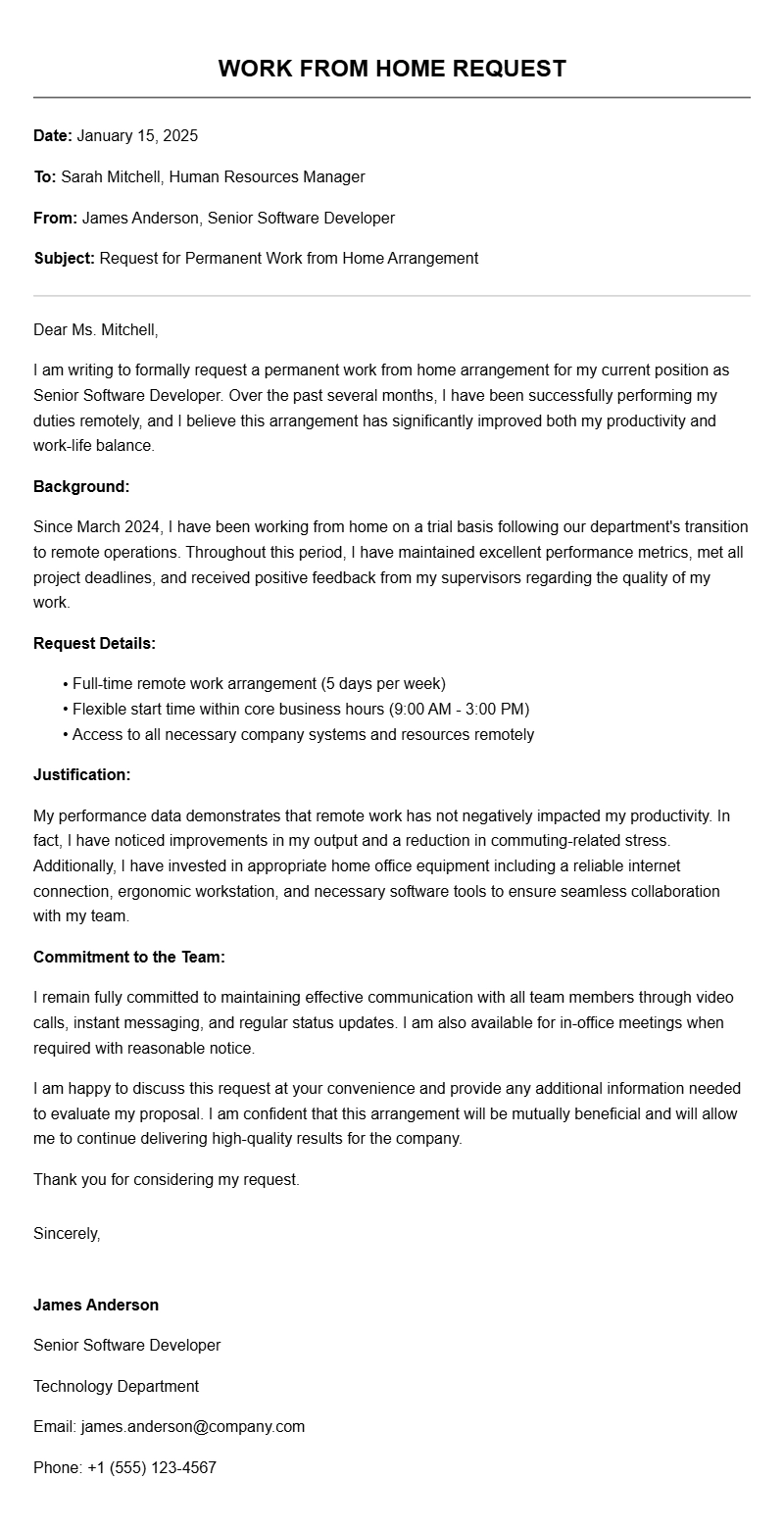
Standard Work‑From‑Home Request Letter
start with To, From, Date, Subject Then paragraphs: I am writing to formally request permission to work from home… details Include table: “Preferred Remote Work Schedule”, days of week Also mention that can be reached via email, phone Wrap up Make sure body length ~180-200 words. Let’s calculate Let’s draft each letter and count approximate words. We’ll write about 180-200 words We must keep each body to about 120-250 words We’ll generate 10 letters Potential issues: we need to keep each sample varied. Could vary the reason, style of request, tone, mention attachments, propose a trial period, ask for a meeting, include contact details table, provide schedule table, mention any equipment needs, discuss confidentiality, etc Now let’s write We’ll create for each a title that describes the scenario Let’s produce them We’ll need to avoid using any double quotes inside body. Since we will use single quotes for attributes, but any apostrophe (‘) is okay. Use “to”, “from” etc But some words may include apostrophes like “I’m”. That’s fine. Not a double quote But we must be careful not to include double quotes anywhere, like in the phrase “Work‑From‑Home” which contains hyphen not double quote. That’s fine Let’s begin We’ll also include a small table to show schedule. Use
| Day | Work Location |
|---|---|
| Monday | Home Office |
| Wednesday | Home Office |
During these days I will maintain regular communication via email, instant messaging, and scheduled video calls. I will ensure that all deliverables are submitted on time and that confidentiality of company data remains intact.
Please let me know if you require any additional information or would like to discuss this proposal in more detail at a convenient time.
Thank you for considering my request.
Word count: Let’s count. Approximately 140 words? Let’s count: To: (1) Ms. Emily Hart (3) = 4 words? Actually “Ms. Emily Hart,” = 3 words. Then “Operations Manager” = 2. So 5? Anyway approximate Let’s count precisely We’ll manually count the words later **2. Work-From-Home Request Due to Health Condition**
Work‑From‑Home Request – Health Condition
To: Mr. David Liang, Human Resources Director
From: Sofia Patel, Marketing Coordinator
Date: 27 May 2026
Subject: Request for Remote Work on Medical Grounds
I am writing to request a temporary work‑from‑home arrangement due to an ongoing medical condition that limits my ability to commute to the office. My doctor has advised me to avoid prolonged travel and to work in a more controlled environment during the next six weeks.
During the remote period I will continue to fulfil my responsibilities, attend virtual meetings, and meet deadlines. I will use a secure VPN connection and follow all company data‑security policies to protect confidential information.
If a face‑to‑face meeting is required, I am happy to arrange a suitable time and location. I have attached a letter from my physician for your reference.
Please advise on the approval process and any paperwork needed to formalise this arrangement. I appreciate your understanding and support.
**3. Work-From-Home Request Due to Commute Challenges**
Work‑From‑Home Request – Commute Challenges
To: Mrs. Linda Brooks, Department Head
From: Alex Johnson, Customer Support Specialist
Date: 28 May 2026
Subject: Request for Work‑From‑Home Flexibility
Due to recent changes in public transit schedules and the length of my daily commute, I find it increasingly difficult to maintain a consistent level of productivity during core business hours. I would like to request permission to work from home three days a week, effective 15 June 2026.
Working remotely will allow me to eliminate travel time, focus on complex case resolutions, and be more readily available for urgent client queries. I will ensure that all calls are answered promptly and that my performance metrics remain within target.
The table below summarises my proposed schedule:
| Day | Location |
|---|---|
| Tuesday | Home |
| Thursday | Home |
| Friday | Home |
I would be grateful for your consideration and am open to discussing this proposal at your convenience.
**4. Work-From-Home Request for Caregiver Responsibilities**
Work‑From‑Home Request – Caregiver Responsibilities
To: Ms. Rachel Green, Team Leader
From: Maria Santos, Business Analyst
Date: 29 May 2026
Subject: Request to Work Remotely to Manage Caregiving Duties
I am writing to ask for a flexible work‑from‑home arrangement to better manage my responsibilities as a primary caregiver for an elderly parent. With the current need to attend medical appointments and provide daily assistance, I believe remote work will enable me to maintain my professional commitments without compromising personal obligations.
I propose to work from home on Mondays and Wednesdays, using secure remote access to company systems. I will keep my calendar up to date, join all scheduled video conferences, and ensure that all deliverables are completed on time.
If the arrangement proves effective, I would appreciate the option to continue it on an ongoing basis, subject to periodic review. Please let me know if you would like to discuss this further.
Thank you for your understanding.
**5. Work-From-Home Request for Temporary Relocation**
Work‑From‑Home Request – Temporary Relocation
To: Mr. Thomas White, Director of Operations
From: Daniel Kim, Software Engineer
Date: 30 May 2026
Subject: Request to Work From Home While Relocating
I am planning to relocate to another city in early July to be closer to family. During the transition period, I would like to work remotely for approximately eight weeks so that I can manage the move without interruption to my duties. I am confident that I can continue to meet project deadlines and collaborate effectively with my team using digital tools.
My plan includes the following steps:
- Set up a secure home office with the required software and VPN access.
- Maintain regular communication through instant messaging and video calls.
- Provide weekly status reports to keep the team informed.
Please let me know if any additional documentation or approvals are needed. I appreciate your support in making this transition smooth.
**6. Work-From-Home Request – Part‑Time Remote Work**
Work‑From‑Home Request – Part‑Time Remote Work
To: Mrs. Anita Roy, HR Manager
From: Hannah Clarke, Content Writer
Date: 1 June 2026
Subject: Request for Part‑Time Work‑From‑Home Arrangement
I am writing to request a part‑time remote work schedule, allowing me to work from home on Tuesday and Thursday each week. This arrangement will help me balance my professional responsibilities with the need to attend university classes in the evenings.
I will ensure that my availability during core hours remains unchanged, that all assignments are submitted promptly, and that I am reachable via email and phone throughout the day. I will also continue to attend all mandatory meetings virtually.
Attached is a copy of my university timetable for your reference. I would welcome the opportunity to discuss any concerns you may have and to formalise the terms of this arrangement.
**7. Work-From-Home Request for School Holiday Childcare**
Work‑From‑Home Request – School Holiday Childcare
To: Mr. Jonathan Lee, Senior Manager
From: Priya Nair, Administrative Assistant
Date: 2 June 2026
Subject: Request for Remote Work During School Holidays
With the upcoming school holidays, I need to arrange childcare for my children at home. To ensure I can continue performing my duties without interruption, I would like to work from home on the days when school is closed, starting 8 July 2026.
During these periods I will maintain a schedule that aligns with the office’s core hours, use secure remote access for all work tasks, and keep my supervisor informed of my progress. I will also ensure that any urgent tasks are handled promptly and that communication channels remain open.
Please let me know if a formal application form or additional supporting documentation is required. I appreciate your flexibility and support.
**8. Work-From-Home Request Due to Severe Weather**
Work‑From‑Home Request – Severe Weather Emergency
To: Ms. Carol White, Office Manager
From: Ryan Mitchell, IT Support Specialist
Date: 3 June 2026
Subject: Urgent Request to Work From Home During Weather Emergency
Due to an incoming severe weather warning expected to affect the city on 5 June 2026, I am requesting permission to work from home on that day. This will allow me to stay safe while ensuring that critical system monitoring and support tasks are not disrupted.
I will be reachable via phone and will monitor all server alerts remotely. I will also coordinate with on‑site staff to address any issues that require immediate attention.
I understand that any such arrangement must be approved in advance and will comply with the company’s remote‑work policy. Please confirm whether this request can be accommodated as soon as possible.
**9. Work-From-Home Request to Improve Productivity**
Work‑From‑Home Request – Productivity Improvement
To: Dr. Susan Brown, Director of Research
From: Mark Thompson, Research Analyst
Date: 4 June 2026
Subject: Request for Remote Work to Enhance Productivity
I have noticed that my output and the quality of my analysis improve significantly when I work in a quiet, distraction‑free environment. I would therefore like to request a trial period of four weeks during which I will work from home on Mondays and Fridays.
During the trial I will continue to meet all project deadlines, attend required meetings via video conference, and provide regular updates to my supervisor. I will also ensure that all data handling complies with the company’s security protocols.
I would appreciate your feedback at the end of the trial and am happy to discuss any adjustments that may be necessary. Thank you for considering this opportunity to optimise my work environment.
**10. Work-From-Home Request for a Specific Project**