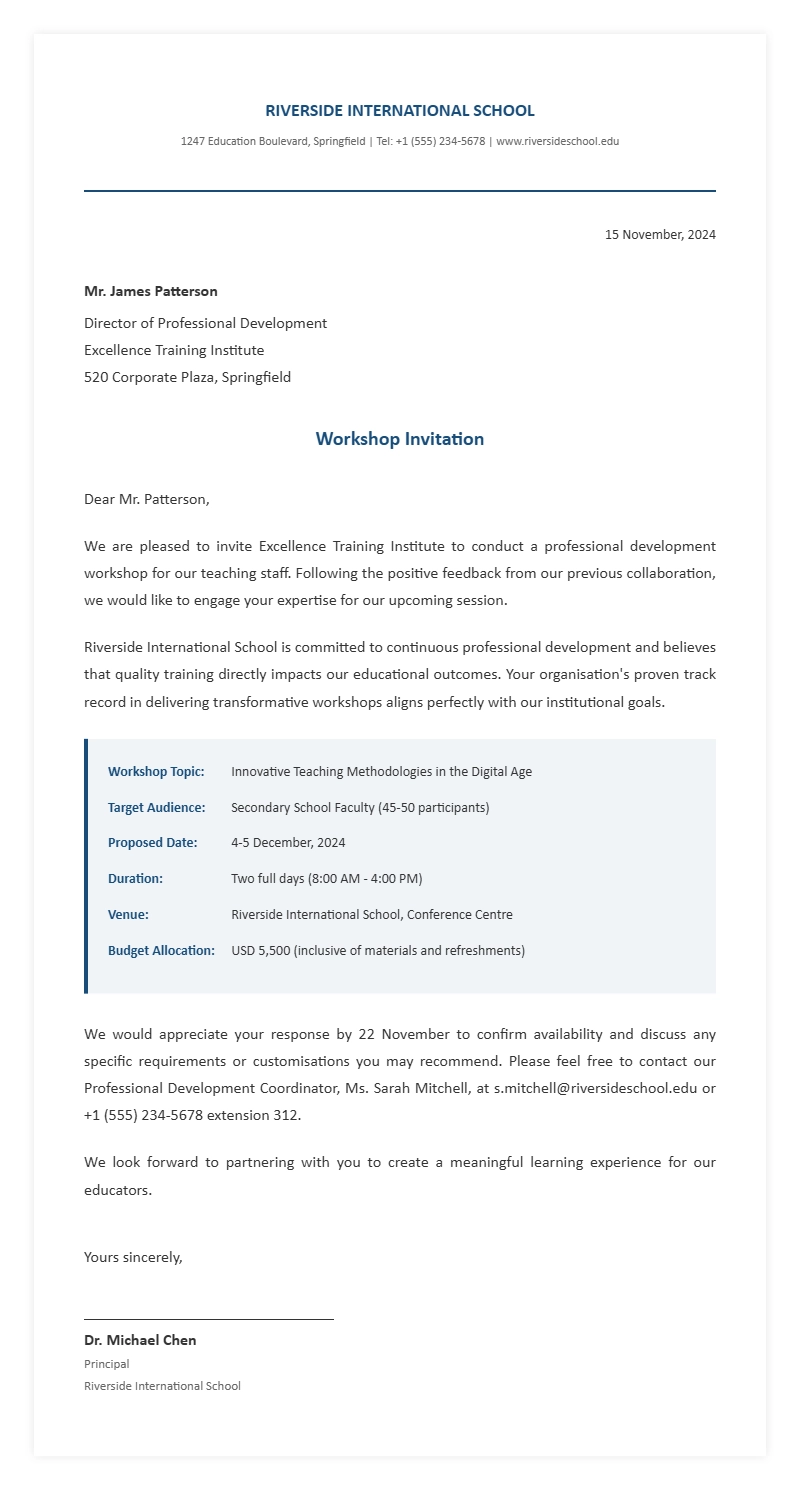
Writing a workshop invitation letter for school can feel awkward if you’re not sure what to include or how formal to be. You want it to sound professional enough to be taken seriously, but friendly enough that people actually want to attend. The good news is that once you understand the basic structure, you can adapt it to almost any workshop scenario—whether you’re inviting parents to a literacy workshop, teachers to a professional development session, or students to a special skills workshop.
This guide walks you through what these letters actually need, shows you real examples you can modify, and points out the mistakes that make invitations end up in the trash.
What Is A School Workshop Invitation Letter?
A school workshop invitation letter is a formal or semi-formal document that asks someone to attend an educational event or training session. It can come from a teacher, principal, PTA coordinator, or any school staff member organizing a workshop.
These letters serve a practical purpose: they create a record of the invitation, provide essential details, and set expectations about attendance and participation. Unlike a casual email or text, a formal letter signals that the event matters and that you’re serious about having the recipient there.
School workshop invitations typically go to parents, teachers, community members, or student groups. The tone and formality shift depending on who you’re inviting and what the workshop covers.
When Do You Need A Workshop Invitation Letter?
You’ll send an invitation letter when:
- A school is hosting a professional development or training session for staff
- Parents are invited to attend a workshop on child development, reading strategies, or technology skills
- Community members or volunteers are asked to lead a workshop or guest session
- Students need a formal invitation to a specialized workshop or skills-building event
- External organizations are invited to present at school
- Documentation is required for attendance tracking or compliance purposes
Basically, if the event needs to feel official, or if you need a paper trail, you send a letter instead of just posting it on a bulletin board or sending an email.
Key Components Of A Workshop Invitation Letter
Every effective workshop invitation includes these sections:
Sender Information
Your name, title, school name, and contact details. This goes at the top and tells the recipient who’s actually inviting them.
Date
When the letter is written. This matters for record-keeping, especially if attendance is mandatory.
Recipient Information
The name and title of the person you’re inviting. Use their correct name and role—getting this wrong signals carelessness.
Opening Statement
A clear, direct sentence explaining why you’re writing. Don’t bury the invitation in flowery language.
Workshop Details
The title, date, time, location, and duration. These are non-negotiable details. If you leave any out, people will email asking for them.
Purpose And Content Overview
What the workshop will cover and why it matters. Keep this brief but specific enough that people understand what they’re signing up for.
Logistics
Parking, what to bring, dress code, materials provided, registration requirements, or any other practical information.
RSVP Instructions
How and when they should confirm attendance. Include a deadline. Without one, people procrastinate indefinitely.
Closing
A professional sign-off with your signature (if printed) or typed name.
Step-By-Step Guide To Writing Your Letter
Step 1: Start With Your Header
Put your school’s letterhead at the top if you have one. If not, include your name, title, school name, address, phone number, and email. Keep it clean and easy to read.
Step 2: Add The Date And Recipient Info
Date the letter. Then add the recipient’s name, title, and address. If you’re sending to a group (like “All Third Grade Teachers”), you can use that instead of individual names.
Step 3: Write A Clear Opening
Use language like “I am writing to invite you to…” or “We would like to invite you to attend…” Get to the point immediately. Don’t start with background information or context.
Step 4: Include All Workshop Details
Give the exact information in a format that’s easy to scan. Many people skim letters looking for dates and times, so make those obvious.
Step 5: Explain The Purpose
Why is this workshop happening? What will participants learn or gain? This section should answer the question: “Why should I care enough to show up?”
Step 6: Cover Logistics
What do people need to know to actually attend? Where do they park? Is there a cost? Should they bring anything? Do they need to register in advance?
Step 7: Provide Clear RSVP Instructions
Tell them exactly how to respond. “Please email me at [email] by Friday, March 15th” is better than “Please let me know if you can attend.” Include your contact information again here.
Step 8: Close Professionally
Use “Sincerely,” “Best regards,” or “Thank you” followed by your full name and title. If printing, sign above your typed name.
Workshop Invitation Letter Template
Here’s a basic template you can adapt to your situation:
[Your School Letterhead]
[Date]
[Recipient Name]
[Recipient Title]
[School/Organization Name]
[Address]
Dear [Recipient Name],
I am writing to invite you to attend [Workshop Title], a professional development workshop designed for [target audience].
Workshop Details:
Date: [Day, Month Date, Year]
Time: [Start time] to [End time]
Location: [Building name, room number, or address]
Duration: [Number of hours]
Workshop Overview:
[2-3 sentences describing what the workshop covers and why it’s valuable. Focus on specific outcomes or skills participants will gain.]
This workshop will be led by [facilitator name/organization], who brings [relevant expertise or background]. Participants will have the opportunity to [specific activities or takeaways].
Logistics:
[Include any of the following that apply:]
– Parking is available at [location]
– Please bring [materials, documents, etc.]
– Light refreshments will be provided
– Attendance is mandatory/optional
– No registration required / Please register at [link or contact]
To confirm your attendance, please email me at [email address] by [RSVP date]. If you have any questions or need accommodations, please let me know.
I hope you will join us for this valuable professional development opportunity.
Sincerely,
[Your Signature – if printed]
[Your Full Name]
[Your Title]
[Phone Number]
[Email Address]
Real-World Examples
Example 1: Parent Workshop Invitation
Lincoln Elementary School
123 Oak Street | Springfield, IL 62701
(217) 555-0123 | office@lincolnelem.edu
March 1, 2024
Dear Parents and Guardians,
You are invited to attend Building Reading Confidence at Home, a workshop for families interested in supporting their child’s literacy development.
Workshop Details:
Date: Thursday, March 21, 2024
Time: 6:00 PM to 7:30 PM
Location: Lincoln Elementary School, Multi-Purpose Room
Duration: 90 minutes
During this workshop, our Reading Specialist, Ms. Jennifer Park, will share practical strategies you can use at home to support reading skills. You’ll learn how to select appropriate books, create a reading routine, and respond to common reading challenges. This workshop is designed for parents of children in grades K-3.
What to Expect:
– Interactive presentation with real-world examples
– Handout of recommended reading strategies and book lists
– Time for questions and small group discussion
– Light refreshments provided
Parking is available in the front lot. No registration is required, but space is limited to 40 participants. If you plan to attend, please email me at jpark@lincolnelem.edu by March 18 so we can plan accordingly.
If you have questions or need childcare information, please contact me at (217) 555-0123.
We look forward to seeing you there.
Sincerely,
Jennifer Park
Reading Specialist
Lincoln Elementary School
Example 2: Teacher Professional Development Workshop
Springfield Public Schools
District Office | 456 Main Street | Springfield, IL 62701
February 15, 2024
Dear Elementary Teachers,
You are invited to attend Trauma-Informed Classroom Practices, a full-day professional development workshop for all K-5 teachers.
Workshop Details:
Date: Wednesday, March 6, 2024
Time: 8:30 AM to 3:30 PM
Location: Springfield High School, Auditorium and Breakout Rooms
Duration: Full day (6 hours with lunch break)
This workshop is mandatory for all elementary staff. Dr. Marcus Williams, a nationally recognized expert in trauma-informed education, will lead the session. Participants will explore how trauma affects learning, learn practical classroom strategies, and develop action plans for their own classrooms.
What’s Included:
– Continental breakfast (7:30 AM – 8:30 AM)
– Lunch provided
– Comprehensive workshop materials and resource guide
– Continuing education credits (6 hours)
– Follow-up coaching sessions available
Attendance is required. Teachers should plan to attend with their grade-level team when possible. Substitutes will be provided for any classroom coverage needed.
Please confirm your attendance by February 28 by completing this form: [link]. If you have accessibility needs or conflicts, email Dr. Sarah Chen at schen@sps.edu immediately.
Parking is available in the south lot. Bring a notebook and pen for note-taking.
Thank you for your commitment to student success.
Sincerely,
Dr. Sarah Chen
Director of Curriculum and Instruction
Springfield Public Schools
(217) 555-0456
schen@sps.edu
Example 3: Student Workshop Invitation
Central Middle School
789 School Lane | Springfield, IL 62701
April 2, 2024
Dear 7th and 8th Grade Students,
You are invited to attend Digital Citizenship and Online Safety, a workshop designed to help you navigate the internet safely and responsibly.
Workshop Details:
Date: Tuesday, April 16, 2024
Time: 2:00 PM to 3:15 PM
Location: Central Middle School, Media Center
Duration: 75 minutes
In this interactive workshop, you’ll learn about online privacy, recognizing scams and misinformation, managing your digital footprint, and what to do if you encounter cyberbullying. The workshop is led by Officer James Rodriguez from the Springfield Police Department’s Youth Outreach Team.
What to Bring:
– A notebook and pen (or digital device if you prefer taking notes)
– An open mind and willingness to participate in discussions
This workshop is optional but highly recommended. Space is limited to 30 students. If you want to attend, sign up with your homeroom teacher or visit the main office by April 12.
Questions? Stop by the main office or email Mr. Torres at jtorres@cms.edu.
See you there!
Sincerely,
James Torres
Assistant Principal
Central Middle School
Common Mistakes To Avoid
Missing Or Vague Details
Don’t assume people know where or when the workshop is happening. Include the exact date, time, building name, and room number. “Next Tuesday afternoon in the school” is not enough information.
Unclear RSVP Instructions
If you don’t tell people exactly how to respond and when, many won’t. “Please let me know if you can make it” is weaker than “Email me at [email] by Friday, March 22.”
Too Much Explanation, Not Enough Clarity
People skim letters. If your workshop details are buried in paragraphs of context, readers will miss them. Use formatting—bullet points, bold text, or a separate details section—to make key information stand out.
Formal Tone When It Doesn’t Fit
If you’re inviting parents to a casual workshop, overly stiff language (“It is respectfully requested that you consider your availability”) feels out of place. Match your tone to your audience.
Forgetting Contact Information
Include your phone number and email. Some people will have questions, and you want them to reach you easily.
No Clear Purpose Statement
Don’t assume people understand why the workshop matters. Explain what they’ll learn, why it’s valuable, or what problems it addresses.
Ignoring Accessibility And Logistics
Mention parking, whether materials will be provided, if there’s a cost, and what to bring. These practical details affect whether people can actually attend.
Tips For Customizing Your Letter
Adjust Tone Based On Your Audience
A letter to teachers can be more direct and professional. A letter to parents might be slightly warmer. A letter to students should be encouraging without being condescending.
Lead With Benefits, Not Requirements
Instead of “You are required to attend,” try “You’re invited to a workshop that will help you…” People respond better to invitation language, even when attendance is mandatory.
Use Specific Names When Possible
If you’re inviting specific people, use their names. If it’s a group, you can address it generally (“Dear Parents and Guardians”), but always be specific about who the workshop is for.
Include A Personal Touch
A brief line explaining why you personally think this workshop matters can make the invitation feel genuine. “I’ve seen how much this training helps teachers connect with students” feels more real than generic language.
Make It Easy To Say Yes
Provide a link to an online form if possible. Some people will fill out a form when they won’t send an email. The lower the barrier to responding, the higher your attendance rate.
Consider Sending A Reminder
Send a follow-up email or letter a week before the workshop. Many people receive the first invitation and forget about it. A reminder significantly boosts attendance.
Tailor Examples To Your Context
The templates above are starting points. If your workshop is about something specific—financial literacy, mental health, coding, or art—adjust the description to reflect that. Be concrete about what participants will actually do or learn.
Related Letter Types You Might Need
If you’re organizing school events, you might also need to write other types of correspondence. For instance, if you’re inviting people to discuss school issues, a parent-to-school letter sample can help you understand formal communication patterns. If your workshop involves thanking facilitators or guest speakers, check out teacher appreciation letter templates for ideas on expressing gratitude professionally.
Sometimes workshops involve vendors or service providers. If you need to dispute an invoice or resolve billing issues related to workshop costs, invoice dispute letter samples can guide that conversation. For reimbursements or other financial matters, credit request letter templates provide structure. And if a workshop covers topics like insurance literacy or you need to address insurance-related matters, insurance claim letter templates show how to handle those communications professionally.
Final Thoughts
A good workshop invitation letter does one job: it clearly invites someone to an event and gives them everything they need to show up. You don’t need fancy language or complicated structure. You need accuracy, clarity, and all the practical details in an easy-to-find format.
Start with the template that matches your situation, fill in your specific details, read it once to make sure nothing’s missing, and send it out. If you include the date, time, location, purpose, and RSVP instructions, you’ve done the job right. The rest is just making sure your tone fits your audience.
Standard Format & Layout Reference