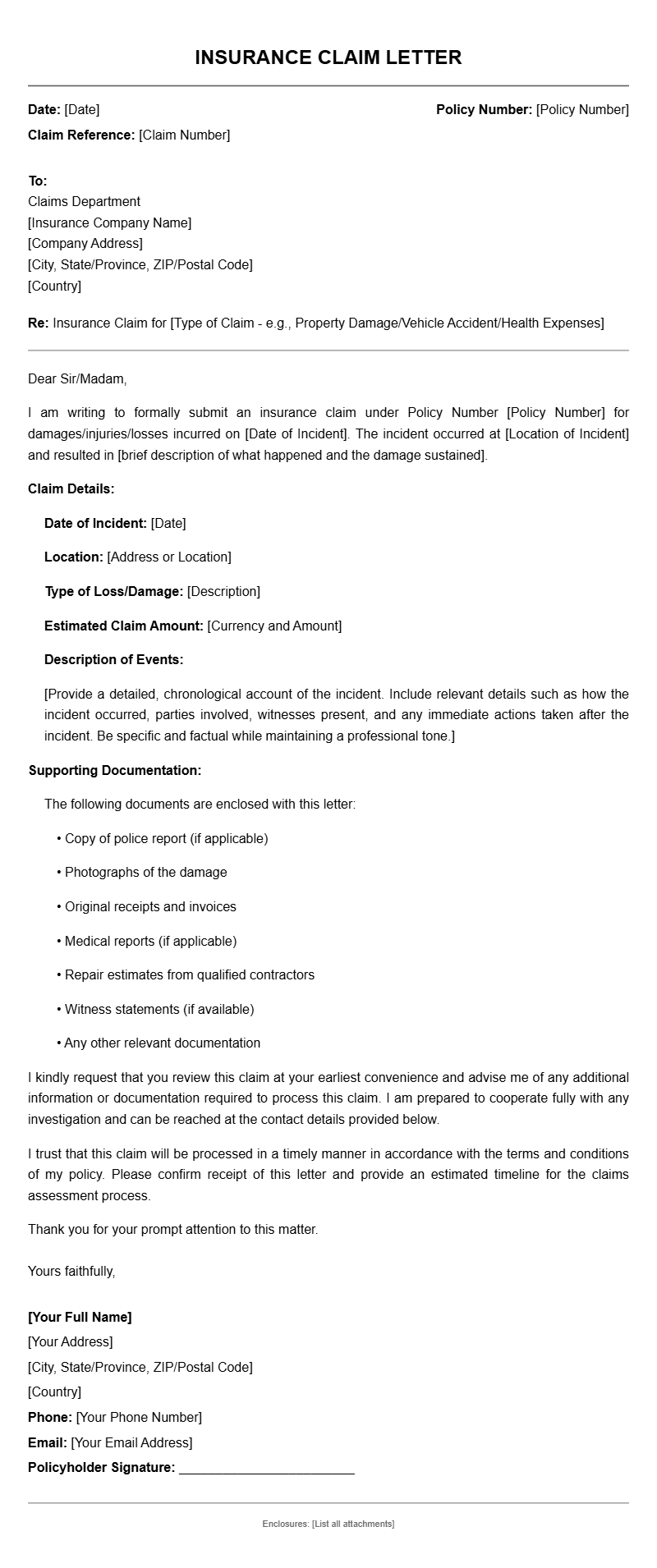
After spending years helping policyholders navigate the claims process, I’ve seen one thing trip people up more than anything else: they know their claim is valid, but they can’t figure out how to explain it clearly on paper. A poorly written insurance claim letter can mean the difference between a smooth payout and weeks of back-and-forth frustration. That’s exactly why having a solid template and understanding the key elements matters so much.
What Is an Insurance Claim Letter?
An insurance claim letter is a formal written request sent to your insurance company to initiate or support a claim for payment. It explains what happened, what was damaged or lost, and what you’re asking the insurer to cover. Think of it as your documented case for why the insurance company should pay—and the first impression that sets the tone for all future communications.
Whether you’re dealing with property damage, a medical claim, or auto insurance, the letter serves as the paper trail that keeps everyone accountable. Insurance adjusters process dozens of claims daily, and a letter that’s easy to scan and understand gets moved to the top of the pile.
When You Need This Letter
You’ll typically need to write an insurance claim letter in these situations:
- Filing a claim after water damage, fire, or storm-related property loss
- Requesting reimbursement for medical expenses covered under your policy
- Reporting and claiming for a stolen vehicle or items from your car
- Seeking compensation for damage caused by a contractor or third party
- Appealing a claim that was initially denied
Some situations don’t require a formal letter—minor claims might be handled over the phone or through an online portal. But anytime there’s significant money involved, anytime the claim might be contested, or anytime you’re appealing a denial, putting your case in writing becomes essential.
Key Components of an Effective Claim Letter
After reviewing hundreds of these letters (from both successful and denied claims), I can tell you which elements actually matter. Here’s what yours needs to include:
1. Your Policy Information
Start with the basics: your policy number, the type of insurance, and the date your policy was active when the incident occurred. This isn’t glamorous, but it lets the adjuster pull your file immediately without chasing you for information.
2. A Clear Subject Line
State exactly what the letter is about in plain terms. Something like “Claim Request – Water Damage at [Your Address] – Policy #[Number]” tells the reader everything they need to know before they even start reading.
3. Chronological Description of the Incident
Walk through what happened, step by step, starting from the moment of the incident. Include dates, times, and locations where relevant. Stick to facts—describe what you observed, not what you assume happened.
4. List of Damaged or Lost Items
Create a detailed inventory with as much specificity as possible. For each item, include:
- Description (brand, model, color, size)
- Approximate value or purchase price
- Age or condition before damage
- Receipt or proof of ownership if available
If you don’t have receipts, don’t panic—just be honest about your estimates and explain how you arrived at those numbers.
5. Documentation You’re Including
List every document you’re attaching: photos, receipts, police reports, contractor estimates, medical records, or repair quotes. This checklist approach ensures nothing gets missed and shows you’re organized.
6. Specific Request
End with exactly what you’re asking for. Don’t leave it vague—state the dollar amount if you have an estimate, or specify that you’re requesting a claims adjuster visit to assess the damage.
Step-by-Step: How to Write Your Claim Letter
Let me walk you through this process the way I’d help a friend tackle it. It’s simpler than you might expect.
Step 1: Gather Your Information First
Before you write a single word, collect everything related to the incident. Policy documents, photos of damage, receipts for damaged items, any correspondence with contractors or service providers. Having these in front of you means you’re not stopping to dig through files mid-draft.
Step 2: Open With the Essentials
Your first paragraph or two should answer: who you are, what policy covers you, and what happened. Don’t bury this information—adjuster’s eyes go here first. Include the date of loss, the type of incident, and your claim number if you’re following up on an existing claim.
Step 3: Tell the Story Clearly
Write in short paragraphs, each covering one point or time period. If a pipe burst on March 15th and flooded your basement, say that first, then describe the damage you discovered, then mention when you called the water mitigation company. Clear sequence helps the reader follow your logic.
Step 4: Attach a Clear Inventory
For the items affected, create a simple table or list. Here’s what that looks like in practice:
Damaged Items Inventory:
- Living Room Couch (gray fabric, 3-seater) – purchased 2019 – estimated value: $850
- Sony 55″ TV (model XR-55A80J) – purchased 2021 – estimated value: $1,200
- Oak Coffee Table – purchased 2018 – estimated value: $300
- Carpet (room-size, beige) – installed 2017 – estimated value: $600
You don’t need to be perfect with estimates—the insurance company will verify values—but being specific shows you took this seriously.
Step 5: List Your Attachments
Create a simple bulleted list of everything you’re sending with the letter. This might include photos, receipts, police reports, or contractor estimates. Numbering them gives the adjuster an easy reference.
Step 6: Close With a Direct Ask
End your letter by stating exactly what you want to happen next. “I’m requesting an adjuster visit to assess the water damage” or “I’m requesting reimbursement of $2,950 for flood-damaged belongings per the attached inventory.”
Step 7: Proofread Before Sending
Read it out loud. If you stumble over a sentence, simplify it. Check that all dates match across documents. Make sure your contact information is correct. A letter with errors suggests sloppiness—don’t give the adjuster any reason to question your attention to detail.
Sample Insurance Claim Letter Templates
Here are two templates you can adapt for your situation. The first covers property damage; the second is specifically for appealing a denied claim.
Property Damage Claim Letter Template
Your Name
Your Address
City, State ZIP
Phone Number
Email Address
Date
Insurance Company Name
Claims Department Address
City, State ZIP
Re: formal complaint letter for Policy # [Your Policy Number]
Subject Line: Claim Request – [Type of Damage] at [Your Address] – Policy #[Number]
Dear Claims Department,
I am writing to formally request coverage under my [policy type, e.g., homeowners insurance] policy (# [Policy Number]) for damages resulting from [brief description of incident, e.g., a pipe burst that occurred on March 15, 2024].
On [date of incident], [describe what happened in one to two sentences]. The incident caused damage to [list affected areas or items].
I have attached the following documentation to support this claim:
- Photographs of the damage ([number] images)
- Itemized inventory of damaged belongings
- Contractor estimate for repairs ([contractor name], dated [date])
- Police report (if applicable, report # [number])
According to my attached inventory, the total estimated value of damaged property is $[amount]. I am requesting an adjuster visit to assess the damage and begin the claims process.
Please contact me at [phone number] or [email address] to schedule an inspection or if you require additional information. I am available [your availability].
Sincerely,
[Your Signature]
[Your Printed Name]
Appeal Letter for Denied Claim Template
Your Name
Your Address
City, State ZIP
Phone Number
Email Address
Date
Insurance Company Name
Appeals Department Address
City, State ZIP
Re: Appeal of Claim Denial – Policy # [Number] – Claim # [Number]
Dear Appeals Department,
I am writing to formally appeal the denial of my claim (# [Claim Number]), which was received on [date of denial letter]. I believe this denial was issued in error and respectfully request a review of my case.
The claim was denied for the following reason, as stated in your letter dated [date]: [quote or paraphrase the reason given for denial].
After reviewing my policy and the circumstances of this claim, I would like to provide the following additional information:
[Explain why you believe the denial is incorrect. This might include:
- Clarification of policy language you believe applies
- Additional documentation that supports your claim
- Evidence that the denial was based on incomplete information
- Comparison to similar successful claims under your policy]
I have attached the following documents to support this appeal:
- [List relevant new or additional documents]
- [Reference any policy provisions that support your position]
I request that this appeal be reviewed by a supervisor or a different claims examiner who was not involved in the original decision. I would appreciate a response within [timeframe allowed by your state, often 30-60 days].
Please contact me at [phone] or [email] to discuss this matter further.
Sincerely,
[Your Signature]
[Your Printed Name]
Common Mistakes to Avoid
I’ve watched good claims get botched by easily avoidable errors. Here’s what to watch out for:
Sending It Without Documentation Attached
A claim letter without attachments is just a story. Insurance companies operate on proof. If you say you had a $3,000 laptop destroyed, show them a receipt or a photo of it in your home. One photo from your backup drives beats a long explanation every time.
Being Vague About Dates
Insurance policies have time limits. Your claim letter needs exact dates—the date of incident, the date you discovered it if different, and the date you reported it. “Sometime last month” doesn’t give the adjuster anything to work with.
Mixing Emotional Language With Factual Claims
It’s frustrating to deal with property damage or a denied claim, but your letter isn’t the place for venting. Keep the tone neutral and stick to facts. The adjuster reading your letter isn’t your enemy—yet. Don’t give them a reason to read your message as hostile.
Asking for Too Little or Not Specifying a Request
Banks don’t cash blank checks, and insurance companies don’t process requests that aren’t clear. If you want reimbursement, name an amount. If you want an inspection, ask for one. Vague requests get vague responses.
Forgetting to Keep Copies
Always save a copy of everything you send, including date stamps on emails or courier receipts. This becomes critical if you need to prove when you submitted documentation or if your letter goes missing in their system.
Overlooking the Appeals Process
If your claim gets denied, don’t assume that’s the end. Most insurance companies have a formal appeals process, and many states require insurers to notify you of your right to appeal. Missing that window can cost you your chance at reversal.
Tips for Customize Your Letter
These templates are starting points. Here’s how to make them work for your specific situation:
Match the Tone to Your Relationship With the Insurer
If you’ve been fighting with your insurer for months, your letter might need to be firmer. If this is your first claim with them, a friendlier, more cooperative tone serves you better. Read the room—as much as an email can have a “room.”
Adjust Detail Level Based on Claim Size
A $500 claim doesn’t need a three-page letter with five attachments. But a $50,000 commercial property claim needs extensive documentation, professional estimates, and a very detailed timeline. Scale your effort to match the stakes.
Include Photos Referenced by Name
Don’t just say “photos attached.” Label each attachment with a descriptive name: “Photo 1 – Living Room Water Damage North Wall.jpg” or “Photo 2 – Destroyed HVAC Unit.jpg.” This makes it easy for the adjuster to match evidence to your claims.
Use Certified Mail for Important Submissions
If you’re sending a claim denial rebuttal or an appeal, consider using certified mail with return receipt. This gives you proof of delivery and establishes a paper trail that’s harder to dispute later.
Reference Specific Policy Language When Relevant
If your policy explicitly covers something your insurer is questioning, say so. Quote the relevant section: “According to Section 4.2(b) of my policy, water damage resulting from sudden pipe failure is covered up to $50,000.” This shows you’ve done your homework.
Final Thoughts on Making Your Claim Letter Work
An insurance claim letter isn’t a creative writing exercise—it’s a communication tool. The best ones are clear, organized, and complete. They give the adjuster exactly what they need to process your claim without chasing you for basic information. And that professionalism often pays off in faster turnaround times and fewer requests for additional documentation.
If you’re dealing with a more complex situation like a denied claim or a dispute over coverage limits, consider having a consumer advocate or formal complaint specialist review your letter before sending. Sometimes a fresh set of eyes catches phrasing that could be interpreted differently than you intended. For straightforward property damage claims, though, the templates above give you everything you need to get started.
Editable Document Format Examples