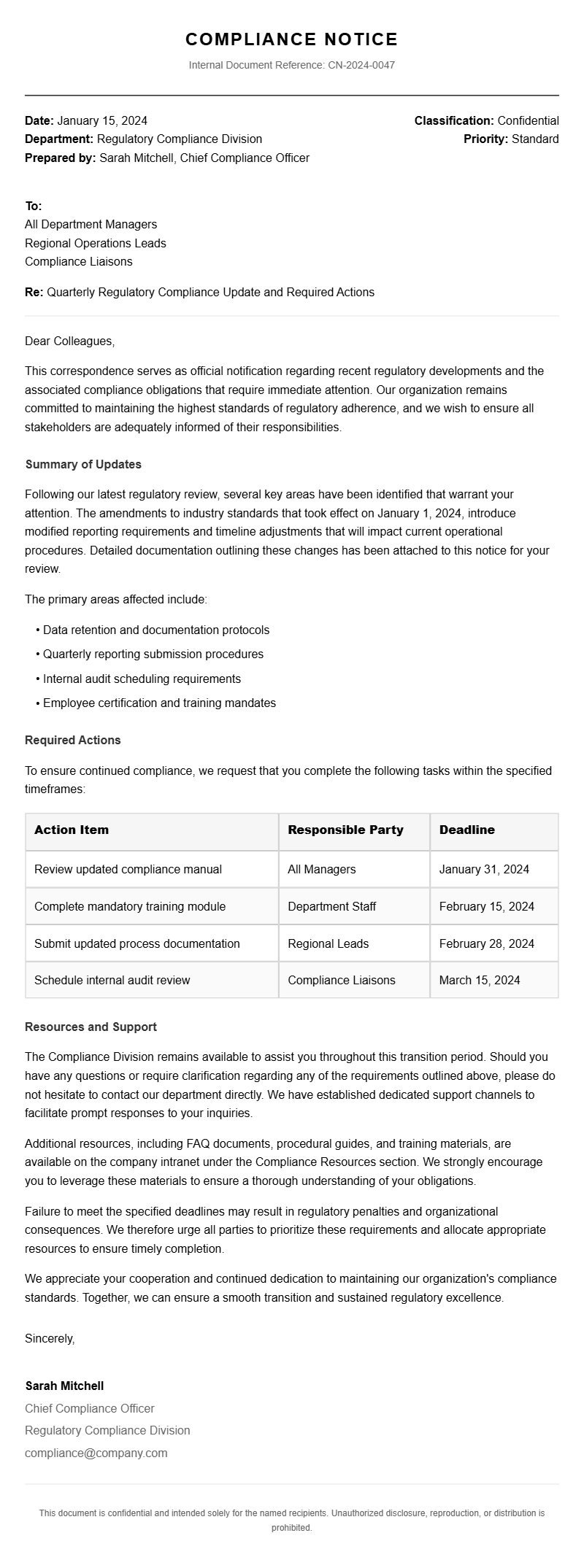
When a regulator, client, or partner expects you to take action on a compliance issue, the first thing you reach for is a solid compliance notice letter. Most people search for a template because they need to move fast, not because they want to read a textbook on legal drafting. This guide gives you a clear, usable roadmap: what the letter is, when to use it, which parts matter, and how to customize a template that actually fits your situation.
What Is a Compliance Notice Letter?
A compliance notice letter is a formal written communication that informs a recipient (often a vendor, employee, or partner) about a specific regulatory or contractual requirement that isn’t being met. It spells out the problem, references the relevant rule or policy, and requests corrective steps by a set deadline. Think of it as a friendly but firm nudge—enough to get attention, structured enough to protect you if the issue escalates.
When Do You Need a Compliance Notice Letter?
- A supplier has missed a safety certification deadline that your industry requires.
- An employee has repeatedly failed to complete mandatory training.
- A contractor’s work doesn’t meet environmental standards outlined in your contract.
- A business partner hasn’t provided required insurance documentation.
If you find yourself in any of these scenarios, a compliance notice letter bridges the gap between “something’s wrong” and “here’s what we need to fix it.” For other business correspondence needs, you might also look at our annual business report letter templates or company to vendor letter templates for broader coverage.
Key Sections Every Compliance Notice Letter Should Include
Most effective compliance notices share a common skeleton. Skipping any of these can leave the recipient confused or give them a loophole to ignore the request.
- Header Information – Your company name, address, and contact details; the date the letter is issued.
- Recipient Details – Name, title, company, and address of the party you’re contacting.
- Subject Line – A concise statement that mentions the compliance issue and the specific regulation or clause being referenced.
- Statement of the Issue – A clear, factual description of the non‑compliance, including dates, documents, or observations that support your claim.
- Relevant Regulation or Contract Clause – Cite the exact rule, law, or contract section that applies.
- Required Corrective Action – Precisely what the recipient must do, by when, and in what form (e.g., submit proof, perform a task).
- Deadline and Consequences – The date by which the corrective action must be completed and what happens if it isn’t (e.g., suspension of contract, reporting to regulator).
- Signature Block – Authorized signatory’s name, title, and contact information.
Step‑by‑Step Guide to Writing Your Letter
- Gather the facts. Collect dates, emails, reports, or any documentation that shows the non‑compliance. You’ll need concrete evidence for the “Statement of the Issue.”
- Identify the applicable rule. Locate the exact regulation, industry standard, or contract clause that is being violated. Copy the text verbatim if it’s short; otherwise, reference the section number.
- Draft a polite but firm opening. Example: “We have become aware that the safety inspection for your facility, due on March 1, has not been completed as required under OSHA Regulation 29 CFR 1910.134.”
- Describe the gap. Use plain language. “The inspection report we received on March 5 does not include the required airflow measurements.”
- State the required action. Be explicit: “Please arrange for a qualified inspector to perform the airflow test and submit the completed report no later than April 10.”
- Set a deadline and outline consequences. “If we do not receive the report by April 10, we may suspend the service contract and notify the relevant regulatory agency.”
- Proofread and format. Keep the letter to one page if possible. Use a clean font, standard margins, and a consistent layout.
Real‑World Example and Editable Template Snippet
Below is a condensed version you can adapt. Replace the bracketed placeholders with your specific details.
[Your Company Name]
[Street Address] • [City, State ZIP] • [Phone] • [Email]
Date: [Month Day, Year]
To: [Recipient Name] – [Title] – [Company Name]
[Recipient Address]
Subject: Compliance Notice – Failure to Provide Required Insurance Certificate (Policy No. [XXXXX])
Dear [Recipient Name],
We have reviewed the insurance documentation submitted for the current contract period and discovered that the certificate of liability coverage you provided on [date] does not meet the minimum coverage limits outlined in Section 4.2 of our agreement. Specifically, the policy amount is $500,000, whereas the contract requires at least $1,000,000 in aggregate coverage.
Please obtain an updated certificate from your insurer that reflects the required coverage limit and forward it to us no later than [14 days from today]. Failure to provide compliant documentation by this date may result in suspension of payments under the contract and may trigger the termination clause in Section 7.1.
If you have any questions or need clarification, feel free to contact me directly at [phone] or [email].
Sincerely,
[Your Name] – [Your Title]
[Your Company Name]
You can paste the snippet into a word processor, swap the placeholders, and send it out. For other types of formal notices, check our insurance company to client letter templates and custody agreement letter templates for additional patterns.
Common Mistakes to Avoid
- Vague language. Phrases like “you are not following the rules” without specifying the rule make the notice easy to dismiss.
- Missing deadlines. Always include a clear, realistic date for corrective action. Without it, the recipient can claim they didn’t know when compliance was expected.
- Overly aggressive tone. Threatening immediate termination or legal action can backfire, especially if the issue is minor and easily fixed.
- Neglecting to keep a copy. Store the sent letter and any responses in a dedicated compliance folder; you’ll need this trail if the matter escalates.
- Incorrect citations. If the regulation or contract clause you quote is wrong, the recipient can argue the notice is invalid.
Tips for Customizing Your Template
- Match the industry language. If you’re in healthcare, refer to HIPAA; in construction, cite OSHA standards. Using the correct terminology adds credibility.
- Add a brief goodwill statement. A short line like “We value our partnership and hope to resolve this quickly” can keep the relationship amicable.
- Use clear, concise bullet points for the required actions; this reduces the chance of misunderstanding.
- Include a reference number (e.g., “Ref: COMP-2026-041”) to make tracking easier for both parties.
- Proofread for jargon. If a term isn’t familiar to the recipient, replace it with plain language or add a brief explanation.
Getting a compliance notice right the first time saves you from back‑and‑forth, potential fines, or contract termination. Keep the template simple, factual, and action‑oriented, and you’ll have a reliable tool that works across different regulatory contexts.
Common Document Templates & Previews