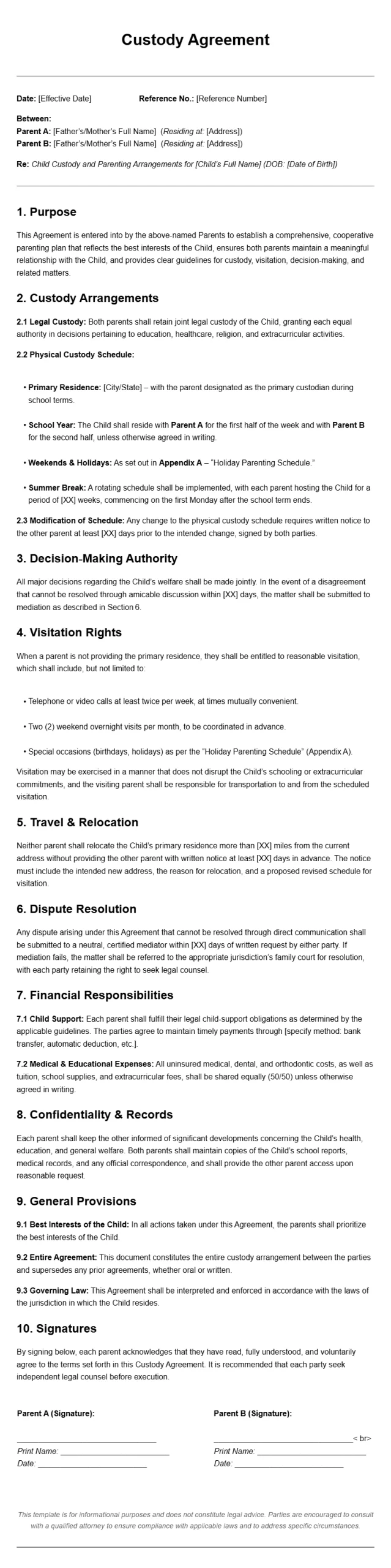
Writing a custody agreement letter can feel overwhelming, especially when you’re dealing with the emotional weight of co-parenting decisions. Whether you’re drafting your first agreement or updating an existing one, having a solid template to work from makes the process much more manageable. This guide walks you through everything you need to create a practical, enforceable custody agreement letter that works for your specific situation.
What Is a Custody Agreement Letter?
A custody agreement letter is a written document that outlines how parents will share responsibility for their children after separation or divorce. Unlike a formal custody order issued by a court, this letter serves as a foundation for negotiation and can eventually become part of your official parenting plan. Think of it as a roadmap that both parents create together, detailing who makes decisions, where children live, and how visits will work.
Many people start with freelancer agreement letter samples when they need templates for any written arrangement, but custody agreements have their own specific requirements that generic templates won’t address. The key difference is that custody letters must account for children’s needs, scheduling logistics, and future flexibility in ways that professional contracts don’t.
When Do You Need a Custody Agreement Letter?
You’ll typically need this document when you’re going through a divorce or separation and need to establish formal parenting arrangements. Courts usually require some form of written agreement before they’ll approve custody arrangements. Beyond court requirements, having everything documented protects both parents if disagreements arise later.
Common situations include:
- Initial divorce proceedings where children are involved
- Unmarried parents establishing paternity and parenting plans
- Modifying an existing custody order due to life changes
- Relocation requests where one parent wants to move
- Grandparent or third-party custody arrangements
Key Components of a Custody Agreement Letter
A solid custody agreement covers several essential areas. Missing any of these sections can lead to confusion or disputes down the road.
Custody Classification
Your letter should clearly state whether you’re seeking joint custody or sole custody, and break this down further into legal custody (decision-making authority) and physical custody (where children actually live). Many parents assume custody is all-or-nothing, but the reality is much more flexible. You might have joint legal custody while one parent has primary physical custody, or vice versa.
Living Arrangements and Scheduling
This section details the actual day-to-day schedule. Include regular weekly arrangements, holiday schedules, school break allocations, and how summer months work. Be specific about which parent has children on which days and times. Vague scheduling language like “reasonable visitation” causes problems later.
Decision-Making Responsibilities
Outline who handles major decisions about education, healthcare, religious upbringing, and extracurricular activities. In joint arrangements, specify whether decisions require mutual agreement or if each parent has authority in certain areas.
Communication Protocols
Modern co-parenting often involves regular communication. Your agreement should address how parents will share information about children’s school performance, medical appointments, and daily activities. This might include preferred methods like email, texting, or co-parenting apps.
Transportation and Logistics
Specify who transports children for exchanges, who pays for transportation costs, and where transfers happen. Many conflicts arise from unspoken expectations about pickup and drop-off, so spell it out clearly.
Step-by-Step Guide to Writing Your Custody Agreement Letter
Follow these steps to create a comprehensive agreement that holds up over time.
Step 1: Gather Your Information
Before writing anything, collect children’s birth certificates, existing court orders, school enrollment information, and schedules from both parents. Understanding your actual logistics helps you write realistic expectations rather than assumptions.
Step 2: List Priorities for Each Parent
Both parents should write down what matters most to them. One parent might prioritize stability in schooling while another needs flexibility for work travel. Identifying priorities early prevents conflicts during negotiation.
Step 3: Draft the Basic Schedule
Start with a simple weekly calendar showing where children are each day. Build from there to include alternating weekends, holiday rotations, and vacation time. Many parents find it helpful to use a shared calendar app to visualize arrangements before committing them to writing.
Step 4: Address Decision-Making Areas
Work through each major decision area separately. For education, will children attend public school in one district, or will you split based on residence? For healthcare, who handles routine appointments and how are emergency decisions made? These specifics prevent future arguments.
Step 5: Add Conflict Resolution Processes
Include how you’ll handle disagreements before they escalate. Many agreements include mediation requirements or specify that parents will attempt direct communication before involving attorneys. This saves significant time and money if issues arise.
Step 6: Review and Revise
Read through your draft pretending you’re the other parent. Would this schedule work for someone with your job? Your family obligations? Your parenting style? Revisions at this stage prevent problems after the agreement is finalized.
Custody Agreement Letter Template
Use this template as a starting point and customize it for your situation. Bracketed sections indicate areas requiring your specific information.
Basic Template Structure:
This custody agreement is entered into by [Parent Name] (“Mother”) and [Parent Name] (“Father”) regarding their children: [Children’s Names and Birth Dates].
Legal Custody: Both parents shall share joint legal custody of the children, meaning both parents participate in major decisions regarding education, healthcare, and welfare.
Physical Custody Schedule: Children shall reside primarily with [Primary Parent] during the school year. The non-custodial parent shall have parenting time every other weekend from Friday at 6 PM through Sunday at 6 PM, plus one midweek dinner visit of [specific time/days].
Holiday Schedule: Holidays shall rotate annually between parents. In even-numbered years, Mother shall have children for [specific holidays]. In odd-numbered years, Father shall have children for those holidays. Parents shall alternate major holidays including [list specific holidays].
Vacation Time: Each parent may arrange up to [number] weeks of vacation time with children annually, with [advance notice requirement] written notice to the other parent.
Decision-Making: Major decisions require mutual agreement. Routine decisions within each parent’s parenting time may be made unilaterally. Examples include bedtime schedules, meal choices, and daily activities.
Communication: Parents shall maintain regular communication regarding children’s activities, school progress, and health through [preferred method]. Each parent shall have reasonable telephone or video contact with children during the other parent’s parenting time.
Modifications: This agreement may be modified by written agreement of both parents, subject to court approval if required.
Similar templates are available for other family communication needs, including donation request letter templates when organizing school or community support initiatives.
Common Mistakes to Avoid
These errors cause problems in custody agreements repeatedly. Steer clear of them from the start.
- Vague scheduling language: Phrases like “reasonable visitation” or “frequent contact” mean different things to different people. Be specific about days, times, and locations.
- Ignoring logistics: Not specifying exchange locations, transportation responsibilities, or who pays for what creates constant friction.
- One-size-fits-all approaches: What works for a toddler doesn’t work for a teenager. Your agreement should grow with your children.
- Forgetting to address relocation: If either parent might move, address this explicitly before it becomes an issue.
- Not including dispute resolution: Without a process for handling disagreements, minor issues escalate into major conflicts.
- Focusing only on the present: Your agreement needs flexibility for school changes, activities, and developmental stages.
Tips for Customizing Your Template
Every family situation differs, so your agreement should reflect your specific circumstances.
Consider children’s ages and needs: Infants and young children have different scheduling needs than school-age kids or teenagers. A teenager should have input into their schedule, while younger children need more structured arrangements.
Account for work schedules: If one parent travels frequently for work, build in flexibility that accommodates this reality. Rigid schedules break down when work demands change.
Include extended family: Some agreements address grandparent visits or maintain connections with extended family during holiday times. This matters more in some families than others.
Plan for education transitions: What happens when children start middle school, high school, or need special services? Address how decisions about education will be made.
Build in review periods: Consider requiring annual reviews of the agreement to make adjustments as children grow and circumstances change. This prevents the need for constant formal modifications.
For other situations requiring formal documentation, you might find misconduct warning letter samples helpful if you’re dealing with workplace documentation needs.
Making Your Agreement Work Long-Term
A written agreement only works if both parents commit to following it while remaining flexible about circumstances that couldn’t be predicted. Successful co-parenting relationships treat the agreement as a foundation, not a rigid rulebook.
Keep copies of your finalized agreement accessible. Document any informal modifications you make over time, especially schedule changes that become regular patterns. If changes work well, formalize them through proper amendment processes rather than relying on verbal understandings that fade over time.
Remember that courts prefer parents who can cooperate on arrangements. Demonstrating good-faith efforts to follow your agreement and communicate constructively with your co-parent serves everyone involved, especially your children.
Practical Document Examples