When you’re applying for a new job, renting an apartment, or even securing a loan, one document often comes into play: the employment verification letter. This letter serves as proof of your current or past employment, confirming details like your dates of employment, job title, and salary. To make things easier for you, we’re going to explore employment verification letter templates, when you might need one, and how to create a solid document that meets your needs.
What Is an Employment Verification Letter?
An employment verification letter is a formal document provided by an employer that verifies an employee’s job status. This letter can confirm various details about your employment, including your role, salary, and the duration of your employment. While employers usually handle requests from employees, knowing how to draft one can be invaluable for both parties.
When Is It Used?
You’ll encounter employment verification letters in several situations:
- Job Applications: New employers often request verification to confirm your work history.
- Rental Applications: Landlords may need proof of income to ensure you can pay rent.
- Loan Applications: Banks and financial institutions often require this letter to assess your financial stability.
Key Components of an Employment Verification Letter
To create an effective letter, ensure it includes the following elements:
- Company Letterhead: Use official letterhead to establish authenticity.
- Contact Information: Include the employer’s name, address, phone number, and email.
- Date: The date the letter is issued.
- Employee Details: The employee’s name, job title, and employment dates.
- Salary Information: If applicable, include the employee’s salary or hourly wage.
- Signature: The letter should be signed by a representative of the company.
Step-by-Step Writing Guide
Creating an employment verification letter doesn’t have to be complicated. Follow these steps:
- Start with the company letterhead.
- Include the date of writing.
- Address the letter appropriately, often just stating “To Whom It May Concern.”
- Clearly state the employee’s name and job title.
- Mention the employment dates and a brief description of the employee’s responsibilities.
- If necessary, include salary details.
- Close with your contact information and signature.
Realistic Examples/Templates
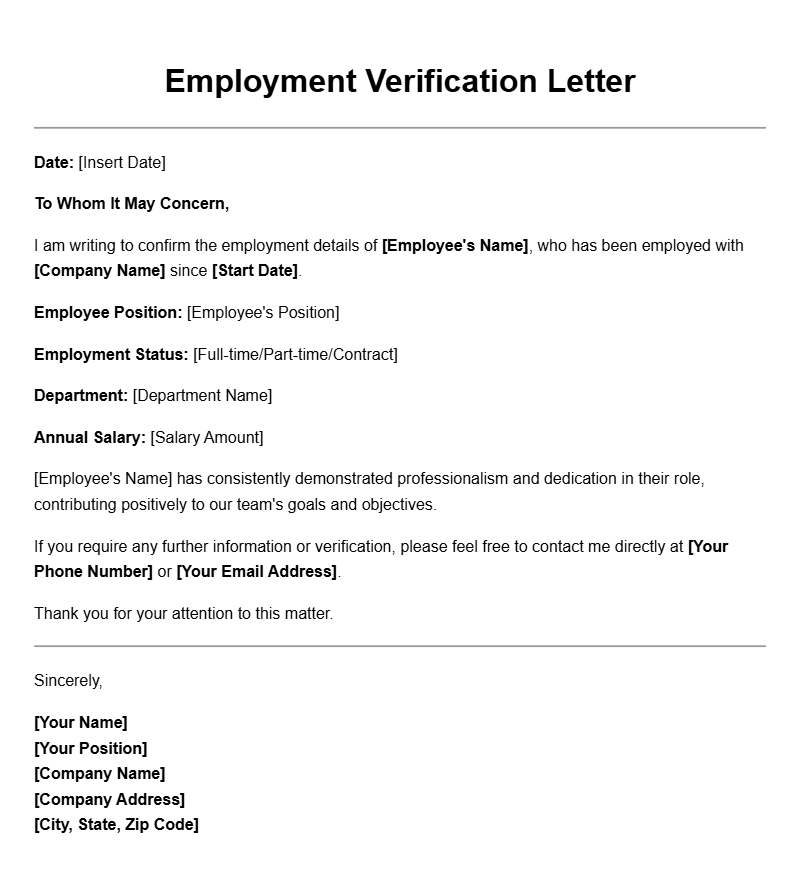
Here’s a simple template you can modify:
[Company Letterhead]
[Date]
To Whom It May Concern,
This letter is to verify that [Employee Name] has been employed with [Company Name] since [Start Date]. Currently, [he/she/they] holds the position of [Job Title].
During [his/her/their] tenure, [Employee Name] has shown [brief description of responsibilities/skills].
[If applicable, include salary information.]
If you have any questions, please feel free to reach out to me at [Contact Information].
Sincerely,
[Your Name]
[Your Position]
[Company Name]
Common Mistakes to Avoid
When writing or requesting an employment verification letter, keep these pitfalls in mind:
- Not using official letterhead, which can raise doubts about authenticity.
- Omitting critical details like employment dates or job title.
- Forgetting to sign the letter, which can make it seem impersonal.
Tips for Customization
Tailoring the letter to fit specific situations can enhance its effectiveness:
- Adjust the tone based on the audience; keep it formal for financial institutions and slightly less formal for potential employers.
- Include additional information if the recipient requests it, such as job performance or reasons for leaving.
- Make sure to update the letter if the employee changes roles or if their employment status changes.
Document Structure & Example Models