When something unsafe happens at work, on your property, or in a public space, documenting it properly matters. A safety complaint letter creates an official record of the incident, explains what went wrong, and tells the responsible party what you expect them to do about it. Whether you’re reporting a hazard to your employer, a landlord, or a government agency, the right template saves time and helps ensure your complaint gets taken seriously.
The difference between a casual complaint and an effective one often comes down to structure and specificity. A well-written safety complaint letter demonstrates that you’ve thought through the problem, can describe it clearly, and know what resolution looks like. That combination tends to prompt faster action than vague frustration.
What A Safety Complaint Letter Actually Does
A safety complaint letter is a formal written record of a hazard, unsafe condition, or incident that poses a risk to health or wellbeing. It serves multiple purposes at once: it notifies the responsible party of the problem, documents that you reported it and when, creates a paper trail for potential legal or regulatory action, and signals that you take the issue seriously enough to put it in writing.
Unlike a casual email or conversation, a formal letter carries weight. It shows you’re not just venting—you’re making an official complaint. Many organizations track these letters, investigate them, and respond within required timeframes. If nothing improves, that letter becomes evidence that you reported the problem and were ignored.
Safety complaints go to different recipients depending on the situation. You might address one to your manager or HR department, a property owner or manager, a government safety agency, or a company that provides a service or product you believe is unsafe.
When You Need A Safety Complaint Letter
You should write a safety complaint letter whenever an unsafe condition or incident needs formal documentation and you want a response from someone in authority. Common scenarios include:
- Workplace hazards: broken equipment, inadequate training, missing safety gear, unsanitary conditions, or incidents that resulted in injury
- Rental property issues: faulty wiring, mold, broken locks, pest infestations, or lack of working fire exits
- Public space dangers: potholes, broken playground equipment, inadequate lighting, or slippery surfaces in stores
- Product safety: defects in something you purchased that could cause harm
- School or facility safety: bullying, inadequate supervision, unsafe equipment, or security concerns
The key indicator is that the problem poses a real risk and you’ve already tried informal communication without results—or the situation is serious enough that informal communication isn’t appropriate. If someone could get hurt and nothing’s being done, it’s time to put it in writing.
Key Components Of A Complaint Letter
An effective safety complaint letter includes specific elements that make it clear, professional, and hard to dismiss or mishandle.
Your Contact Information
Start with your name, address, phone number, and email at the top. This lets the recipient contact you if they need clarification or want to inform you of actions taken. Date the letter clearly so there’s no ambiguity about when you submitted it.
Recipient Details
Include the name and title of the person you’re addressing it to, their department, and the organization. If you don’t know the specific person, address it to the department or position responsible for safety (like “Safety Manager” or “Property Manager”).
Clear Subject Line
A one-line subject makes it obvious what the letter is about. Something like “Safety Complaint: Faulty Electrical Outlet in Break Room” tells the reader immediately what they’re dealing with.
Description Of The Hazard Or Incident
This is the core of your letter. Describe what you observed or experienced in concrete terms. Include the date and time it occurred or when you first noticed it, the location, and exactly what the problem is. Avoid emotional language or assumptions about intent. Stick to facts: “The railing on the stairs to the second floor is loose. When I applied pressure to test it, it moved visibly. This creates a fall hazard.” That’s more effective than “Someone is going to get hurt because nobody cares about safety around here.”
Impact Or Risk
Explain why this matters. Who could be harmed? What’s the potential injury? This helps the recipient understand urgency. “An employee or visitor could fall and suffer serious injury” is concrete. “This is dangerous” is not.
What You Want Done
Be specific about the resolution you’re requesting. Do you want the hazard removed? Do you want a repair? Do you want training or policy changes? “Please repair or replace the railing within 7 days and confirm completion in writing” gives a clear expectation. “Fix this” does not.
Documentation Reference
If you’ve already reported this verbally, mention it: “I first reported this issue to [Name] on [Date]. As of today, no action has been taken.” This shows you’ve given them a chance to address it informally.
Closing And Signature
Keep it professional but not overly formal. “Sincerely” or “Respectfully” works fine. Sign your name and print it below. If you’re sending this via email, your typed name counts as a signature.
Step-By-Step Guide To Writing Your Letter
Gather Your Information First
Before you write, collect the details. When exactly did you notice the problem? Where is it located? Have you taken photos? Did anyone else witness it? Is there an incident report already filed? Having this ready prevents you from forgetting important details or having to rewrite the letter.
Choose The Right Recipient
Send your letter to someone with actual authority to fix the problem. At work, that’s typically your direct manager, HR, or a dedicated safety officer—not a coworker or someone in an unrelated department. For rental issues, contact your landlord or property manager. For public safety, you might need to contact the city, county, or the business responsible. Sending it to the wrong person delays resolution.
Write In Clear, Direct Language
Avoid jargon, sarcasm, and emotional appeals. Your goal is to be taken seriously, not to vent. Read your draft aloud to yourself. If it sounds like you’re angry or being dramatic, tone it down. The facts are powerful on their own.
Be Specific About Dates And Times
Vague timing weakens your credibility. “Last week” is worse than “Tuesday, March 14th at approximately 2:30 PM.” Specificity shows you’re paying attention and not exaggerating from memory.
Propose A Reasonable Timeline
If you’re requesting action, give them a realistic but firm deadline. For urgent safety issues, 24-48 hours is reasonable. For repairs that need scheduling, 7-14 days might be appropriate. Make it clear you expect a response confirming receipt and outlining their plan.
Keep Copies For Your Records
Print or save a copy of everything you send. If you hand-deliver it, ask for a receipt. If you email it, keep the email. If you mail it, use certified mail with return receipt. You’re building a documented timeline in case this escalates.
Template: Basic Safety Complaint Letter
Here’s a straightforward template you can adapt to your situation:
[Your Name]
[Your Address]
[City, State ZIP]
[Your Phone Number]
[Your Email]
[Date]
[Recipient Name]
[Recipient Title]
[Organization Name]
[Organization Address]
[City, State ZIP]
Subject: Safety Complaint—[Brief Description of Issue]
Dear [Recipient Name/Title]:
I am writing to formally report a safety hazard at [Location/Organization Name] that requires immediate attention.
On [Date], at approximately [Time], I observed the following unsafe condition: [Describe the hazard in specific detail. Include location, what you saw, and why it’s unsafe.]
[Optional: If relevant, describe any incident that resulted or could have resulted: “On [Date], [describe what happened as a result of this hazard].”]
This hazard poses a risk of [describe potential injury or harm]. [If applicable: “I first reported this issue verbally to [Name] on [Date], but no corrective action has been taken.”]
I request that you take the following action: [Specify what needs to be done—repair, removal, training, policy change, etc.] I expect this to be completed by [Date], and I request written confirmation of the corrective measures taken.
Please contact me at [Phone/Email] if you need any additional information or clarification. I am available to discuss this matter at your convenience.
Sincerely,
[Your Signature]
[Your Typed Name]
Template: Workplace Safety Complaint
This version is tailored for on-the-job safety issues:
[Your Name]
[Employee ID, if applicable]
[Department]
[Date]
[Manager Name]
[Title]
[Department]
Subject: Formal Safety Complaint—[Department/Area]
Dear [Manager Name]:
I am filing a formal safety complaint regarding unsafe working conditions in the [Department/Area] that require immediate corrective action.
Incident/Hazard Description:
On [Date], I observed [specific hazard]. [Describe location, equipment involved, conditions that make it unsafe.]
Potential Risk:
This hazard creates a risk of [describe potential injury]. [If an incident occurred: “On [Date], this hazard resulted in [describe incident].”]
Previous Communication:
I brought this issue to your attention on [Date] during [meeting/conversation]. As of today, no corrective measures have been implemented.
Requested Action:
I request that the following steps be taken:
1. [First action needed]
2. [Second action needed]
3. [Third action needed, if applicable]
I expect a written response outlining the corrective plan within [Number] business days. Please contact me at [Phone/Email] to discuss this matter.
Respectfully,
[Your Signature]
[Your Name]
Template: Rental Property Safety Complaint
For landlord or property manager issues:
[Your Name]
[Property Address]
[Apartment/Unit Number]
[Date]
[Landlord/Property Manager Name]
[Property Management Company, if applicable]
[Address]
Subject: Safety Concern Requiring Immediate Repair—[Property Address]
Dear [Landlord/Property Manager Name]:
I am writing to formally report a safety hazard in my rental unit that requires immediate repair.
Description of Hazard:
[Describe the problem specifically. Example: “The bathroom exhaust fan is non-functional, resulting in moisture accumulation and visible mold on the ceiling. This poses a health risk and violates housing codes.”]
Location: [Specific room/area]
Date First Noticed: [Date]
Current Status: [Is it getting worse? Is it ongoing?]
This condition creates a health hazard and may violate [state/local housing codes—if you know them]. I request that you repair this issue within [reasonable timeframe, typically 7-14 days].
Please contact me at [Phone/Email] to schedule access if needed. I expect written confirmation of the repair date and completion.
Sincerely,
[Your Signature]
[Your Name]
Common Mistakes That Weaken Your Letter
Being Too Emotional Or Accusatory
Phrases like “You don’t care about safety” or “This is completely unacceptable” make your letter sound like a complaint rather than a formal report. The recipient may become defensive instead of focused on fixing the problem. Stick to describing what happened and what needs to change.
Lack Of Specificity
Vague complaints are easy to dismiss. “The workplace is unsafe” tells them nothing. “The guardrail on the loading dock platform is missing bolts and wobbles when touched” gives them something concrete to address. Specific details force action.
Forgetting To Document Previous Attempts
If you’ve already reported this verbally, mention it. This shows you’ve been reasonable and gives context for why a formal letter is now necessary. It also prevents the recipient from claiming they didn’t know about the problem.
Unrealistic Timelines
Demanding a major repair be completed in 24 hours when it requires ordering parts or hiring a contractor makes your letter seem unreasonable. A reasonable timeline makes your request more likely to be honored. For urgent hazards, 24-48 hours is appropriate. For repairs, 7-14 days usually works.
Not Keeping A Copy
If something goes wrong later and you need to prove you reported it, you’ll need documentation. Always keep a copy of what you sent and proof that it was received.
Sending To The Wrong Person
Your coworker can’t fix the electrical system. Your HR department might not handle maintenance. Send your letter to someone with actual authority to address the problem. If you’re unsure, ask or send it to the department head responsible for that area.
Mixing Multiple Unrelated Issues
One letter, one main complaint. If you have several separate safety concerns, write separate letters. This keeps each issue clear and prevents the recipient from addressing only part of your complaint and claiming they’ve resolved everything.
Customization Tips For Different Situations
For Workplace Incidents
Reference any incident reports filed, OSHA regulations if applicable, and your company’s safety policies. If your workplace has a safety committee, copy them on the letter. Mention if coworkers witnessed the issue—this strengthens your credibility.
For Rental Properties
Know your local tenant rights and housing codes. Reference them in your letter if the hazard violates them. This adds legal weight to your complaint. Keep records of all communication with your landlord, and consider sending the letter via certified mail.
For Public Spaces Or Businesses
If you’re reporting a hazard in a store, park, or public building, address your letter to the manager or the owner. Include details about when you first noticed the problem and whether you reported it verbally. If others were affected, mention that too.
For Product Safety
Include the product name, model number, purchase date, and where you bought it. Describe exactly how the product is unsafe and what happened as a result. Keep the product if possible—you may need it as evidence. Send the letter to the manufacturer or retailer.
When Copying Other Parties
In serious situations, you might copy your letter to HR, a safety officer, union representative, or a government agency. Add “CC:” at the bottom of the letter to show who else received it. This increases accountability and shows you’re serious.
Formatting And Delivery
A professionally formatted letter carries more weight than a casual email. Use standard business letter format: 1-inch margins, 12-point readable font like Times New Roman or Arial, single spacing, and left alignment. Keep it to one page if possible. Two pages is acceptable for complex situations, but longer than that becomes hard to follow.
Deliver it in a way that creates a paper trail. Email is fine if you keep the sent message and any response. Hand delivery with a signed receipt is stronger. Certified mail with return receipt is the most defensible option if the issue is serious. Never deliver it verbally—you need written proof that you submitted it.
If you email it, use a clear subject line and keep the tone professional. Follow up with a phone call if you don’t receive acknowledgment within a few days. This shows you’re tracking the complaint and expect a response.
What Happens After You Send It
In many workplaces and organizations, safety complaints trigger an investigation. The recipient should acknowledge receipt within a few days and outline what they’ll do to address the issue. For serious hazards, action should begin immediately. For repairs or other issues requiring scheduling, they should give you a timeline.
If you don’t hear back within a reasonable timeframe, follow up. Send a second letter referencing your first one and asking for a status update. Document this follow-up too.
If the organization ignores your complaint or takes inadequate action, you have options. You can escalate it to a higher authority, file a complaint with a government agency like OSHA or your local housing authority, or consult with an attorney if you believe you’ve been retaliated against for reporting safety concerns.
Many organizations take safety complaints seriously because they create liability. A documented hazard that causes injury looks far worse if there’s evidence the organization knew about it and did nothing. That’s why your letter matters—it creates accountability.
Related Documentation You Might Need
Depending on your situation, you may also need other formal letters or documents. If you’re documenting a workplace performance issue alongside safety concerns, an employee recommendation letter might be relevant for future reference. If you’re seeking compensation or documenting an incident for insurance purposes, you might need to reference loan approval letter templates or other formal documentation processes. For broader organizational issues, understanding how school accreditation letter samples work can give you insight into how institutions document compliance and safety standards.
If your safety complaint is part of a larger business or organizational concern, you might also benefit from understanding how to structure formal requests like business proposal letter samples or formal time-off requests such as vacation request letter templates to see how professional communication is structured in your organization.
A well-written safety complaint letter is straightforward to create once you understand what it needs to contain. Gather your facts, address it to the right person, describe the hazard clearly, explain the risk, request specific action, and keep a copy. The template approach removes guesswork and helps you focus on accuracy. Send it through a method that creates documentation, follow up if needed, and don’t hesitate to escalate if the organization doesn’t respond appropriately. Your safety matters, and putting it in writing makes sure it gets the attention it deserves.
Editable Document Format Examples
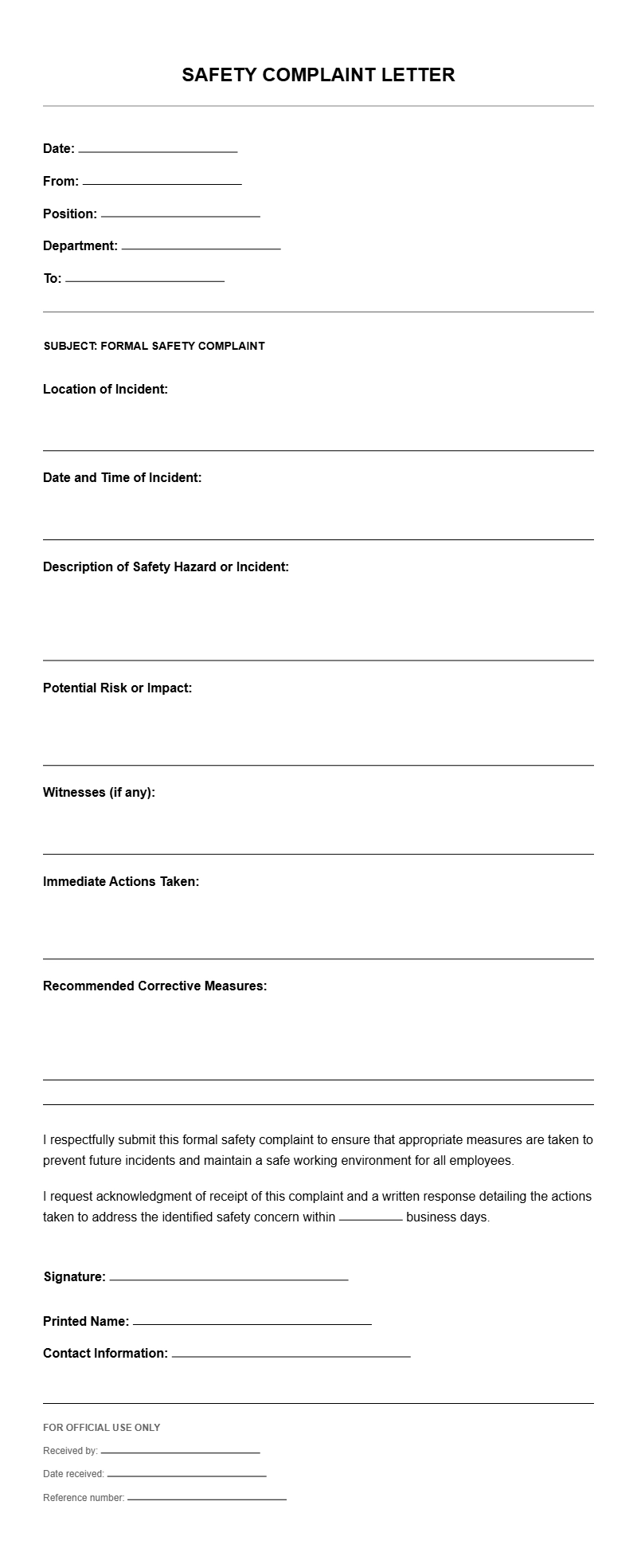
Workplace Safety Hazard Complaint Letter
Date: 15 November 2024
To: Health and Safety Manager
ABC Manufacturing Ltd
Industrial Park, Unit 7
Manchester, UK M15 4PQ
Re: Formal Safety Complaint – Inadequate Machine Guarding
Dear Sir or Madam,
I am writing to lodge a formal complaint regarding unsafe working conditions in the Production Department. On multiple occasions over the past two weeks, I have observed that several industrial cutting machines lack proper safety guards, creating a significant risk of serious injury to staff members.
Specifically, the following hazards require immediate attention:
- Missing protective barriers on the CNC lathe (Station 4)
- Damaged emergency stop buttons on the hydraulic press
- Inadequate warning signage near high-temperature equipment
- Insufficient personal protective equipment available for night shift workers
Despite raising these concerns verbally with my supervisor on 8 November, no corrective action has been taken. I believe these conditions violate our workplace safety policies and expose employees to unnecessary risk.
I request that a formal safety inspection be conducted within five working days and that remedial measures be implemented immediately. I am available to discuss this matter further at your earliest convenience.
Yours faithfully,
James Mitchell
Production Operator
Employee ID: 4782
Department: Manufacturing
Construction Site Safety Violation Report
Date: 22 October 2024
To: Site Safety Officer
BuildRight Construction
Riverside Development Project
London, UK
Re: Safety Complaint – Non-Compliance with Fall Protection Standards
Dear Safety Officer,
I am submitting this complaint regarding serious safety violations observed on the Riverside Development Project site. On 21 October, I witnessed multiple workers operating at heights without proper fall protection equipment, contrary to our site safety protocols and UK construction regulations.
Specific Incidents:
| Date | Location | Violation | Workers Involved |
|---|---|---|---|
| 21 Oct, 10:15 AM | Scaffolding, Level 3 | Missing harnesses | Approximately 4 workers |
| 21 Oct, 2:30 PM | Roof edge area | Defective guardrails | 2 workers |
| 20 Oct, 11:00 AM | Stairwell construction | No safety netting | 3 workers |
These violations pose an immediate risk of serious injury or fatality. I request urgent corrective action, including mandatory safety retraining for all site personnel and a comprehensive equipment inspection before work resumes.
Yours faithfully,
Sarah Chen
Site Safety Representative
Chemical Storage Safety Complaint
Date: 5 December 2024
To: Environmental Health and Safety Department
ChemTech Solutions Ltd
Industrial Complex, Building C
Birmingham, UK
Re: Urgent Safety Complaint – Improper Chemical Storage
Dear EHSD Team,
I am writing to formally report dangerous chemical storage practices in our laboratory facility that require immediate intervention. During a routine inspection on 4 December, I discovered several serious compliance violations that violate both company policy and environmental regulations.
Issues Identified:
- Incompatible chemicals stored adjacently without proper separation
- Expired safety data sheets for multiple hazardous substances
- Damaged storage containers with visible corrosion
- Inadequate ventilation in the storage area
- Missing secondary containment trays beneath chemical containers
- Staff members without current chemical safety certification
This situation presents serious risks including chemical reactions, toxic fume exposure, and environmental contamination. I have documented photographic evidence and detailed notes of all violations.
I strongly recommend an immediate facility audit by external safety consultants and suspension of chemical handling activities until full compliance is achieved. I am available to provide additional information and support the investigation process.
Yours faithfully,
Dr. Michael Patterson
Laboratory Safety Coordinator
ChemTech Solutions Ltd
Electrical Safety Hazard Complaint Letter
Date: 18 September 2024
To: Facilities and Safety Manager
TechVision Services
Office Complex, Floor 12
Edinburgh, UK EH3 8RA
Re: Safety Complaint – Electrical Hazards in Server Room
Dear Facilities Manager,
I am formally notifying you of critical electrical safety hazards in the Server Room (Room 1204) that require urgent remediation. These conditions pose serious risk of electrical shock, fire, and equipment damage.
Hazards Observed:
- Overloaded power distribution units with daisy-chained extension leads
- Exposed electrical wiring without proper conduit protection
- Non-functional circuit breaker labels and unclear electrical routing
- Inadequate earthing and grounding verification
- Water damage near electrical equipment from recent flooding
- Staff lacking current electrical safety training
These conditions violate electrical safety standards and create potential liability for the organisation. I have documented all observations with dates and times.
Requested Actions:
- Immediate electrical safety audit by certified electrician
- Installation of proper cable management systems
- Replacement of damaged equipment and wiring
- Mandatory electrical safety training for all personnel
- Quarterly compliance inspections going forward
Please confirm receipt of this complaint and provide a timeline for remedial action.
Yours faithfully,
David Thompson
IT Operations Manager
Ergonomic Workplace Safety Complaint
Date: 9 November 2024
To: Human Resources and Occupational Health
OfficeWorks UK Ltd
Corporate Headquarters
Bristol, UK
Re: Safety Complaint – Inadequate Ergonomic Workplace Setup
Dear HR and Occupational Health Team,
I am submitting a formal complaint regarding ergonomic deficiencies in our office environment that are causing or contributing to work-related musculoskeletal disorders among staff members.
During the past six months, I have documented increasing reports from colleagues experiencing back pain, neck strain, and repetitive strain injuries. Upon investigation, I have identified the following systemic issues:
- Desks and chairs not adjustable to accommodate individual worker requirements
- Computer monitors positioned at incorrect heights, forcing unnatural neck positioning
- Inadequate lumbar support in standard office chairs
- Insufficient workspace for proper document positioning and keyboard/mouse placement
- Lack of adjustable footrests and monitor stands
- No formal ergonomic assessment process for new employees
These conditions are likely contributing to increased sick leave, reduced productivity, and potential long-term health complications for staff. I recommend engaging an occupational health specialist to conduct comprehensive ergonomic assessments and implementing necessary equipment upgrades.
I would welcome the opportunity to discuss this matter and provide supporting documentation from affected colleagues.
Yours faithfully,
Emma Robinson
Office Manager
Employee Wellbeing Committee
Vehicle Fleet Safety Complaint
Date: 27 October 2024
To: Fleet Safety Manager
TransportCo Logistics
Distribution Centre
Leeds, UK LS10 1AB
Re: Fleet Safety Complaint – Defective Vehicle Maintenance Standards
Dear Fleet Safety Manager,
I am formally reporting serious safety concerns regarding the maintenance and roadworthiness of our company vehicle fleet. Recent inspections have revealed multiple defects that create unacceptable risk to drivers and other road users.
Vehicles with Identified Defects:
| Vehicle Reg | Defect Type | Severity | Date Reported |
|---|---|---|---|
| LM15 KWX | Brake fluid leak, reduced braking capacity | Critical | 24 Oct |
| LM16 PQR | Worn tyre tread below legal limit | High | 25 Oct |
| LM14 STU | Non-functional headlights and wipers | High | 26 Oct |
| LM17 VWX | Structural damage to driver door | Medium | 27 Oct |
Drivers have reported concerns about vehicle reliability, and I fear an accident is inevitable if these issues remain unresolved. I request immediate vehicle inspections and removal of unsafe vehicles from service until repairs are completed.
Yours faithfully,
Robert Hayes
Fleet Supervisor
Sanitation and Hygiene Safety Complaint
Date: 12 August 2024
To: Facilities and Health Standards Manager
FreshFood Catering Services
Central Kitchen Facility
Glasgow, UK G2 1BD
Re: Urgent Safety Complaint – Sanitation and Food Hygiene Violations
Dear Facilities Manager,
I am writing to report serious food safety and sanitation violations in our central kitchen facility that pose significant health risks to our customers and staff. These breaches violate food safety regulations and company standards.
Critical Issues Identified:
- Inadequate cleaning and sanitisation of food preparation surfaces
- Cross-contamination between raw and cooked food storage areas
- Temperature monitoring equipment non-functional on refrigeration units
- Staff handling food without proper hand washing or hygiene protocols
- Pest evidence (droppings and gnaw marks) in storage areas
- Expired food items stored alongside fresh inventory
- Insufficient training records for food safety certification
These conditions create immediate risk of foodborne illness outbreaks and potential regulatory enforcement action. I have documented all observations with photographs and timestamps.
I recommend immediate facility closure for comprehensive deep cleaning, pest control treatment, equipment repair, and mandatory food safety retraining for all kitchen staff before resuming operations.
This matter requires urgent attention and I am available to provide additional details.
Yours faithfully,
Jennifer Walsh
Kitchen Operations Supervisor
Fire Safety System Failure Complaint
Date: 3 November 2024
To: Building Safety and Security Manager
CentralOffice Property Management
Tower Block A, Level 1
Manchester, UK M1 2AB
Re: Critical Safety Complaint – Fire Safety System Deficiencies
Dear Building Safety Manager,
I am formally reporting critical deficiencies in our building’s fire safety systems that compromise occupant protection and violate fire safety regulations. An inspection conducted on 2 November revealed multiple failures requiring immediate corrective action.
Fire Safety System Failures:
- Fire Detection: Smoke detectors in Sections B and C non-functional; no recent maintenance records available
- Alarm Systems: Audible alarm coverage insufficient in lower floors; emergency lighting inoperative in stairwell
- Sprinkler Systems: Pressure gauges indicating low water pressure; multiple sprinkler heads obstructed
- Emergency Exits: Secondary exit doors locked; evacuation signage missing or illegible
- Fire Extinguishers: Several units expired; staff untrained in proper use
- Evacuation Procedures: No recent evacuation drills; assembly point unclear
These deficiencies create serious risk of fire-related casualties and property damage. I request immediate engagement of certified fire safety engineers to conduct comprehensive system testing and remediation.
Until these issues are resolved, I recommend restricting occupancy to essential personnel only.
Yours faithfully,
Thomas Anderson
Building Safety Officer
Personal Protective Equipment Compliance Complaint
Date: 31 July 2024
To: Health and Safety Department
IndustrialWorks Manufacturing
Production Facility, Block D
Coventry, UK CV1 2RA
Re: Safety Complaint – Inadequate Personal Protective Equipment Provision
Dear Health and Safety Team,
I am submitting a formal complaint regarding the systematic failure to provide adequate personal protective equipment (PPE) to workers in hazardous areas. This non-compliance creates serious health and safety risks and violates PPE regulations.
PPE Deficiencies:
- Insufficient safety footwear available; workers sharing or wearing worn shoes with inadequate protection
- Hearing protection unavailable or non-compliant in high-noise manufacturing areas
- Respiratory protection equipment missing for dust and fume exposure areas
- Eye and face protection not provided for grinding and welding operations
- Cut-resistant gloves unavailable; workers using inappropriate alternatives
- High-visibility clothing not issued to all warehouse personnel
- No documented PPE fit-testing or training records
I have observed workers attempting to improvise protection using unsuitable materials, indicating awareness of hazards but lack of proper resources. This situation creates liability and exposes workers to preventable injury.
I request immediate provision of compliant PPE for all affected employees, implementation of proper inventory management systems, and mandatory PPE training and fit-testing for all personnel.
Yours faithfully,
Mark Sullivan
Safety Representative
Manufacturing Division
Noise and Environmental Hazard Complaint
Date: 19 September 2024
To: Environmental Health and Safety Officer
MetalWorks Processing Ltd
Industrial Estate
Sheffield, UK S9 1ER
Re: Safety Complaint – Excessive Noise Levels and Environmental Hazards
Dear EHSO,
I am formally reporting unacceptable noise levels and environmental hazards in our processing facility that are causing health effects to workers and breaching occupational exposure limits.
Documented Hazards:
| Area | Hazard Type | Estimated Level | Health Impact |
|---|---|---|---|
| Press Department | Machinery noise | 95+ dB(A) | Hearing damage risk |
| Grinding Section | Dust and noise | 92+ dB(A) + particulates | Respiratory and hearing |
| Welding Area | Fumes and noise | 88+ dB(A) + metal fumes | Multiple health effects |
Multiple workers have reported hearing loss, tinnitus, and respiratory symptoms. Hearing protection is inconsistently available and improperly fitted. No recent noise assessment or environmental monitoring has been conducted.
Required Actions:
- Comprehensive noise and air quality assessment by external specialists
- Engineering controls to reduce noise at source
- Provision and fitting of appropriate hearing protection
- Respiratory protection equipment and fit-testing
- Occupational health surveillance programme for affected workers
I am available to discuss this urgent matter.
Yours faithfully,
Christopher Moore
Health and Safety Representative