When a school needs to close—whether for weather, building issues, disease outbreaks, or emergencies—notifying families quickly and clearly becomes critical. A school closure notice letter template gives administrators a structured way to communicate the decision, explain the reason, and provide next steps. Without a solid template, important details get missed, confusion spreads, and parents show up expecting school to be open.
If you’re handling communications for a school district, you’ve probably realized that closure notices need to be professional, factual, and easy to understand. They also need to reach multiple audiences—parents, staff, students, and sometimes the broader community. This guide walks through what these letters should include, how to write them effectively, and provides templates you can adapt immediately.
What A School Closure Notice Letter Actually Is
A school closure notice letter is a formal communication from a school or district administration announcing that school will not be held on a specific date or dates. It’s different from a delay notice (which pushes back the start time) or an early dismissal notice (which ends the day early). A closure means the building is completely shut down.
These letters serve several purposes at once. They inform families about the decision, explain why it happened, clarify what students should do instead, and sometimes address makeup days or online learning options. They also create a paper trail showing that the district communicated responsibly.
The letter format lets you be thorough in a way that text alerts or social media posts can’t. You can explain context, provide specific instructions, and give families time to make arrangements.
When Schools Actually Send Closure Notices
Closure notices go out in several common situations:
- Severe weather. Snow, ice, extreme heat, or flooding makes travel unsafe or the building inaccessible.
- Building emergencies. Heating system failure, water damage, gas leak, or structural damage requires the building to close.
- Health emergencies. Disease outbreaks, contamination, or pandemic-related closures affect operations.
- Power outages. Extended loss of electricity makes the building unusable.
- Security threats. Active incidents or threats may force temporary closure.
- Staff shortages. Widespread illness among staff sometimes necessitates closure when substitutes aren’t available.
- Scheduled closures. Professional development days, holidays, or district-wide events announced in advance.
The tone and urgency of your letter shifts depending on the situation. An emergency closure due to a gas leak needs immediacy and clear instructions. A scheduled closure for a professional development day can be more routine.
Essential Components Of A Closure Notice Letter
Every effective closure letter includes these core elements:
- Clear statement of closure. Say directly which school(s) are closed and on which date(s).
- Reason for closure. Briefly explain why without unnecessary detail. Families want to understand the decision.
- Duration. Is it one day, multiple days, or indefinite pending further notice?
- What happens next. Will there be online learning, makeup days, or no instruction?
- Instructions for students and staff. Are after-school programs canceled? What about athletic events or evening activities?
- Contact information. How can families reach the school with questions?
- Timestamp. When was the decision made? This prevents confusion about old notices.
- Follow-up information. When will the next update come, if applicable?
You don’t need flowery language or lengthy explanations. Families are stressed about logistics. They need facts, clarity, and actionability.
How To Write A School Closure Notice Letter
Step 1: Start with the essential announcement. Open with the closure itself. Don’t bury the lead. Parents scanning the letter need to see immediately that school is closed.
Step 2: Provide the reason without over-explaining. One or two sentences about why the closure happened. “Due to severe winter weather and hazardous road conditions” is sufficient. You don’t need to detail weather forecasts or list every affected road.
Step 3: Be specific about scope. Which schools? All buildings or just elementary? All grades or specific programs? “All schools in the district” is clear. “All buildings except the administrative office” is also clear.
Step 4: Explain what students should do instead. Will learning continue online? Should students expect assignments? Is it a no-school day with no instruction? This prevents parents from wondering if they need to facilitate learning at home.
Step 5: Address what else is affected. After-school programs, athletics, evening events, special services—mention these if they’re canceled or modified. If you don’t address them, people will call to ask.
Step 6: Give clear next steps for questions. Provide a phone number or email. If the closure might extend, say when the next update will come.
Step 7: Include a timestamp and sender identification. Who is this from? When was it sent? This prevents confusion if multiple notices go out.
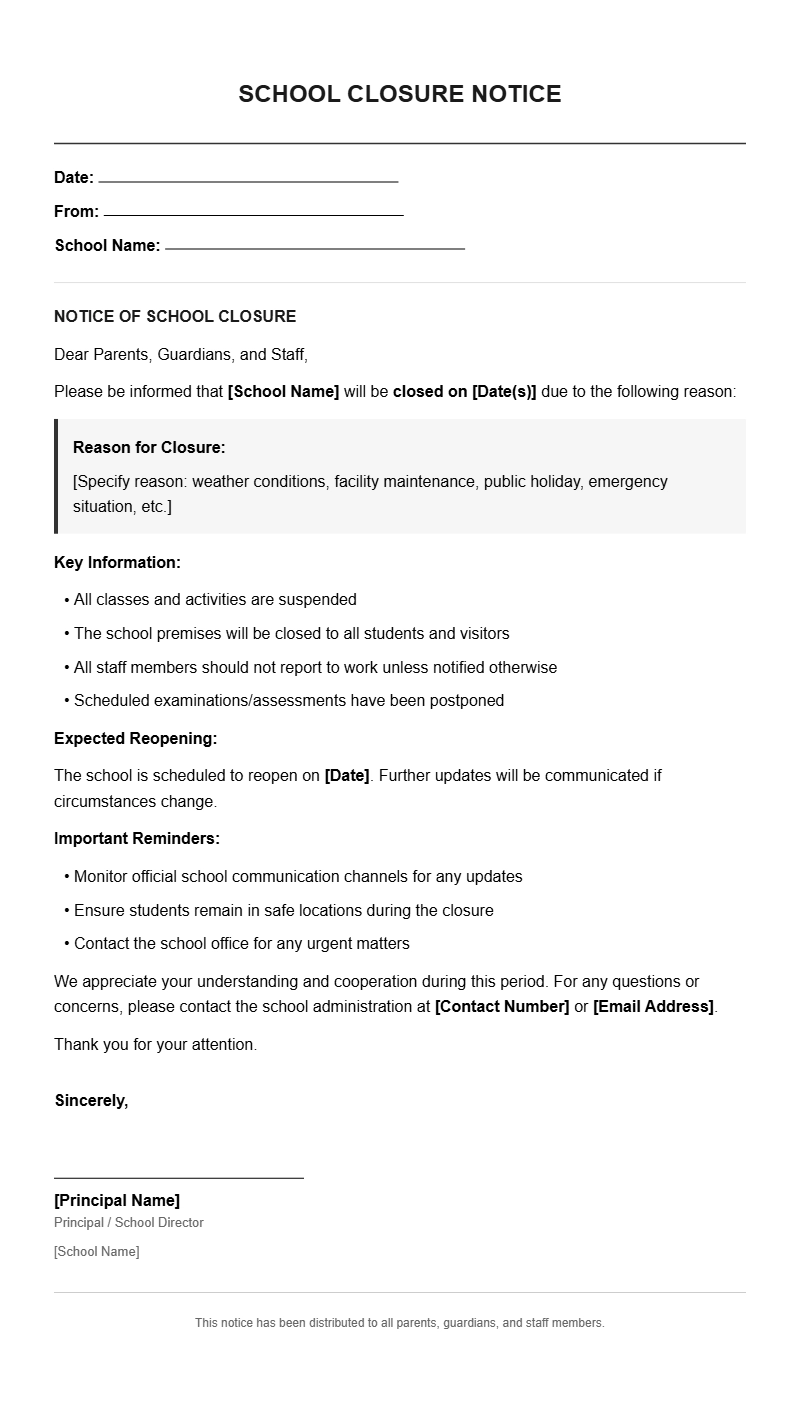
School Closure Notice Letter Template
Here’s a straightforward template you can customize:
[Date]
Dear Families and Staff,
This is to notify you that [School Name/All Schools in the District] will be closed on [Date(s)] due to [reason: severe weather, building emergency, etc.].
All classes, activities, and programs scheduled for [date(s)] are canceled. This includes after-school programs, athletic events, and evening activities. [Optional: Online learning assignments will be posted to [platform] by [time], or No instruction is expected on this day.]
Students should plan to return to school on [date]. [If applicable: We will provide an update by [time/date] regarding [specific situation, e.g., whether closure will extend].]
If you have questions, please contact [School Name] at [phone number] or [email address].
Sincerely,
[Name]
[Title]
[School/District Name]
This template works for most routine closures. Adapt it based on your specific situation and district style.
Template For Emergency Closures
When a closure happens unexpectedly and urgently, the tone shifts slightly. Here’s a version for emergencies:
[Time and Date]
URGENT: School Closure Notice
Effective immediately, [School Name] is closed today ([date]) due to [emergency reason: gas leak, power outage, etc.]. All students and staff should not report to school.
If your student is currently at school, they will be supervised and released to authorized pickup only. Please do not come to campus unless you receive a direct call from the school.
For updates, monitor [district website/social media/local news] or call [emergency hotline]. We will provide information about reopening by [time/date].
This is an active situation. Further updates will follow.
[Name]
[Title]
Emergency closures prioritize immediate action over formality. Keep sentences short. Use bold for the announcement. Give families a clear way to stay informed.
Template For Extended Or Indefinite Closures
When closure might last multiple days or the timeline is uncertain, families need reassurance and information:
[Date]
Dear Families and Staff,
Due to [reason], [School Name/District] will be closed beginning [date]. We will assess the situation daily and provide updates by [time] each day regarding whether school will reopen.
During the closure:
- All in-person classes are suspended.
- Online learning will continue via [platform]. Teachers will post assignments by [time].
- All athletic events and activities are postponed.
- Meal services are available at [location/time] for families who need them.
We will communicate reopening decisions through [method: email, text, website]. Please check [website] for the latest information.
Thank you for your patience. We will reopen as soon as it is safe to do so.
Sincerely,
[Name]
[Title]
Extended closures create anxiety. Acknowledge it. Provide structure for families. Give them a reliable way to get updates so they don’t have to keep checking multiple sources.
Common Mistakes To Avoid In Closure Letters
Burying the announcement. Don’t start with background or context. Lead with the closure itself. Parents scanning quickly need to see it immediately.
Being vague about which schools are affected. “Some buildings may be closed” creates confusion. “Elementary schools in the north district are closed; middle and high schools are open” is clear.
Forgetting to address after-school programs. Parents assume everything is canceled unless told otherwise, but some programs might continue. Clarify.
Leaving out what students should do instead. If online learning continues, say so. If not, say that too. Silence creates questions.
Using jargon or overly formal language. “Due to inclement meteorological conditions” is harder to parse than “due to heavy snow.” Keep it simple.
Not including a timestamp. If a closure notice circulates without a date and time, people won’t know if it’s current or old.
Providing no contact information. Someone will have a question. Give them a way to reach you.
Sending only through one channel. Text alerts, email, website, social media—use multiple methods. Not all families check everything equally.
Customizing Your Template For Your District
Every district has slightly different needs. Here’s how to adapt a template effectively:
Account for your communication channels. If your district uses a mass notification system, the letter might be shorter because it’s supplementing alerts. If this is your primary notice, it needs more detail.
Match your district’s tone. Some districts are more formal; others are conversational. Look at previous closure letters and match that style.
Include district-specific details. Do you have multiple buildings? Do you offer meal services during closures? Do students continue online learning? Customize accordingly.
Plan for your specific risks. A district in a snow-heavy region might have a template ready for winter weather. A district near a river might have one for flooding. Draft templates in advance for your most common closure scenarios.
Consider your audience’s needs. If many families speak English as a second language, translate the letter or provide it in multiple languages. If families rely heavily on text alerts, keep the letter brief and ensure the alert contains the essential information.
Decide on your update schedule. If a closure might extend, commit to a specific time each day when you’ll update families. Stick to it. Predictability reduces anxiety.
Related Communications You Might Need
School closures sometimes connect to other formal notices. If you’re handling closure communication, you may also need to prepare workplace incident report letters if the closure stems from a safety issue, or disciplinary appeal letters if the closure involves student conduct incidents. For longer-term planning around building issues, templates for sponsorship requests might help if you’re seeking funding for repairs.
If your district partners with external organizations, you might also reference collaboration letter samples for reaching out to community partners about closure impacts, or proposal templates when contracting temporary facilities or services during extended closures.
Final Practical Steps
Create a closure letter template now, before you need it. Add it to a shared drive where relevant staff can access it. Include placeholder text for the variable information (date, reason, next steps). Have someone review it for clarity before you save it as final.
When a closure actually happens, fill in the specifics, have one person review it for accuracy, and send it through all your communication channels at the same time. The faster families hear the news from you, the less they’ll rely on rumors or outdated information.
Keep copies of every closure letter you send. Over time, you’ll build a record of what worked and what didn’t. You’ll also have examples to reference if questions arise about how decisions were communicated.
Sample Documents for Multiple Use Cases