You’re probably here because you need to ask someone for money, resources, or support—and you want to get it right the first time. Writing a sponsorship request letter feels nerve-wracking for most people. You want to sound professional without coming across as desperate, and you need to give enough detail without writing a novel. I’ve helped dozens of nonprofits, small business owners, and event organizers craft these letters, and I’m going to walk you through exactly what works.
What Is a Sponsorship Request Letter
A sponsorship request letter is a formal letter you send to a company, organization, or individual asking them to support your event, project, or cause. The support can come as money, products, services, or venue access. Think of it as your elevator pitch in written form—you have about 30 seconds to hook the reader and make them see why sponsoring you benefits them.
These letters differ from a business proposal because they’re typically shorter and focus more on the relationship and mutual benefit rather than detailed logistics. A proposal comes later, after you’ve sparked their interest.
When to Send a Sponsorship Request Letter
You’ll typically write this type of letter when you’re:
- Organizing a community event like a 5K race, festival, or charity drive
- Running a sports team or club that needs equipment or travel funding
- Planning a conference, workshop, or educational program
- Launching a new product and looking for event partnerships
- Seeking ongoing support for your nonprofit’s programs
The timing matters. Send your letter 6-8 weeks before you need a decision, and always personalize it for each recipient. Mass emails to “Dear Sir/Madam” recipients almost never convert.
Key Components of an Effective Sponsorship Request Letter
Every winning sponsorship letter includes these elements:
- Personalized greeting – Address a specific person by name whenever possible
- Clear value proposition – Explain what you offer in return (logo placement, social mentions, access to your audience)
- Specific details about your event or cause – Who, what, when, where, and why
- Sponsorship tiers or options – Give them choices at different price points
- Social proof or credibility – Mention past successes, partnerships, or community impact
- Clear call to action – Tell them exactly what you want (a meeting, a phone call, or their decision by a specific date)
If you’re also working on other professional letters, you might find our recommendation letter templates helpful for building out your document toolkit.
Step-by-Step Guide to Writing Your Letter
Here’s how I approach writing these letters with clients:
Step 1: Research Your Potential Sponsor
Before you write a single word, spend 15-30 minutes researching the company. Look at their website, recent news, social media, and any previous sponsorship they’ve done. You want to understand what they care about and what kind of audience they’re trying to reach.
Step 2: Match Their Interests to Your Offering
Companies sponsor things because it helps their business goals—brand awareness, community goodwill, lead generation, or employee engagement. Frame your request around what matters to them, not just what you need from them.
Step 3: Write a Compelling Opening
Skip the generic “I am writing to request sponsorship” opener. Instead, try something like: “I noticed your company has supported youth programs in the downtown area, and I wanted to share an opportunity that aligns perfectly with that commitment.”
Step 4: Describe Your Event or Cause
Be specific. “Our annual 5K raises money for local scholarships” hits harder than “we host a running event.” Include attendance numbers, community impact, and what makes your event unique or growing.
Step 5: Present Sponsorship Options
Offer 2-3 clear tiers. This makes the decision easier and often results in higher commitments than an open-ended ask. Here’s a simple structure:
- Bronze: $500 – Logo on event t-shirt and social media mention
- Silver: $1,500 – Above plus banner at event and verbal recognition
- Gold: $3,000 – Above plus VIP table, featured blog post, and logo on all promotional materials
Step 6: Close With a Specific Ask
End by requesting a specific next step. “Would you be available for a 15-minute call next Tuesday or Wednesday to discuss this further?” gives them a clear action to take.
Sponsorship Request Letter Sample
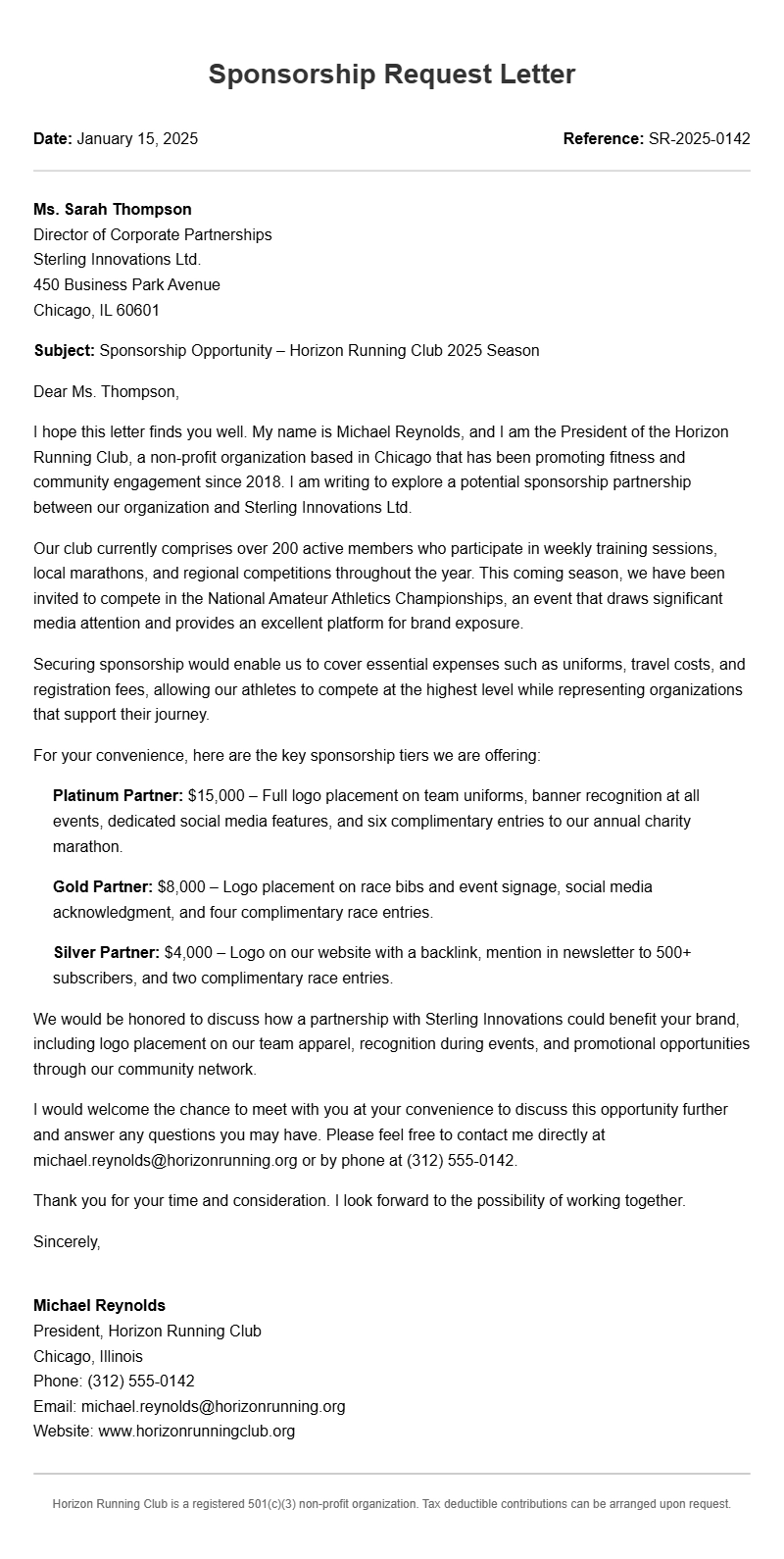
Here’s a real-world example you can adapt. I’ve written this for a community youth soccer league seeking local business sponsors.
Subject: Partnership Opportunity – Riverside Youth Soccer League 2024 Season
Dear Ms. Thompson,
As the director of the Riverside Youth Soccer League, I’m reaching out because I admire how Central Valley Bank has invested in youth athletics over the past few years. I’d like to share an opportunity that could give your bank meaningful visibility with over 2,000 local families.
This spring, we’re hosting our 12th annual season serving kids ages 8-16. We expect 340 players and approximately 1,200 family members at our games and tournaments. Many of these families are first-time homeowners and young professionals—exactly the demographic your bank targets.
We’re offering three sponsorship levels for the season:
• Team Sponsor ($750) – Your logo on team uniforms and a feature in our season newsletter (1,400 subscribers)
• Field Sponsor ($1,500) – Above plus signage at both fields, plus 4 tickets to our opening day BBQ
• Season Presenter ($3,000) – Above plus logo on all promotional materials, banners at the concession stand, and a speaking slot at our opening ceremony
Last year, our Platinum sponsor, Morrison’s Hardware, reported a 15% increase in foot traffic from families who recognized their logo at our fields.
Would you have 20 minutes this month for a quick call? I’m happy to work around your schedule.
Best regards,
Marcus Rivera
Riverside Youth Soccer League
Editable Template Snippet
Copy this framework and fill in your specifics:
[Your Organization Name]
[Your Address]
[City, State ZIP]
[Email] | [Phone]
[Date]
[Sponsor Contact Name]
[Company Name]
[Company Address]
Dear [Contact First Name],
I’m [your name] with [your organization]. [One sentence about what you do and who you serve].
I’ve followed [Company Name]’s work in [specific area related to their involvement], and I believe there’s a natural fit for a partnership around [your event or cause].
Our [event name] [date] will [describe who attends and expected numbers]. This audience includes [describe demographics if relevant to sponsor].
We’re offering sponsorship opportunities starting at [lowest tier amount] for [brief benefit]. Higher tiers include [key benefits].
I’d welcome the chance to discuss how we can create value for [Company Name]. Are you available for a brief call [timeframe]?
Sincerely,
[Your Name]
[Your Title]
Common Mistakes to Avoid
I’ve seen sponsorship requests fail for predictable reasons. Here’s what NOT to do:
- Generic, one-size-fits-all letters – If your letter looks like it went to 500 other businesses, it’ll end up in the trash.
- Focusing only on what you need – Sponsors don’t care about your budget problems. They care about their ROI.
- Vague benefit statements – “Great exposure” means nothing. Say “logo placement in front of 2,000 attendees” instead.
- Asking for too much too early – Start with a relationship-building ask, not a “$10,000 sponsorship” demand.
- Forgetting to follow up – Most decision-makers need 2-3 contacts before committing. If you only send one email, you’re leaving results on the table.
- Poor formatting or spelling errors – This signals you might be unprofessional to work with. Always proofread, or have someone else read it.
Tips for Customizing Your Letter
One template won’t work for every sponsor. Here’s how to adapt:
For Large Corporations
Go more formal, include media kits or past event data, and target their corporate giving or marketing departments rather than generic “info@” addresses.
For Small Local Businesses
Keep it shorter, emphasize community connection, and offer affordable entry-level options. A $250 sponsorship tier works better for a local diner than a $5,000 ask.
For Individual Donors
Focus on emotional storytelling and personal values alignment. Individual sponsors give from the heart, not just the checkbook. Share a specific beneficiary’s story if appropriate.
For In-Kind Donations
Frame it differently. Instead of money, ask for products or services, and quantify their tax-deductible value. If you need help documenting these contributions, our background verification letter samples include formats that work for donation acknowledgment.
Final Thoughts
A sponsorship request letter isn’t about begging for money. It’s about presenting a mutually beneficial opportunity in a clear, professional way. The best letters I’ve seen treat the sponsor as a partner, not an ATM. Do your homework, be specific about benefits, and make it easy for them to say yes.
If this is part of a larger professional document strategy, you might also want to explore our certification letter samples or vacation request letter templates for other situations where polished written communication matters.
The hardest part is getting started. Use the sample above, customize it for your situation, and send it out. You won’t get every sponsor you approach, but you’ll be surprised how many say yes when you present your case clearly and professionally.
Template Variations & Sample Formats