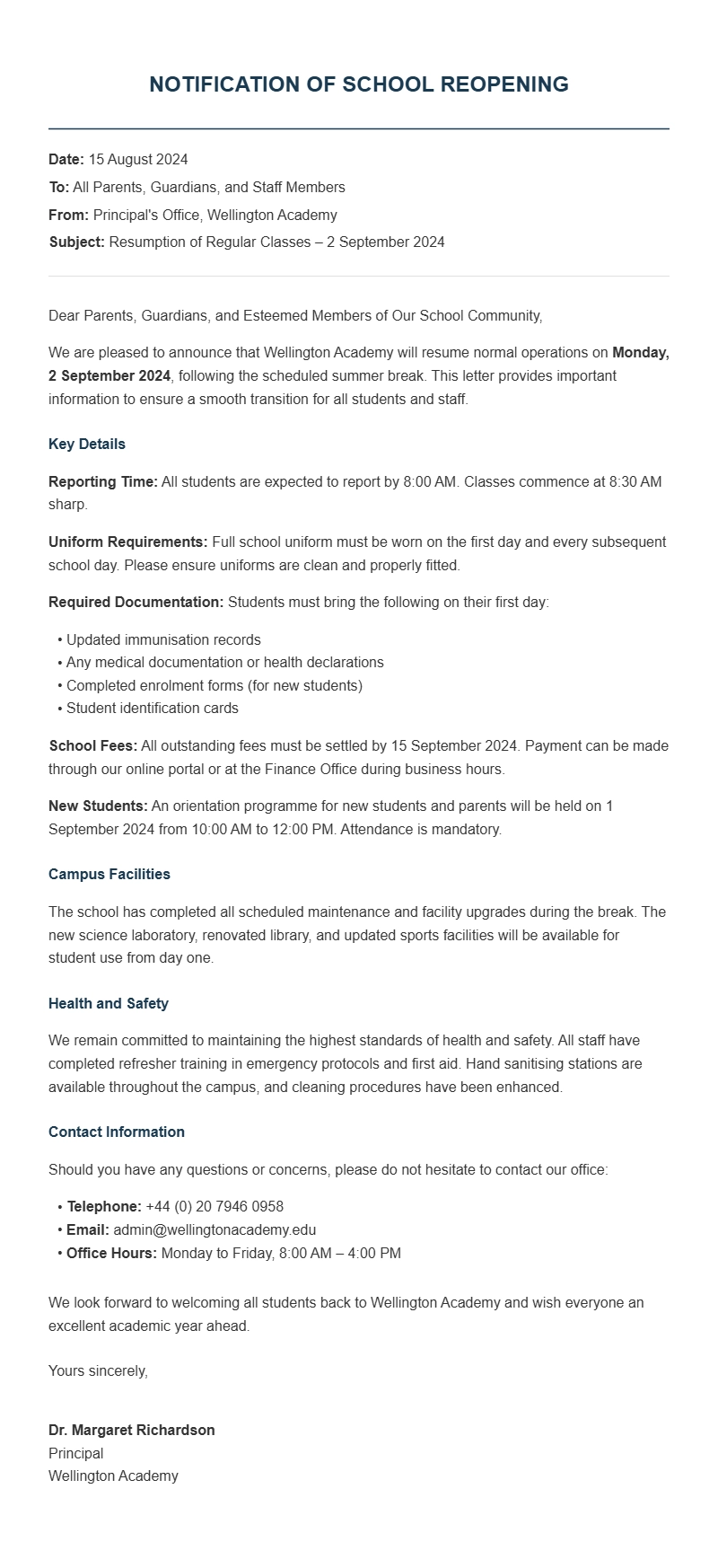
If you’re an administrator, principal, or office manager tasked with notifying families that school is reopening—whether after summer break, winter holidays, or an unexpected closure—you need a clear, professional letter that covers the essentials without overwhelming parents. A school reopening announcement letter sets expectations, provides important dates and logistics, and reassures families that the transition back to learning is organized and thoughtful.
The challenge is striking the right tone. Too formal and you sound distant. Too casual and you lose credibility. The letter needs to include practical information while also acknowledging the real concerns parents have: schedules, health protocols, supply lists, and what their kids should expect on day one.
This guide walks you through what these letters actually need, shows you real-world examples you can adapt, and helps you avoid the mistakes that make parents reach out with confused follow-up emails.
What Is A School Reopening Announcement Letter?
A school reopening announcement letter is an official communication from school leadership to families announcing the return to in-person learning. It serves multiple purposes at once: it confirms the reopening date, outlines what’s changed since the last closure, clarifies new procedures or protocols, and reminds families of important deadlines or requirements.
This isn’t a casual email. It’s a formal document that goes on school letterhead and typically gets sent via email, posted on the school website, and sometimes printed for families without reliable internet access. The letter becomes a reference document families return to throughout the first week back.
Schools send these letters before reopening after summer vacation, winter break, extended weather closures, or pandemic-related shutdowns. Some schools also send them when reopening after renovations or facility upgrades.
When Do Schools Send Reopening Announcements?
Timing matters. You want families to have enough notice to plan—typically two to four weeks before reopening—but not so far in advance that the details get forgotten or outdated.
For predictable closures like summer or winter break, send the letter in late July (for August reopening) or early December (for January reopening). For unexpected closures, send it as soon as the reopening date is confirmed, even if that’s just a few days out.
Some schools send a preliminary announcement confirming the date, then follow up with a more detailed letter about procedures and requirements a week or two later. This two-step approach works well for longer closures where details are still being finalized.
Key Sections Your Letter Needs
An effective reopening letter includes these core elements:
- Reopening date and time – Be specific. “Monday, August 26, 2024” is clearer than “late August.”
- Schedule changes – If start times, dismissal times, or bell schedules have shifted, explain them clearly.
- What’s different – New health protocols, building changes, staffing updates, or curriculum adjustments.
- Required items or paperwork – Supply lists, updated forms, proof of immunizations, or emergency contact updates.
- First-day logistics – Where students enter, where to drop off, parking information, what to bring.
- Support resources – Who to contact with questions, counseling services, or academic support available.
- Gratitude and encouragement – A genuine acknowledgment of the closure’s impact and forward-looking tone.
Step-By-Step Guide To Writing Your Letter
Start With A Clear Opening
Open by stating the reopening date directly. Don’t bury it in the second paragraph. Parents scan these letters quickly and need to find the key date immediately.
Example opening: “I’m pleased to announce that [School Name] will reopen on Monday, August 26, 2024. Students will return to full in-person learning on this date, and we’re ready to welcome everyone back.”
Acknowledge The Closure Briefly
A sentence or two acknowledging why the school closed shows you recognize the impact on families. This doesn’t need to be lengthy or apologetic—just honest.
Example: “We know the extended closure disrupted routines and created uncertainty for many families. We’ve used this time to prepare our buildings and staff for a smooth transition back.”
Explain Schedule And Logistics
This section is critical. Parents need to know exactly what time to drop off their kids, where to do it, and what the first day looks like. Use a table or bullet list if schedules vary by grade level.
Example:
- Elementary students: Drop-off begins at 8:00 AM, first bell at 8:15 AM
- Middle school students: Drop-off begins at 8:30 AM, first bell at 8:45 AM
- High school students: Drop-off begins at 9:00 AM, first bell at 9:15 AM
- Dismissal for all grades: 3:15 PM (buses depart by 3:30 PM)
List Required Items And Deadlines
Be specific about what families need to do before reopening. If updated emergency contact forms are required, say so. If students need new supply lists, provide them or link to them. Include the deadline for each item.
Example:
- Updated emergency contact forms (due by August 24)
- Proof of current immunizations (due by August 26 for new students)
- Signed technology use agreement (available online)
- Supply lists by grade (attached and posted on website)
Address Any New Protocols Or Changes
If health procedures, dress codes, parking rules, or academic structures have changed, explain them here. Keep explanations straightforward without over-justifying.
Example: “We’ve updated our arrival procedures to reduce congestion in the parking lot. All students will enter through the main entrance between 8:00 and 8:15 AM. Parent drop-off is available in the circular drive.”
Provide Contact Information And Resources
Make it easy for families to ask questions. Include the main office phone number, email address, and office hours. If counseling services, tutoring, or academic support are available, mention them here.
Example: “If you have questions before August 26, please contact the main office at (555) 123-4567 or email [email protected]. Our office is open Monday through Friday, 8:00 AM to 4:00 PM.”
Close With Warmth And Forward Momentum
End on an encouraging note that feels genuine, not corporate. Acknowledge the work that went into preparing for reopening and express confidence in the return.
Example: “Our staff has prepared thoughtfully for this transition, and we’re excited to see our students back in the building. Thank you for your patience and partnership during this closure.”
Complete Template Example
Here’s a full template you can customize for your school:
[School Name]
Reopening Announcement
Dear [School Community/Families/Parents],
I’m writing to confirm that [School Name] will reopen for in-person learning on [Date]. After [reason for closure: summer break/weather closure/facility upgrades], we’re ready to welcome students and staff back to campus.
Reopening Date And Schedule
All students will return on [Date]. Our regular bell schedule will resume:
- First bell: [Time]
- Dismissal: [Time]
- Bus routes: [Specify if any changes]
First-Day Logistics
On [Date], students should arrive by [Time]. Drop-off will be available at [Location]. [Include parking, entrance, or other specific directions]. Teachers will meet students at [Location] and guide them to classrooms.
Please plan for a potentially longer arrival time as we reestablish routines. Bring any required documents or forms that haven’t been submitted yet.
Required Items Before Reopening
Please complete the following by [Deadline]:
- [Item 1] – Submit via [method]
- [Item 2] – Available at [location]
- [Item 3] – Due date [specific date]
Important Changes Or Updates
[Describe any new protocols, staffing changes, curriculum adjustments, or facility updates that affect families.]
Support And Questions
If you have questions, please reach out to our main office at [Phone] or [Email]. We’re available [Office hours]. Additional resources, including [counseling/tutoring/academic support], are available for students who need them.
We’re grateful for your partnership and look forward to a strong year ahead.
Sincerely,
[Principal/Administrator Name]
[Title]
[School Name]
Real-World Examples For Different Situations
After Summer Break
Summer reopening letters tend to be longer because families need reminders about basic routines. Include supply lists, classroom assignments (if available), and a warm welcome-back tone.
Example passage: “Over the summer, we’ve refreshed our library, updated technology in classrooms, and welcomed several new staff members to our team. Students will notice these improvements when they return, and we think they’ll love the enhanced learning spaces.”
After An Unexpected Closure
These letters acknowledge disruption more directly and sometimes include reassurance about health or safety measures. The tone should be matter-of-fact but compassionate.
Example passage: “The unexpected closure created challenges for many families, and we appreciate your flexibility during this time. We’ve implemented [specific measures] to support a safe return, and we’re committed to maintaining continuity in student learning.”
After A Facility Upgrade Or Renovation
Highlight what’s new and improved. Families are curious about changes to familiar spaces. This is an opportunity to build excitement about the return.
Example passage: “Our classrooms now feature updated HVAC systems, new interactive displays, and improved lighting. The cafeteria has been completely renovated with additional seating and a new food service setup. We’ll have a building tour available during the first week back.”
Common Mistakes To Avoid
Burying the reopening date. Put it in the first paragraph. Parents should know the date within the first sentence or two.
Overcomplicating logistics. If arrival procedures are complex, use a visual diagram or step-by-step numbered list. Don’t rely on paragraph form alone.
Forgetting to include contact information. Always provide at least one phone number and email address. Don’t assume parents will know how to reach you.
Using jargon or educational buzzwords. Write for parents who may not be familiar with school terminology. “Asynchronous learning” means nothing to most families. Say “online learning” instead.
Making the letter too long. Aim for one to two pages. If you have extensive information, create a separate FAQ document or dedicated webpage.
Forgetting to address new student families. If your school has new families, include a brief welcome and point them toward orientation resources like a school orientation invitation letter or new family guide.
Ignoring accessibility. Send the letter in a format that’s easy to read on mobile devices. Use clear fonts, short paragraphs, and bullet points. Provide a PDF version and consider translating into languages spoken by your school community.
Tips For Customizing Templates To Your School
Adjust tone to match your school culture. A high school might use a more formal tone than an elementary school. Read through the template and rewrite sections to feel authentic to your community.
Include specific names and details. Instead of “[Principal Name],” use the actual principal’s name. Instead of “[School Name],” use your school’s full name. These details make the letter feel more personal and official.
Anticipate parent questions. Before sending, ask yourself: “What will parents wonder about?” If they’ll ask about parking, address it preemptively. If they’ll wonder about mask policies, clarify. This reduces follow-up emails.
Coordinate with other communications. If you’re sending a separate supply list or orientation schedule, reference it in the reopening letter but don’t repeat it. Link to it or mention where families can find it.
Proofread with a non-educator. Ask a parent or community member to read the draft. They’ll catch confusing wording or missing information that staff might overlook.
Test the letter on mobile devices. Most parents will read this on their phones. Make sure it’s readable and properly formatted on a small screen.
Consider similar documents you might need. If you’re reopening after an extended closure, you may also need a custody agreement letter template for updated family information or an insurance cancellation letter template if you’re updating vendor or service agreements. Think about what other formal communications might be necessary.
Timing Your Distribution
Send the letter early enough for families to plan—typically two to four weeks before reopening. For summer breaks, send it in mid-to-late July. For winter breaks, send it in early December. For unexpected closures, send it as soon as the reopening date is confirmed.
Use multiple distribution channels: email to all families, posting on the school website, printed copies for families without email access, and a post on social media. Some schools also send a text notification with a link to the full letter.
Follow up with a reminder email one week before reopening, then another 2-3 days before. These reminders should be brief and link to the original letter rather than repeating all the information.
Making Your Letter Accessible
Not all families have reliable internet access or speak English as a primary language. Make your reopening letter accessible by:
- Providing printed copies at the school office or during pickup events
- Offering translation into the languages spoken by your school community
- Formatting the letter for screen readers if posting as a PDF
- Using clear, simple language without educational jargon
- Including a phone number families can call for questions or to request a printed copy
If your school has families who communicate through interpreters, provide interpretation services during the first week back or offer a recorded video message from the principal that can be translated.
What To Do After You Send It
Once you’ve sent the reopening letter, monitor incoming questions. Common questions reveal gaps in your communication. If multiple families ask the same thing, send a follow-up clarification email or update your FAQ.
Create a dedicated FAQ document addressing the most common questions. Post it on your website and send it to families a few days before reopening. This reduces phone calls and emails on the first day back.
On the first day of school, have staff available to answer questions and help with any logistics that went wrong. The first week is chaotic—expect some confusion even with clear communication.
After the first week, solicit feedback from families about what was helpful and what was confusing. Use this feedback to improve your next reopening announcement.
Adapting For Different Grade Levels
Elementary schools often need to include more detailed first-day information because parents are more involved in drop-off. Middle and high schools can be briefer but should address parking, bus routes, and locker assignments.
For elementary: Include classroom assignments, teacher names, what students should bring, and reassurance about handling separation anxiety.
For middle school: Include locker numbers, combination locks, lunch procedures, and expectations about independence.
For high school: Include parking information, schedule changes, technology requirements, and expectations about student responsibility.
Next Steps
Start with the template provided above and customize it for your specific situation. Write a draft, have a colleague review it for clarity, then proofread it carefully. Send it early enough for families to plan, and use multiple distribution channels to ensure everyone receives it. Follow up with reminders and be prepared to answer questions in the days leading up to reopening. After the first week, gather feedback and use it to improve your next communication. Clear, timely, and accessible reopening announcements set the tone for a successful return to school.
Template Variations & Sample Formats