If you’re staring at a blank page wondering how to write a student conduct warning letter, you’re not alone. Most educators and administrators face this task at some point, and getting the tone right matters. A conduct warning letter needs to be firm enough to correct behavior but not so harsh that it demoralizes a student or invites a grievance. Below, you’ll find practical templates, a step-by-step guide, and the common pitfalls to avoid — all based on real experience handling student discipline.
WHAT IS A STUDENT CONDUCT WARNING LETTER?
A student conduct warning letter is a formal written notice that informs a student their behavior violates school policies and must change immediately. It serves as an official record of the incident and the institution’s response. Unlike an informal chat or verbal warning, this document creates a paper trail that can be referenced if the behavior continues or escalates. It’s often the first step in a progressive discipline ladder.
WHEN IS IT USED?
These letters are appropriate for a wide range of infractions, including:
- Academic dishonesty: plagiarism, cheating on exams, unauthorized collaboration.
- Disruptive behavior: interrupting class, using phones repeatedly, confrontational language.
- Attendance or tardiness issues: chronic absences without valid excuses.
- Policy violations: dress code breaches, misuse of school property, leaving campus without permission.
- Harassment or bullying: first-time minor incidents (serious cases might go directly to suspension).
The key is that the warning acts as a corrective measure before more severe actions like suspension become necessary. If the student fails to change, you may later need a termination appeal letter to handle an expulsion hearing, but a conduct warning is the early intervention.
KEY COMPONENTS OF AN EFFECTIVE LETTER
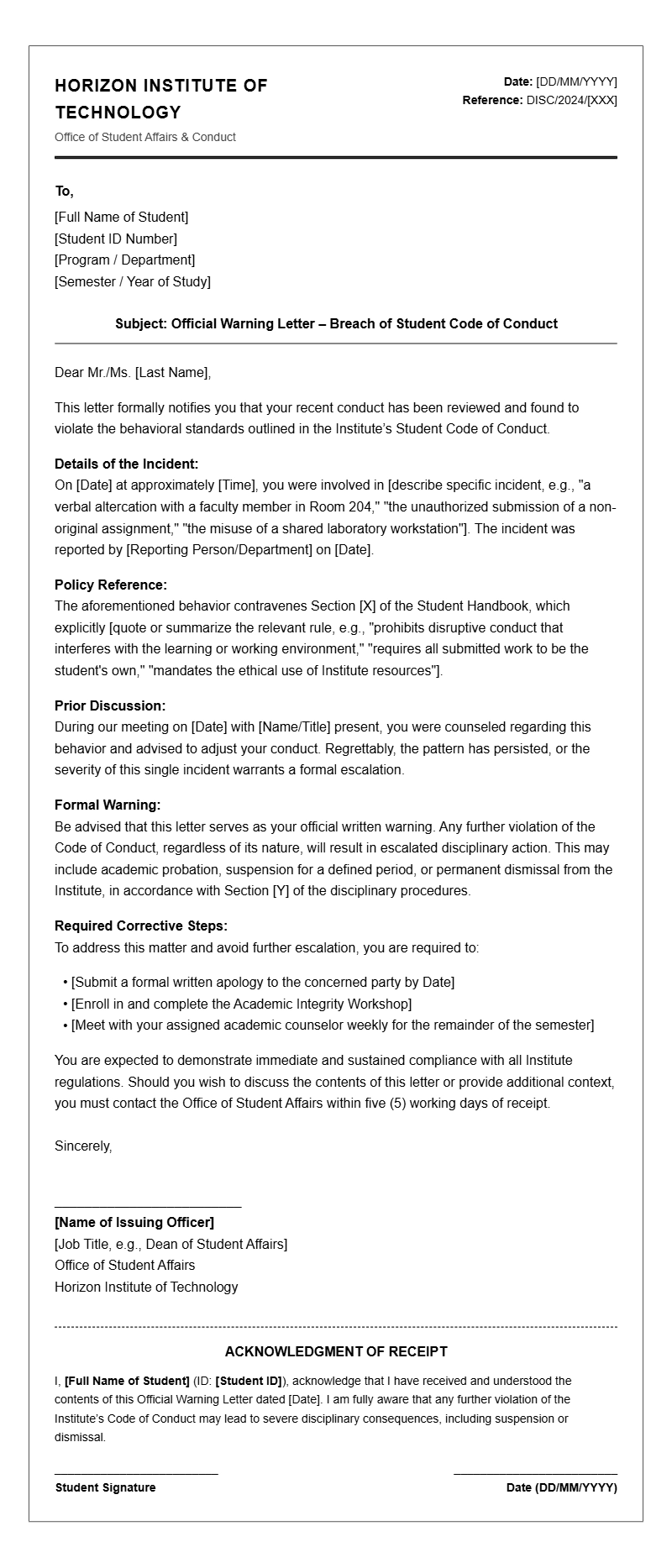
Every conduct warning letter should include these sections:
- Student details: full name, student ID, class or grade level.
- Date and location of the incident(s).
- Specific description of the behavior — avoid vague terms like “poor attitude.”
- Policy reference — cite the exact rule or code that was violated.
- Warning statement — clear that this is a formal warning and that further infractions will lead to escalating consequences.
- Expected change — what the student must do differently (e.g., submit all assignments on time, attend every class).
- Consequences — what will happen if there’s no improvement (e.g., suspension, loss of privileges).
- Signature lines for the administrator, student, and parent/guardian (if applicable).
Think of it as a contract: the student signs to acknowledge receipt, not necessarily agreement. That signature is critical for documentation.
STEP-BY-STEP WRITING GUIDE
1. Gather the facts
Before you write, collect all evidence: witness statements, camera footage, written assignments, attendance records. Ensure the incident is documented in an objective way. Don’t rely on memory alone.
2. Choose the right tone
Your letter should be professional but not robotic. Avoid language that sounds like a legal threat. Instead, frame it as an opportunity to correct course. For example, “We believe you can improve your conduct” sounds more constructive than “You are on notice for violating policy.”
3. Write the body in three parts
Introduction: State the purpose – “This letter serves as a formal warning regarding your behavior on [date].”
Details: Describe what happened, when, where, and which policy applies. Use bullet points if helpful, but keep them factual.
Expectations and consequences: Clearly state what must change and what will happen if it doesn’t.
4. Include a next-steps section
Tell the student what to do now: sign the letter, schedule a meeting with the counselor, submit an improvement plan, etc. This moves the situation forward.
5. Review and send
Check for any accusatory language or emotional phrasing. Have a colleague read it. Then deliver the letter in a private meeting, not in front of other students. Keep a copy for the student’s file. Just as a student enrollment confirmation letter marks the beginning of a student’s journey, a conduct warning may mark a turning point that requires careful handling.
EXAMPLES AND EDITABLE TEMPLATE SNIPPETS
Template 1: Minor classroom disruption (elementary or middle school)
Dear [Student Name],
On [date], you were asked multiple times to stop using your phone during class. You continued to ignore the teacher’s instructions. This behavior violates our Classroom Conduct Policy (Section 4.2) which requires students to follow teacher directions and keep electronic devices off during instruction.
This is a formal warning. If this happens again, you will be sent to the office and your parent will be called. We expect you to keep your phone in your backpack for the remainder of the semester. Please sign below to acknowledge you received this warning.
Template 2: Academic dishonesty (high school or college)
Dear [Student Name],
This letter is a formal warning regarding the assignment submitted on [date] for [Course Name]. Our review found that portions of your paper were copied from an online source without citation. This violates the Academic Integrity Policy (Section 3.1) on plagiarism.
You will be allowed to resubmit a corrected version by [date] for reduced credit. However, any future violation will result in a failing grade for the course and possible suspension. I recommend meeting with the writing center to review citation rules.
Please sign below and return this letter by [date].
Template 3: Chronic attendance issues
Dear [Student Name],
As of [date], you have accumulated [number] unexcused absences this semester. This exceeds the maximum allowed under the Attendance Policy (Section 5.1). You were absent on [dates] without a doctor’s note or parent excuse.
This is a written warning. You are required to attend all remaining classes and provide documentation for any future absences. If you miss three more classes without an excuse, you may be dropped from the course. We want to help you succeed – please see your academic advisor to discuss any challenges you are facing.
If you believe there is an error in these records, please contact the attendance office within five school days.
COMMON MISTAKES TO AVOID
- Being too vague: “You have been disruptive” doesn’t tell the student what they did wrong. Use concrete actions: “You yelled across the room during the lecture.”
- Threatening too harshly: Saying “any future violation will result in immediate expulsion” may overwhelm a minor infraction. Match the consequence to the severity.
- Skipping the policy reference: Without citing a specific rule, the student can argue they didn’t know they were violating anything.
- Not leaving room for improvement: A warning that only spells out punishment, not corrective steps, feels punitive rather than educational.
- Forgetting to get a signature: If the student refuses to sign, note that on your copy. Unsigned letters weaken your case later. Unlike an offer rejection letter which is final, a conduct warning is meant as a corrective step, so treat it as a dialogue.
TIPS FOR CUSTOMIZATION
Every school has its own culture and policies. Here’s how to adapt these templates:
- Adjust the formality: For younger students, use simpler language and a more encouraging tone. For high school or college, use more formal, policy-focused language.
- Add a rehabilitation component: Some warnings include a plan for the student to restore trust, like writing a reflection essay or attending a workshop.
- Include a timeline: Specify when the warning period ends (e.g., “This warning will remain active for the rest of the semester”). That prevents the student from being penalized years later.
- Reference past support – if the student has already been counseled verbally, mention that. It shows the institution attempted less formal measures first.
- Use the letter as a teaching moment – whenever possible, explain how the behavior impacts others or the student themselves. A warning that helps a student learn from a mistake is more effective than one that just punishes.
When writing your letter, remember that clear, respectful documentation can prevent future problems. If the student does improve, you may later send a reinstatement request letter to restore privileges like extracurricular participation — but that starts with a solid warning now.
One last note: writing a professional letter in an educational setting requires the same attention to tone and clarity as drafting an author to publisher letter — both require you to state facts, maintain professionalism, and leave a clear record. Keep that mindset, and your conduct warnings will be fair, effective, and defensible.
Document Examples & Template Samples
First Formal Warning – Classroom Disruption
Date: [Insert Date]
To: [Student Name]
From: [Instructor/Dean Name]
Subject: First Written Warning – Disruptive Behavior in Class
This letter serves as a formal written warning regarding your conduct during [Course Name] on [Date]. You were observed repeatedly talking while the instructor was lecturing, using your phone, and making remarks that distracted other students. Despite a verbal reminder, the behavior continued.
Disruptive conduct violates the institution’s Code of Student Conduct, Section 2.3 (Classroom Behavior). As a first step, you are required to:
- Submit a written reflection on how your behavior affected the learning environment.
- Meet with the class instructor within five business days to discuss improvement strategies.
A copy of this warning will be placed in your student file. Further disruptions may lead to additional consequences, including referral to the Dean of Students or removal from the course.
We believe you can correct this behavior and continue to succeed.
Instructor Signature: ___________________
Student Acknowledgement: ___________________ (sign and return)
Final Warning – Plagiarism Violation
Date: [Insert Date]
To: [Student Name]
From: Academic Integrity Committee
Subject: Final Warning – Plagiarism in Submitted Work
This notice constitutes a final written warning regarding a second violation of the institution’s academic integrity policy. On [Date], your submission for [Assignment Name] was found to contain unattributed content copied from online sources, in violation of Section 4.1 of the Academic Code.
This follows a prior warning issued on [Date]. Cumulative penalties are as follows:
| Violation Date | Course | Penalty |
|---|---|---|
| [First Date] | [Course 1] | Resubmission with zero grade |
| [Second Date] | [Course 2] | Grade of zero on assignment + referral |
You are required to complete an online academic integrity tutorial within 14 days. Any further violations will lead to suspension or expulsion under policy 4.3.
You may appeal this warning in writing within 10 business days to the Academic Appeals Office.
Attendance Warning – Habitual Tardiness
Date: [Insert Date]
To: [Student Name]
From: [Course Instructor]
Subject: Attendance Warning – Habitual Tardiness
I am writing to express concern regarding your pattern of late arrivals in [Course Name]. Our records show that you have been tardy on the following dates:
- [Date 1] – arrived 15 minutes late
- [Date 2] – arrived 20 minutes late
- [Date 3] – arrived 10 minutes late
According to the course attendance policy, more than three unexcused tardies constitute a violation. Each tardy disrupts instruction and puts you at an academic disadvantage. You are hereby required to meet with the instructor to discuss a remedy, such as adjusting your schedule or setting a personal accountability plan.
Continued tardiness will result in a formal conduct referral and possible reduction of your participation grade. Please acknowledge receipt of this warning by signing below.
Student Signature: ___________________
Date: ___________________
Bullying & Harassment Warning – Peer Complaint
Date: [Insert Date]
To: [Student Name]
From: Office of Student Conduct
Subject: Formal Warning – Bullying and Harassment
We have received a complaint alleging that you engaged in bullying behavior toward [Victim Name] on [Date] in the [Location]. The report describes repeated derogatory remarks, intimidation, and exclusionary actions that created a hostile environment.
Such conduct is strictly prohibited under the Student Conduct Code, Section 5.2 (Harassment and Bullying). After reviewing the evidence, we are issuing this official written warning. The following conditions apply:
- You must not contact the complainant directly or through others.
- You are required to attend a mandatory bystander intervention workshop within two weeks.
- Any future incidents will result in immediate suspension pending a hearing.
You have the right to respond to this warning in writing. Please contact our office by [Date] to confirm receipt and your compliance plan.
Dress Code Violation – Repeated Offense
Date: [Insert Date]
To: [Student Name]
From: [School Administration]
Subject: Written Warning – Dress Code Violations
This is a formal warning regarding repeated non-compliance with the school’s dress code policy. On [Date 1] and [Date 2], you were observed wearing [describe item, e.g., hooded sweatshirt inside the building, shorts below required length] after prior verbal reminders.
The dress code (Policy 3.7) requires all students to wear [specific requirements]. Violations disrupt the learning environment and may lead to disciplinary action. We ask that you review the policy and correct your attire immediately.
Your next step: submit a signed statement confirming you understand the dress code and will follow it. Continued violations will result in detention and a meeting with your parents or guardians.
Student Agreement Signature: ___________________
Technology Misuse – Personal Device During Exam
Date: [Insert Date]
To: [Student Name]
From: [Exam Proctor / Academic Dean]
Subject: Warning – Unauthorized Device Use During Examination
During the [Exam Name] on [Date], you were observed using a smartphone while seated at your desk. This violates the institution’s examination policy, which prohibits all personal electronic devices unless explicitly authorized.
You were asked to surrender the device, and the exam was temporarily paused. After reviewing the incident, we issue this first warning. The following consequences apply:
| Action | Details |
|---|---|
| Grade reduction | 10% deduction on the exam score |
| Mandatory workshop | Academic integrity session (online, 1 hour) |
You must complete the workshop by [Date]. A second offense will result in a failing grade for the course and a conduct hearing. Please acknowledge receipt of this warning.
Disruptive Online Behavior – Remote Class Warning
Date: [Insert Date]
To: [Student Name]
From: [Course Instructor]
Subject: Warning – Inappropriate Conduct During Virtual Session
I am writing to address your behavior during the remote class on [Date]. You were observed typing offensive comments in the chat, muting other speakers without permission, and ignoring requests to use the raise-hand feature. This conduct disrupts the learning experience for all participants.
The virtual classroom is governed by the same conduct standards as physical classes (Code of Conduct, Section 6.1). You are required to:
- Review the Netiquette Guidelines posted in the course portal.
- Submit a short apology to the class (via private message to the instructor) by [Date].
- Attend the next two sessions with your camera on to show engagement.
Further incidents will lead to removal from the virtual classroom and referral to student conduct. I trust you will use this warning constructively.
Academic Warning – Incomplete Assignments Due to Negligence
Date: [Insert Date]
To: [Student Name]
From: [Course Instructor]
Subject: Academic Conduct Warning – Incomplete Assignments
Despite multiple reminders, you have failed to submit three major assignments for [Course Name]: [Assignment 1], [Assignment 2], and [Assignment 3]. Our records show no extenuating circumstances or communication requesting extensions.
Neglect of course requirements is considered academic misconduct under policy 1.4 (Academic Responsibilities). This warning serves to notify you that you must submit all missing work within five business days to avoid grade penalties. The following table summarizes the current status:
| Assignment | Due Date | Status |
|---|---|---|
| [Assignment 1] | [Date] | Not submitted |
| [Assignment 2] | [Date] | Not submitted |
| [Assignment 3] | [Date] | Not submitted |
Please contact me immediately to discuss a plan. Failure to comply will result in a failing grade for the course and a mandatory meeting with the academic advisor.
Substance Use on Campus – First and Final Warning
Date: [Insert Date]
To: [Student Name]
From: Office of Student Conduct
Subject: Zero-Tolerance Warning – Possession of Alcohol on Campus
On [Date], you were found in possession of an open container of alcohol in [Location, e.g., the dormitory common area]. This is a direct violation of the campus alcohol policy and state law regarding underage drinking.
Because this is a first offense, we are issuing a combined first and final warning under the zero-tolerance policy. Immediate actions are required:
- Complete a substance awareness course (offered by Student Health Services) within 30 days.
- Write a 500-word reflection on the risks of alcohol use and how it affects academic performance.
- Attend one meeting with a counselor.
Any further violation, including possession, use, or distribution of prohibited substances, will result in immediate suspension and possible expulsion. You must sign and return this letter to confirm receipt.
Social Media Misconduct – Defamatory Posts About Staff
Date: [Insert Date]
To: [Student Name]
From: Dean of Students
Subject: Warning – Inappropriate Social Media Content
It has come to our attention that you posted content on [Platform Name] on [Date] that contained false and defamatory statements about a staff member. The post has since been deleted, but screenshots have been retained in our investigation file.
This behavior violates the Student Code of Conduct, Section 7.4 (Cyberbullying and Online Harassment). The institution recognizes that off-campus online speech can impact the campus community. We issue this formal written warning with the following requirements:
- Remove any remaining related posts or comments.
- Refrain from making any further statements about the staff member online or in person.
- Schedule a restorative conversation with the affected staff member (optional but encouraged).
Failure to comply will result in disciplinary probation or suspension. You may provide a written response to this warning within 7 days. Your cooperation is expected.