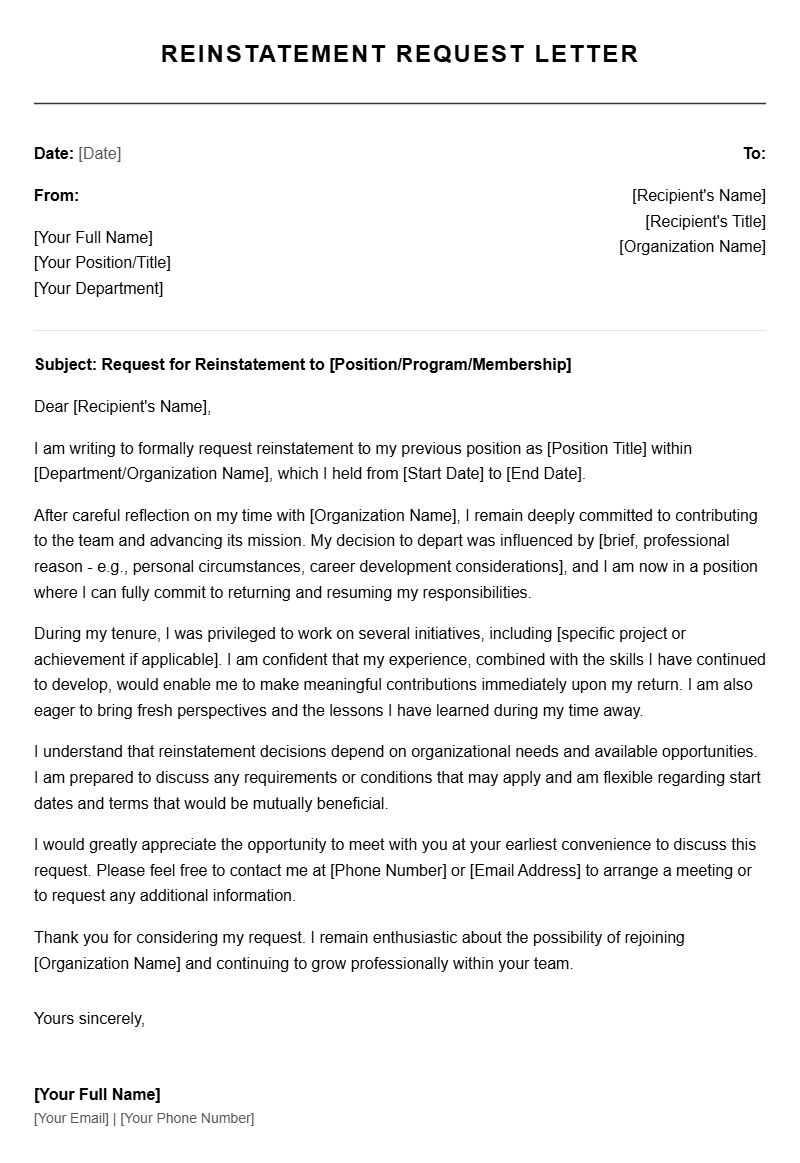
Writing a request to be rehired or reinstated at a job can feel like a high‑stakes moment. You want to explain why you left, what has changed, and why you’re the right fit now. That’s where a clear reinstatement request letter template steps in—it gives you a proven structure so you don’t forget any key details and lets the employer see your professionalism right away.
When You Might Need To Send A Reinstatement Request
Common situations include returning after a voluntary resignation, coming back after a leave of absence (parental, medical, or educational), or rejoining after a temporary layoff. In each case, you’re essentially asking the company to reverse a previous decision and take you back under their employment umbrella.
If you’re also drafting other workplace correspondence, you might find our teacher training invitation letter samples helpful for similar tone and structure.
Core Sections Of A Reinstatement Request Letter
A strong reinstatement request typically contains five parts that work together to present a clear, respectful case:
Header And Contact Information
- Your full name, address, phone, and email.
- Date of writing.
- Recipient’s name, title, department, and company address.
Opening Greeting
Use the recipient’s name (if known) or a polite generic salutation such as “Dear Ms. Johnson,” to set a professional tone.
Explanation Of Circumstances
Briefly describe why you left and what has changed since then. Keep it factual—focus on dates, roles, and any relevant policy or contract details.
Request And Justification
State outright that you are requesting reinstatement. Follow with a concise justification that ties your past performance, new skills, or personal circumstances to the company’s needs.
Closing And Signature
End with a polite statement of appreciation, mention you’re available for a conversation, and provide your signature (or typed name if sending electronically).
Step‑By‑Step Guide To Writing Your Letter
- Collect the basics. Gather your employment dates, the reason for departure, and any supporting documents (e.g., medical clearance, proof of completed training).
- Review company policy. Check the employee handbook or any union agreement for reinstatement procedures—some employers have specific forms or time limits.
- Draft the header. Place your contact info at the top, followed by the date and the employer’s details.
- Write a concise opening. Introduce yourself, mention your previous position, and state the purpose of the letter in one or two sentences.
- Explain the change. Show why returning now makes sense: new qualifications, resolved personal issues, or a shift in business need.
- Present your request. Clearly ask for reinstatement, and include a brief argument why you’re a good fit.
- Close warmly. Thank the reader for considering your request, indicate you’re happy to discuss further, and sign off.
- Proofread. Review for grammar, tone, and factual accuracy. A single typo can undermine a otherwise strong case.
Sample Template You Can Edit
John Doe
123 Main St, Suite 4
Springfield, IL 62701
Phone: (555) 123‑4567
Email: john.doe@email.com
January 25, 2026
Ms. Laura Smith
HR Manager
Bright Solutions Inc.
789 Business Pkwy
Springfield, IL 62702
Dear Ms. Smith,
I am writing to request reinstatement to the position of Marketing Coordinator at Bright Solutions Inc., which I held from March 2022 to August 2023. After a brief sabbatical to complete a digital marketing certification, I am eager to return and apply the new skills I have acquired.
During my previous tenure, I contributed to a 15% increase in lead conversion through targeted email campaigns. The certification program deepened my expertise in SEO, content strategy, and marketing analytics—areas I believe will directly support the department’s upcoming product launch.
I kindly ask for consideration of my reinstatement and am available for a meeting at your earliest convenience to discuss how my background aligns with current team goals.
Thank you for your time and consideration.
Sincerely,
John Doe
Common Mistakes And How To Avoid Them
- Being vague about why you left. Employers need specifics—dates, role titles, and the reason for departure help them assess legitimacy.
- Over‑explaining personal issues. A brief, respectful overview is enough; avoid excessive emotional detail that may feel unprofessional.
- Neglecting to tie new skills to company needs. Show that your recent experience adds value, not just that you’ve taken a break.
- Skipping the proofreading step. Small errors can suggest carelessness, especially in a document about your reliability.
Tips For Customizing Your Letter
- Match the employer’s tone. If the company is formal, keep language crisp; for a creative startup, you can be slightly more relaxed.
- Highlight any policy compliance. If you’re returning after a leave covered by FMLA or a union contract, mention the compliance explicitly.
- Include supporting documents. Attach copies of certifications, medical clearances, or performance reviews when appropriate.
- Keep it concise. One page is usually enough; longer letters risk losing the reader’s attention.
- Use clear subject lines if emailing. Something like “Reinstatement Request – Former Marketing Coordinator” helps the recipient prioritize the message.
Related Resources
If you’re handling other types of workplace letters, our collection covers a range of scenarios:
- holiday greeting letter samples for seasonal communications with staff.
- schedule change letter samples when you need to modify shift or work hours.
- demotion letter samples for formalizing role changes.
- payment confirmation letter templates to verify transactions or reimbursements.
Putting together a reinstatement request letter doesn’t have to be stressful. By following a clear structure, tailoring the content to your specific circumstances, and proofreading before you send, you’ll give the employer a professional, compelling case for bringing you back on board.
Practical Document Examples