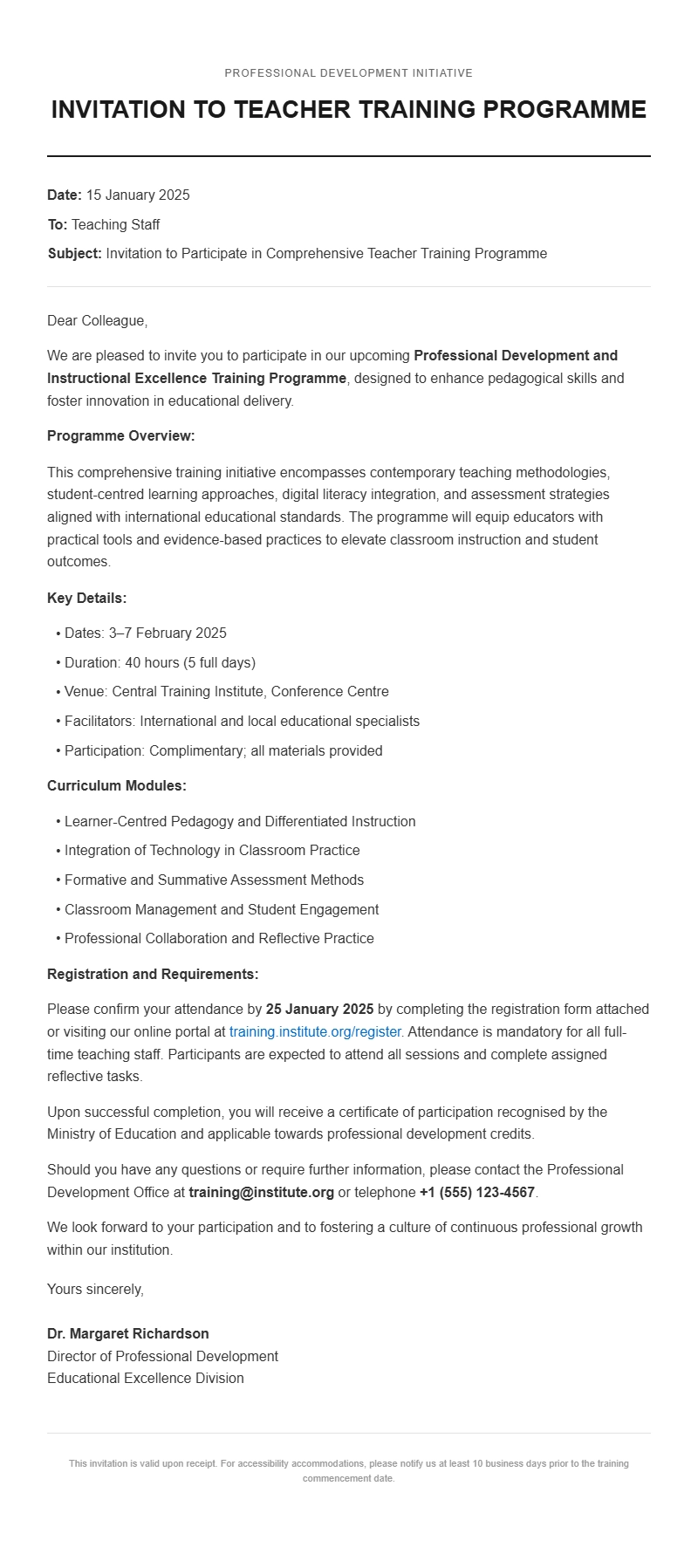
You need to invite teachers to a training program, and you’re staring at a blank document. Whether you’re coordinating professional development for your school district, running a workshop series, or organizing a certification course, a well-written invitation letter sets the tone and gets people to actually show up prepared. This guide walks you through what makes an effective teacher training invitation letter, shows you real templates you can adapt, and helps you avoid the common mistakes that land these messages in the trash folder.
What Is A Teacher Training Invitation Letter
A teacher training invitation letter is a formal request asking educators to attend a professional development session, workshop, course, or certification program. It’s different from a casual email because it carries weight—it’s often the official record that someone was invited, and it sets expectations for attendance and participation.
These letters typically come from school administrators, district coordinators, training organizations, or education departments. They might invite teachers to attend in-service days, subject-specific workshops, leadership training, new curriculum rollouts, or compliance-required courses like CPR certification or mandatory reporting.
The letter serves multiple purposes: it informs teachers about what’s happening, when, and where; it explains why their attendance matters; it provides logistical details they need; and it creates a paper trail for compliance and record-keeping.
When You Actually Need A Formal Invitation Letter
Not every training announcement needs a formal letter. A quick Slack message or email works fine for casual optional sessions. But you should use a formal invitation letter when:
- Attendance is mandatory or required for certification
- The training is part of district or state compliance requirements
- You need documented proof that teachers were notified
- The event is significant enough to warrant official communication
- You’re inviting teachers from multiple schools or districts
- The training involves external organizations or funding
- Teachers need to arrange coverage or adjust their schedules
If you’re just reminding your staff about a quick 30-minute meeting, a memo is fine. If you’re asking teachers to commit several hours, travel, or adjust their teaching schedule, a formal letter shows you respect their time and take the opportunity seriously.
Key Components Of An Effective Invitation Letter
A solid teacher training invitation includes these elements, though not always in this exact order:
- Clear subject line or opening—Immediately state what the training is and why it matters
- Specific dates and times—No ambiguity. Include start and end times, multiple dates if applicable
- Location details—Physical address, room number, or Zoom link. Include parking information if relevant
- Purpose and relevance—Brief explanation of why this training exists and how it benefits teachers or students
- Who should attend—Be specific. Is this for all teachers, specific grade levels, subject areas, or new staff only
- What to bring or prepare—Materials, documents, or anything teachers need to bring
- Registration or RSVP details—How to confirm attendance and any deadlines
- Agenda or overview—What will actually happen during the training
- Contact information—Who to reach out to with questions
- Professional closing—Sign off appropriately based on your relationship to the recipients
The best invitations are specific enough that teachers know exactly what they’re signing up for, but concise enough that they’ll actually read the whole thing.
Step-By-Step Guide To Writing Your Letter
Start With A Clear, Direct Opening
Don’t bury the lead. Teachers should know within the first sentence what you’re asking them to do. Something like: “You are invited to attend the district’s mandatory professional development workshop on literacy instruction strategies, scheduled for [date].”
If the training is optional, say that upfront too. Teachers appreciate knowing whether they have a choice.
Explain The Why
People are more likely to attend when they understand the purpose. Don’t just say “You must attend.” Explain what teachers will learn, how it connects to student outcomes, or why the district is prioritizing this area. Keep it honest and specific. “This training addresses feedback from last year’s assessment data” is better than “Professional growth is important.”
Give Concrete Logistics
Write out the date as both the day of the week and the date. “Tuesday, March 14, 2024, 2:00 PM to 4:30 PM” is clearer than “3/14 at 2pm.” If the training spans multiple sessions, list each one. Include the exact location or meeting link.
Be Specific About Who Should Attend
If this is for elementary teachers only, say so. If it’s for anyone teaching 9th grade math, be clear. Vague invitations lead to confusion and resentment from people who show up unnecessarily.
Include Practical Details
What should teachers bring? Do they need to print anything? Is lunch provided? Will they get CEUs or professional development credits? Can they attend remotely? These details matter and prevent last-minute scrambling.
Make RSVP Easy
Tell teachers exactly how to confirm attendance. A Google Form link, an email address, or a sign-up sheet all work. Give a deadline that’s realistic but firm—usually at least a week before the event.
Close Professionally
End with your name, title, and contact information. If you’re inviting teachers from outside your immediate circle, include your phone number and email so they can reach you with questions.
Teacher Training Invitation Letter Templates
Template 1: Mandatory District Training
Use this for required professional development that all or most teachers must attend.
Dear [Teacher Name/Staff],
You are invited to attend the mandatory professional development workshop: “Implementing Culturally Responsive Teaching Practices in Your Classroom.”
Date: Thursday, April 18, 2024
Time: 3:00 PM to 5:00 PM
Location: Lincoln High School, Room 201 (Building C)
Parking: Use Lot B; visitor passes are not required
Who Should Attend: All teachers in grades 6-12
Overview: This workshop responds to feedback from our recent climate survey and student achievement data. You’ll learn evidence-based strategies for creating inclusive classrooms, addressing implicit bias, and connecting curriculum to students’ lived experiences. The session includes interactive activities and time to work with your department on implementation planning.
What to Bring: A notebook and pen. Your department’s current curriculum map if available (optional).
Registration: Please confirm your attendance by April 12 using this form: [link]. If you have conflicts or cannot attend, contact me as soon as possible.
Questions: Reach out to me at [email] or [phone]. I’m happy to discuss the content or any logistics.
Thank you for your commitment to professional growth and student success.
Sincerely,
[Your Name]
[Your Title]
[School/District]
Template 2: Optional Workshop Or Elective Training
Use this when attendance is voluntary but you want to encourage participation.
Dear Colleagues,
I’d like to invite you to an optional professional development workshop: “Classroom Management Strategies for High-Need Students.”
Date & Time: Saturday, May 11, 2024, 9:00 AM to 12:30 PM
Location: Central Office, Training Room 3
Virtual Option: Zoom link available for those who prefer to attend remotely
What You’ll Learn: Practical, research-backed techniques for managing challenging behaviors, building rapport with difficult students, and reducing classroom disruptions. Led by Dr. Sarah Mitchell, a behavioral specialist with 15 years of classroom experience.
Who This Is For: Any teacher interested in strengthening classroom management skills. Especially useful for teachers working with students who have emotional or behavioral challenges.
Details: Coffee and light breakfast provided. You’ll receive a handout packet and access to video recordings if you can’t stay for the entire session. This workshop qualifies for 3 professional development hours.
To Register: Email me at [email] with your name and whether you’ll attend in person or virtually. Space is limited to 30 participants, so register by May 4.
Looking forward to seeing you there!
[Your Name]
[Your Title]
Template 3: External Training Or Certification Course
Use this when inviting teachers to training offered by an outside organization or for specific certification.
Dear [School Name] Staff,
We are pleased to offer a professional development opportunity: “Advanced Google Classroom Integration,” presented by [Training Organization Name].
Session Dates: Wednesdays, June 5, 12, and 19, 2024
Time: 4:00 PM to 5:30 PM
Location: [School Name], Media Center
Eligibility: All teachers. No prior Google Classroom experience necessary.
Course Overview: This three-session workshop covers advanced Google Classroom features for organizing assignments, providing feedback, and tracking student progress. Participants will complete hands-on activities and leave with templates ready to use in their classrooms.
Cost: Free for all staff. The district is covering registration fees.
To Enroll: Complete this registration form by May 29: [link]. Attendance at all three sessions is expected. If you cannot commit to all dates, please let me know.
Questions: Contact [name] at [email].
We hope you’ll take advantage of this opportunity to strengthen your instructional toolkit.
[Your Name]
[Your Title]
Common Mistakes That Undermine Your Invitation
Being vague about attendance expectations. Teachers need to know if this is required or optional. Don’t make them guess. “Strongly encouraged” is confusing—either it’s mandatory or it’s not.
Burying key information in long paragraphs. Teachers skim. Use short paragraphs, bolded headers, and white space. If someone reads only the first sentence and the date/time line, they should still understand what’s being asked of them.
Forgetting to include a deadline for RSVP. Without a deadline, some teachers will procrastinate forever, and you won’t know how many to expect. Set a firm date and mention it clearly.
Providing incomplete location details. “Room 201” means nothing if the teacher doesn’t know which building. Include the full address or building name. If it’s virtual, provide the Zoom link or meeting platform.
Neglecting to explain the purpose. Teachers want to know why this matters. “You are required to attend” feels like punishment. “This training addresses the literacy gaps we identified in fall assessments and will give you tools to help your students” gives teachers a reason to show up mentally engaged.
Making registration complicated. If teachers have to navigate three different systems or fill out a long form, some won’t bother. Keep registration simple: one link, one email address, or one sign-up sheet.
Sending the invitation too late. Teachers need time to arrange coverage or adjust their schedules. Send invitations at least two weeks in advance for mandatory training, three weeks for optional sessions.
Forgetting contact information. If a teacher has a question and can’t reach you, they might just skip the event. Always include your email and phone number.
Tips For Customizing Templates To Your Situation
Adjust tone based on your relationship. If you’re inviting teachers from your own school where everyone knows you, the letter can be slightly warmer and less formal. If you’re inviting teachers from multiple schools or an external audience, keep it more formal and professional.
Emphasize what’s in it for them. Teachers are busy. Explain what they’ll gain: new skills, resources they can use immediately, CEU credits, or solutions to problems they actually face. Don’t make it sound like busywork.
Be transparent about logistics that matter. If the training is early morning, say so. If parking is hard to find, mention it. If it’s virtual and asynchronous, that’s a big deal—highlight it. Teachers appreciate honesty about the practical stuff.
Customize the “who should attend” section. Don’t send the same letter to everyone if only certain teachers need to attend. Tailor it. “All new teachers” or “Secondary math and science teachers” is more respectful than a mass email that makes people wonder if it’s for them.
Include relevant context if there’s history. If this training is responding to something specific—student feedback, assessment data, a new initiative—mention it. It shows the training isn’t random.
Link to related resources when helpful. If teachers can preview materials, see a syllabus, or read background information, include a link. This helps them decide whether to attend and prepares them mentally.
Consider adding a personal note if appropriate. If you have a genuine connection to the trainer or know this training will be valuable, a brief personal comment (“I attended this workshop last year and found it incredibly useful”) can boost attendance.
Making Your Letter Stand Out
The best invitation letters feel like they’re written for real people with real schedules and real concerns. Avoid corporate jargon like “synergize,” “leverage,” or “stakeholder engagement.” Teachers can spot empty language from a mile away.
Be specific. Instead of “professional growth,” say “you’ll learn three strategies for differentiating instruction that you can use in your classroom tomorrow.” Instead of “enhancing student outcomes,” say “students in classes using this approach showed a 12% improvement in reading fluency.”
Acknowledge that attending training takes time. A simple “I know this is an ask on your time” or “thank you for prioritizing your professional development” shows you get it.
If you’re inviting teachers to something you’re genuinely excited about, let that come through. Enthusiasm is contagious. But don’t oversell or make promises the training can’t deliver on.
Adapting For Different Training Types
A letter inviting teachers to a one-hour compliance training looks different from one inviting them to a multi-day conference. For short, required sessions, keep the letter brief and focus on logistics. For longer, more substantive training, you can include more detail about what teachers will learn and how it connects to their work.
If you’re inviting teachers to attend an academic conference or external professional development, emphasize the learning opportunity and how it benefits their practice. If you’re inviting them to help train other teachers, frame it as a leadership opportunity.
For compliance-based training like CPR certification, be clear about requirements and deadlines. Teachers need to know if this is a one-time thing or annual. For optional enrichment, focus on the benefits and make it sound appealing enough that teachers want to come.
When To Follow Up
Send your invitation, then follow up once. A week before the training, send a reminder with the date, time, and location. This catches people who meant to register but forgot, and it gives you a final headcount.
If attendance is mandatory and someone hasn’t registered, you might send a personal note asking if they’re planning to attend or if they have conflicts you should know about. This is especially important for teachers new to your school who might not be sure if the invitation applies to them.
After the training, a brief thank-you email acknowledging attendance and inviting feedback shows you value teachers’ participation and are open to their input on future professional development.
What To Do If Teachers Don’t Respond
If registration is slow, send a friendly reminder that the deadline is approaching. Sometimes teachers genuinely forget. Sometimes they’re waiting to hear if they’ll have coverage. A second email or a personal conversation can help.
If you absolutely need a headcount for catering or materials, you might set a firm deadline and note that you need responses to plan accordingly. Most teachers will respond when they understand you need the information.
For mandatory training where people still don’t show up, follow your school’s or district’s attendance policies. But first, check in—sometimes there’s a legitimate reason (illness, family emergency, miscommunication about which teachers were supposed to attend). A conversation is better than automatic consequences.
Formatting Your Letter For Digital Or Print
If you’re sending this as an email, use clear formatting: short paragraphs, bolded headers, and plenty of white space. Avoid large blocks of text. People read emails differently than printed letters—they scan more and read less.
If you’re printing it, use a standard font like Arial or Calibri, 11 or 12 point. Leave at least one-inch margins. Include your school’s letterhead if you have one. Sign it by hand if you’re printing copies; it adds a personal touch.
If you’re sharing a digital version, PDF works well because the formatting stays consistent across devices. Google Docs or Word documents are fine too, but PDFs prevent accidental changes.
Sample Situation: How To Adapt For Your School
Let’s say you’re a principal inviting all staff to a mandatory workshop on new grading policies. You’d start with a clear statement: “All staff are required to attend the professional development workshop on our updated grading and reporting procedures.” You’d explain why the change is happening (maybe the district adopted new standards, or your school decided to move to standards-based grading). You’d include the date, time, and location. You’d note what teachers should bring (their current grade book, maybe). You’d explain that this affects how they assess and report student progress, so understanding it is essential. You’d set a clear RSVP deadline. And you’d include your contact information in case teachers have questions about the new policy.
If you were instead inviting a few interested teachers to an optional workshop on project-based learning, you’d take a different approach. You’d frame it as an opportunity, not a requirement. You’d highlight what teachers would learn and how it could transform their classroom. You’d mention that space is limited and registration is first-come, first-served. You’d make it clear that this is optional but valuable. You’d include the trainer’s background and maybe a link to their website or previous work.
Next Steps
Use one of the templates above as your starting point. Customize it with your specific dates, location, and purpose. Read it out loud—if it sounds stiff or confusing, revise it. Ask yourself: Would I want to attend this training based on this invitation? If the answer is no, figure out why and fix it.
Send your invitation well in advance, set a clear RSVP deadline, and follow up once before the event. Keep your contact information easy to find in case teachers have questions. When teachers show up prepared and informed, the training itself goes much better.
A well-written invitation letter takes 15 minutes but significantly increases attendance and engagement. It shows respect for teachers’ time, clarity about expectations, and professionalism on your part. That matters more than you might think.
If you’re also handling other types of formal correspondence, you might find similar principles apply. For instance, when you’re coordinating partnerships or agreements with external organizations, an affiliate partnership letter follows similar logic: be clear about expectations, include specific details, and make it easy for the other party to respond. The same goes for administrative notices—a well-structured compliance notice letter gets better results when it’s specific and professional.
Editable Document Format Examples