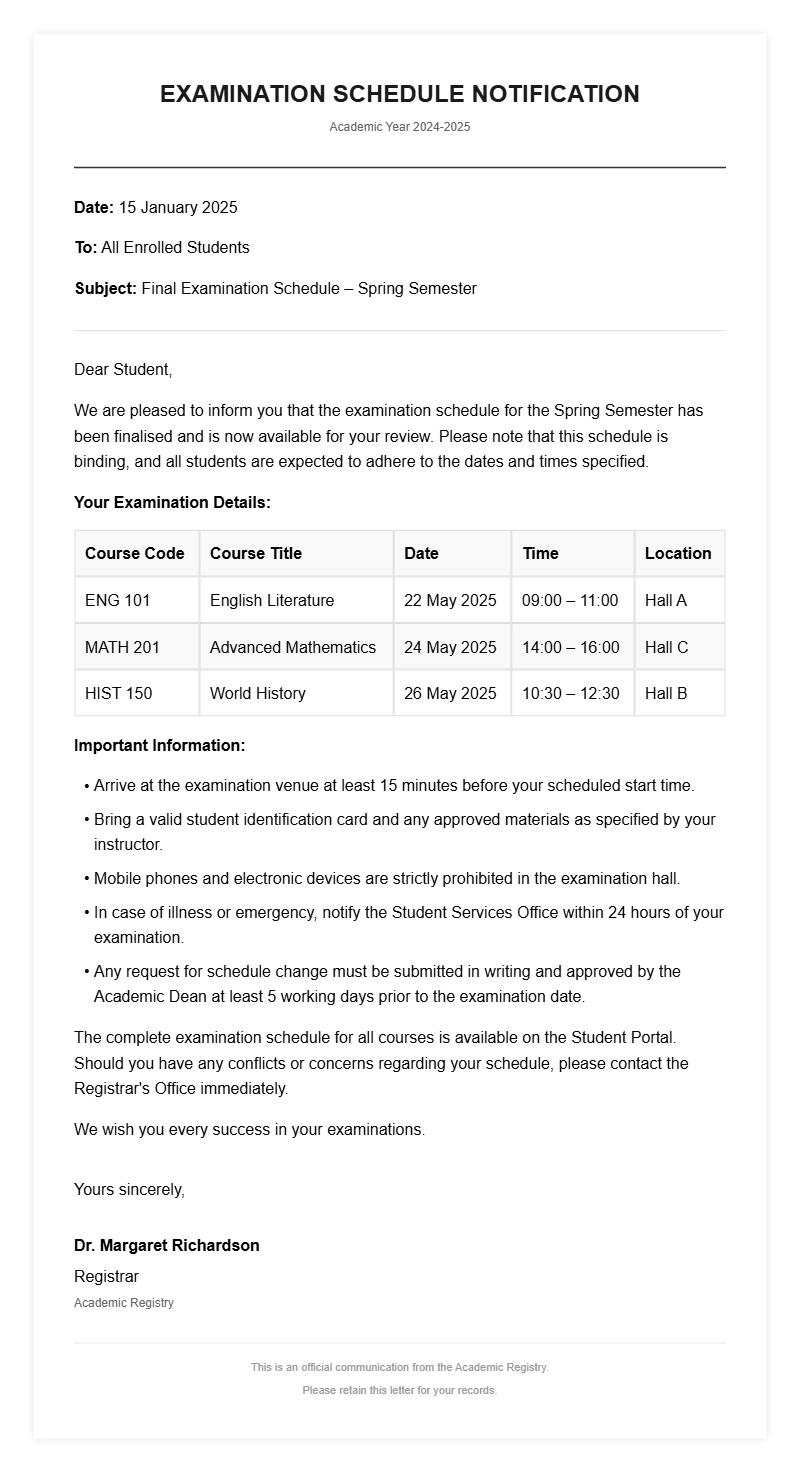
If you’re running a school, managing a student cohort, or coordinating an academic program, you know how important it is to keep everyone on the same page about exam dates and schedules. A student exam schedule letter serves as your official communication tool—it tells students exactly when and where their tests happen, what they need to bring, and what to expect. Without a clear, well-structured letter, you’ll end up fielding the same questions repeatedly and dealing with confused students showing up at the wrong times.
This guide walks you through creating an effective exam schedule letter, gives you ready-to-use templates, and shows you how to customize them for different situations.
What Is A Student Exam Schedule Letter?
A student exam schedule letter is a formal document that communicates test dates, times, locations, and relevant instructions to students. It’s different from a simple email or calendar invite because it carries official weight—it’s a record that students received the information, and it often includes important details that need to be documented.
These letters typically come from the academic office, department head, or exam coordinator. They might be sent individually to each student, distributed to entire classes, or posted on a school portal. The best versions are clear enough that a student can understand everything they need to know without having to ask follow-up questions.
When You Need To Send An Exam Schedule Letter
Timing matters. Schools typically send exam schedule letters:
- At the start of the semester, outlining the general exam window and key dates
- Four to six weeks before midterms or final exams
- After exam timetables are finalized but before students make travel plans
- When there are changes to previously announced schedules
- When accommodations or special exam arrangements are in place
The earlier you send it, the better. Students need time to plan their study schedules, arrange transportation, and request time off work if necessary. A letter sent two weeks before exams is better than one sent two days before, but a month’s notice is ideal.
Key Sections Your Exam Schedule Letter Should Include
A solid exam schedule letter has these core components:
- Date and recipient information — When the letter is written and who it’s addressed to
- Subject line — Something like “Final Exam Schedule – Spring 2024” so it’s immediately clear what the letter covers
- Opening statement — A brief intro explaining that the exam schedule is attached or detailed below
- Exam dates and times — The specific schedule, either in a table or list format
- Location details — Where each exam takes place, including room numbers if applicable
- What to bring — Required materials (ID, calculator, blue books, etc.)
- Important policies — Arrival time, late arrival procedures, academic integrity expectations
- Special accommodations information — How students with approved accommodations will be contacted
- Contact information — Who to reach out to with questions or conflicts
- Closing — Professional sign-off with the sender’s name and title
Not every letter needs every section—adjust based on your situation. A high school might emphasize location details and what to bring, while a university might focus more on accommodation procedures.
How To Write Your Exam Schedule Letter Step By Step
Start with the basics. Include the date you’re writing the letter, the recipient’s name (or “Dear Students”), and a clear subject line. If this is going to multiple students, use a generic greeting like “Dear [Class Name] Students” or “Dear Spring 2024 Test-Takers.”
Open with your main message. Don’t bury the lead. Your first sentence should tell students they’re receiving their exam schedule. Something like: “Your final exam schedule for the Spring 2024 semester is attached below. Please review it carefully and plan accordingly.”
Present the schedule clearly. If you have only a few exams, a simple list works fine. If you’re scheduling dozens of exams across multiple days and rooms, use a table. Make sure you include:
- Subject or course name
- Date (day and date)
- Start time and duration
- Location (building, room number)
- Any special notes (online, remote, etc.)
Explain what students need to do. Be specific about arrival time (usually 10-15 minutes early), what identification they need, and what materials are permitted. If calculators aren’t allowed, say so. If students need to bring blue books, mention it here.
Cover the policies that matter. Address late arrivals, what happens if a student misses an exam, academic integrity expectations, and whether phones should be turned off. Keep the tone matter-of-fact, not punitive.
Provide a contact option. Give students a clear way to report conflicts, request accommodations, or ask questions. This might be an email address, office hours, or a form link.
Close professionally. Use a standard closing like “Sincerely,” “Best regards,” or “Respectfully,” followed by your name and title.
Exam Schedule Letter Template
Here’s a straightforward template you can adapt:
[Date]
Dear [Student Name/Class Name] Students,
Your final exam schedule for [Semester and Year] is detailed below. Please review all information carefully, as this schedule is final. If you have a documented conflict or approved accommodation, contact the Registrar’s Office at [email/phone] by [deadline date].
Exam Schedule:
Course Name / Subject: Biology 101
Date: May 15, 2024
Time: 9:00 AM – 11:00 AM
Location: Science Building, Room 201
Course Name / Subject: English Composition
Date: May 17, 2024
Time: 1:00 PM – 3:00 PM
Location: Liberal Arts Building, Room 105
Important Information:
- Arrive 10 minutes before your scheduled start time.
- Bring a valid student ID and any approved materials (calculator, approved notes, etc.).
- Phones and smartwatches must be powered off and stored.
- If you are more than 15 minutes late, you will not be permitted to take the exam.
- Academic integrity policies apply. Any violation will be reported to the Dean of Students.
Students with Approved Accommodations:
If you have approved testing accommodations through the Disability Services Office, you will receive a separate notification with your modified exam details and location. Do not report to the standard exam location.
Exam Conflicts or Questions:
Contact [Office Name] at [email] or [phone number] if you have a documented conflict, need to request an accommodation, or have questions about your schedule.
Sincerely,
[Your Name]
[Your Title]
[School/Department Name]
Template For Schools With Multiple Exam Days
If you’re managing a larger schedule, a table format works better. Here’s how to structure it:
| Course | Date | Time | Location | Notes |
| Mathematics 201 | May 14, 2024 | 8:00 AM – 10:00 AM | Engineering Building, Room 310 | Bring approved calculator |
| History 150 | May 14, 2024 | 1:00 PM – 3:00 PM | Social Sciences Building, Room 201 | No notes allowed |
| Chemistry 101 | May 16, 2024 | 9:00 AM – 11:00 AM | Science Building, Room 105 | Lab coat required |
| Literature 220 | May 18, 2024 | 2:00 PM – 4:00 PM | Online via Zoom | Link sent 24 hours before exam |
Tables are easier to scan than paragraphs, and students can quickly find their exam information without reading through unnecessary text.
Template For Exam Schedule Changes Or Delays
Sometimes you need to announce changes after the initial schedule goes out. Here’s how to handle it:
Dear [Student Name/Class],
Due to [reason—building maintenance, instructor illness, weather, etc.], the following exam has been rescheduled:
Originally Scheduled: May 20, 2024, 10:00 AM
New Date and Time: May 22, 2024, 10:00 AM
Location: Remains the same – Science Building, Room 201
All other details remain unchanged. Please update your calendar and study plans accordingly. If this change creates a hardship or conflict with another exam, contact [office] immediately at [contact info].
We apologize for any inconvenience.
Sincerely,
[Name and Title]
Common Mistakes To Avoid
Vague location information. Saying “Science Building” isn’t enough. Students need the room number, floor, and ideally, a note about which entrance to use if the building is large. If exams are held in multiple locations, be crystal clear about which course goes where.
Burying important details. Don’t assume students will read every word. Put critical information like “Arrive 15 minutes early” and “No phones allowed” in a separate, highlighted section, not buried in a paragraph.
Unclear accommodation procedures. If students with accommodations get a different schedule or location, explain exactly how they’ll be notified and what they should do. Don’t make them guess or chase down information.
No contact information for conflicts. Students will have scheduling conflicts. Make it easy for them to report these—provide an email, phone number, or online form. If you don’t, you’ll get confused students showing up at the wrong time or not showing up at all.
Inconsistent formatting or typos. A letter with spelling errors or inconsistent dates looks unprofessional and makes students doubt whether the information is accurate. Proofread before sending.
Assuming everyone knows your policies. Not every student knows what “academic integrity” means in practice or what happens if they’re late. Be explicit. If phones should be off, say “phones must be powered off and stored away, not just silenced.” If late arrivals won’t be admitted, state that clearly.
Sending too late. A schedule sent one week before exams doesn’t give students enough time to plan. Aim for at least three to four weeks’ notice.
Customizing Your Letter For Different Situations
For online or hybrid exams. Include the platform (Zoom, Blackboard, Proctorio, etc.), how students access it, tech requirements, and what to do if they experience technical issues. Specify whether the exam will be proctored and what that means for their environment (quiet room, camera on, etc.).
For students with accommodations. You might send a separate, personalized letter to these students detailing their specific exam arrangements. This might include extended time, separate room, reader/scribe support, or other modifications. Make sure they understand exactly what’s different about their exam experience and confirm they’ve received the information.
For makeup or deferred exams. If a student has a legitimate reason to take an exam at a different time, send them a separate letter with their specific date, time, and location. Include a note about what documentation they need to bring and any conditions for the makeup exam.
For departmental or course-specific exams. If you’re a department coordinator sending a letter just to your students, you might include additional context about how the exam fits into the course grade, whether it’s cumulative, or what topics are emphasized. You could also reference any study materials or review sessions you’ve scheduled.
For students with exam conflicts. Sometimes a student has two exams scheduled at the same time. Send them a letter explaining which exam they’ll take at the scheduled time and when they’ll take the other one. Be clear about the rescheduled time and confirm they’ve received this information.
Formatting Tips For Readability
How you format the letter affects whether students actually read it and understand it.
Use white space. Don’t pack everything into dense paragraphs. Break up sections with headings, bullet points, and blank lines. A letter that looks overwhelming won’t get read carefully.
Bold key dates and times. Make the schedule itself stand out from the surrounding text. If the exam is on May 20 at 9:00 AM, make that bold or put it in a different color.
Number your action items. If students need to do several things before the exam (bring ID, arrive early, review the academic integrity policy), number them. This makes it easier to follow and remember.
Use a readable font and size. Stick with standard fonts like Arial, Calibri, or Times New Roman, at least 11 or 12 point. Avoid decorative fonts or tiny text.
Keep paragraphs short. Three to four sentences per paragraph is ideal. Longer paragraphs are harder to scan and remember.
Sending Your Letter Effectively
The best template means nothing if students don’t receive it or don’t see it.
Use multiple channels. Send it via email, post it on your school portal or learning management system, and print copies to distribute in class. Different students check different places.
Send it early and repeat it. Send the schedule four to six weeks out. Send a reminder two weeks before. Send another reminder one week before. You won’t over-communicate—students will appreciate the extra reminders.
Confirm receipt if possible. If you’re using your school portal, you can often see who’s opened the email or accessed the document. For paper copies, have students sign a receipt confirming they got the schedule.
Be accessible. If your school serves international students or students with language barriers, consider providing the letter in multiple languages or offering a simplified version.
Integrating Your Exam Schedule With Other Communications
Your exam schedule letter doesn’t exist in isolation. It’s part of a larger communication flow. If you’re sending information about exam accommodations, consider how that relates to your broader onboarding process. Some schools use similar formal letter formats for various academic communications—you might look at how teacher onboarding letters are structured for consistency across your institution.
Similarly, if you’re dealing with student complaints or concerns about exam arrangements, the formal documentation practices you use for things like harassment complaints can inform how you document exam-related disputes or appeals.
What Happens After You Send The Letter
Sending the letter is the beginning, not the end.
Expect questions. Even with a clear letter, students will ask for clarification. Have a system in place to answer them—an email inbox, office hours, or a FAQ document.
Track conflicts and accommodations. Keep a record of any students who report exam conflicts or request accommodations. Follow up to confirm their alternative arrangements are in place.
Be ready to adjust. If multiple students report the same problem with the schedule, be willing to change it. A letter is not set in stone if it creates genuine hardship.
Follow up after exams. After exams are done, send a brief thank-you note thanking students for their professionalism during the exam period. This small gesture builds goodwill and sets a positive tone for future communications.
Real-World Example: A Complete Letter
Here’s what a full, realistic exam schedule letter looks like:
March 15, 2024
Dear Spring 2024 Students,
Your final exam schedule is attached. This schedule is final and was created to minimize conflicts and ensure fairness across all courses. Please read through your exam details carefully and plan your study schedule accordingly.
Your Exam Schedule:
| Course | Instructor | Date | Time | Location |
| Introduction to Psychology | Dr. Martinez | May 13, 2024 | 9:00 AM – 11:00 AM | Science Building, Room 201 |
| Business Ethics | Prof. Chen | May 15, 2024 | 1:00 PM – 3:00 PM | Business Building, Room 110 |
| Advanced Spanish | Dr. Rodriguez | May 17, 2024 | 10:00 AM – 12:00 PM | Languages Building, Room 305 |
Before Your Exam:
- Arrive 10 minutes early. Exams start promptly at the scheduled time.
- Bring your student ID and any approved materials (calculator, dictionary, etc.).
- Review your course syllabus to confirm what materials are permitted.
- Check the course page on Blackboard for any last-minute updates.
During Your Exam:
- Phones, smartwatches, and other electronic devices must be powered off and stored in your bag.
- You may not leave the exam room during the first or last 15 minutes.
- Academic integrity policies apply. Cheating will result in a failing grade and disciplinary action.
- If you have a question, raise your hand and wait for an instructor.
If You Have An Exam Conflict:
A conflict exists only if you have two exams scheduled within 24 hours of each other. If you have a documented conflict, contact the Registrar’s Office at registrar@school.edu or call 555-0123 by April 15, 2024. Provide your name, student ID, and course names. Do not contact your instructor directly.
If You Have Approved Accommodations:
You will receive a separate email from the Disability Services Office with your exam details and location by April 20, 2024. Do not report to the standard exam location. If you do not receive this email, contact Disability Services immediately at disabilities@school.edu.
If You Miss Your Exam:
Contact your instructor within 24 hours with documentation of your absence (medical note, emergency documentation, etc.). Your instructor will determine whether a makeup exam is permitted. Missing an exam without documented justification may result in a failing grade.
Questions?
Contact the Registrar’s Office at registrar@school.edu, call 555-0123, or visit our office in Admin Building, Room 150 during business hours (Monday–Friday, 8:00 AM – 5:00 PM).
We wish you success on your exams.
Sincerely,
Sarah Johnson
Registrar
State University
Adapting This For Different School Levels
High school. Keep it simpler and more direct. High schoolers need clear, straightforward information. Emphasize what to bring and what policies will be enforced. You might also include a note to parents if exams are a big deal at your school.
College or university. You can assume more independence and responsibility. Include more detail about accommodation procedures and what to do if there’s a conflict. You might reference your academic integrity code by name.
Graduate programs. Graduate exams are often more specialized. Include specific details about format (written, oral, comprehensive, etc.), what materials are allowed, and how results will be communicated. Graduate students may also need information about retake policies or appeals processes.
Online or distance learning programs. Focus on tech requirements, proctoring procedures, and troubleshooting steps. Make it very clear how students access the exam and what to do if they experience technical problems.
Using Templates For Ongoing Communication
Once you create a solid exam schedule letter template, you can reuse it each semester with minimal changes. Keep a master version with placeholders for dates, names, and specific details. This saves time and ensures consistency across your communications.
If you handle other formal academic communications, maintaining a consistent style and format across documents builds trust and makes your institution look organized. The principles behind a clear, well-structured exam schedule letter apply to other formal communications you might send—whether that’s information about internship opportunities or documentation related to workplace matters like bank authorization procedures for student accounts or funds.
Final Checklist Before Sending
Before your exam schedule letter goes out, run through this checklist:
- All dates, times, and locations are correct and have been verified
- Student names or course names are spelled correctly
- The tone is professional but friendly, not overly formal or casual
- Key information (arrival time, what to bring, policies) is highlighted or in a separate section
- Contact information for questions or conflicts is clear and easy to find
- The letter has been proofread for typos and grammatical errors
- The format is readable—good use of white space, appropriate font size, clear headings
- You’ve included information about accommodations or special circumstances if applicable
- You know when and how you’ll send it and through which channels
- You have a plan for answering student questions or handling conflicts
A well-crafted exam schedule letter prevents confusion, sets clear expectations, and shows students you’ve thought through the details of their exam experience. Spend the time to get it right, and you’ll save yourself headaches later. Use these templates as your starting point, customize them for your specific situation, and send them early enough that students can actually plan around them.
Document Structure & Example Models