When you need to invite a candidate to interview for a teaching position, the invitation letter sets the tone for the entire hiring process. It’s your first formal communication after screening applications, and it needs to be clear, professional, and welcoming. A well-crafted invitation tells the candidate exactly what to expect, respects their time, and reflects your school’s standards.
Many hiring managers either overthink this document or treat it as a quick formality. The reality is somewhere in between. You need something that communicates essential information without being stiff or impersonal. This guide walks you through creating or customizing a teacher interview invitation letter that works for your situation.
What Is A Teacher Interview Invitation Letter?
A teacher interview invitation letter is a formal document sent to a teaching candidate after their application has been selected for consideration. It confirms that the school wants to move forward with the hiring process and provides the candidate with interview details and logistics.
This document serves multiple purposes. It acts as official confirmation, gives the candidate time to prepare, and establishes professionalism from the start. Unlike a casual email, a formal letter carries weight and shows that the school takes the hiring process seriously.
The letter typically comes after an initial phone screening or immediately following the application review stage, depending on your school’s process. Some districts send it via email, others use printed letters. Both approaches work, though email is faster and more common for most schools today.
When You Use A Teacher Interview Invitation Letter
You send this letter at a specific moment in the hiring timeline: after you’ve decided to interview a candidate but before the actual interview date. Timing matters because you want to give candidates enough notice to prepare—usually at least five to seven business days.
Common scenarios include:
- After reviewing applications for a posted teaching position
- Following a phone screening that went well
- When conducting second-round interviews
- For both full-time and substitute teacher positions
- When filling emergency or mid-year openings
The letter also works as a paper trail for your hiring records. If there are ever questions about the interview process, having formal written invitations shows you followed proper procedures. This is especially important for schools with structured HR departments or those that need to document their hiring practices.
Key Components Of An Effective Invitation Letter
A strong teacher interview invitation includes specific elements that answer the candidate’s immediate questions. Here’s what needs to be in there:
- Opening statement: A brief sentence confirming their application was reviewed and they’re invited to interview
- Position title: The exact role they’re interviewing for (e.g., “5th Grade Math Teacher” rather than just “Teaching Position”)
- Interview date and time: Specific day, time, and timezone if applicable
- Location details: Building name, room number, parking information, or video call link
- What to bring: Copies of credentials, references, or other documents
- Interview format: Whether it’s one-on-one, panel, teaching demonstration, or a combination
- Duration estimate: How long the process typically takes
- Contact information: Who to reach out to with questions or if they need to reschedule
- Confirmation request: Ask them to confirm attendance
- Closing sentiment: A welcoming note about your school or enthusiasm for meeting them
Not every letter needs all these elements, but most should include at least eight of them. The key is being specific enough that the candidate has no confusion about what’s expected.
How To Write A Teacher Interview Invitation Letter
Start with your school’s letterhead or standard formatting. If you don’t have a template already, use a simple business letter format with your school name, address, and contact information at the top.
Step 1: Address the candidate properly. Use their full name and correct spelling. If you’re unsure about their preferred name or pronouns, check their application materials. A personal touch matters here.
Step 2: Open with a clear statement. Get straight to the point. “We are pleased to invite you to interview for the position of 6th Grade English Language Arts Teacher” is direct and professional. You can add warmth, but don’t bury the main message.
Step 3: Provide specific interview details. Include the exact date, time, and location. “Tuesday, March 14th at 2:00 PM in Room 205 of the Main Building” leaves no room for confusion. If it’s virtual, include the video call link or instructions for joining.
Step 4: Explain what to expect. Tell them whether they’ll meet with the principal, a panel, or department staff. Mention if there’s a teaching demonstration, lesson planning exercise, or other activities. If the interview will take 45 minutes, say that. Candidates appreciate knowing what they’re walking into.
Step 5: List what they should bring. Request items like copies of their resume, references, teaching license, or portfolio samples. Be reasonable—don’t ask for excessive documentation at this stage.
Step 6: Include practical logistics. Where should they park? What entrance should they use? Who do they check in with when they arrive? These details prevent awkward delays on interview day.
Step 7: Ask for confirmation. Request that they reply by a specific date to confirm their attendance. This gives you time to adjust if they can’t make it.
Step 8: Close professionally. A sentence expressing your interest in meeting them and your school’s commitment to finding the right teacher works well. Keep it genuine—avoid corporate-sounding phrases.
Step 9: Sign and date it. Include the name and title of the person sending the letter. If it’s an email, a professional signature block replaces a handwritten signature.
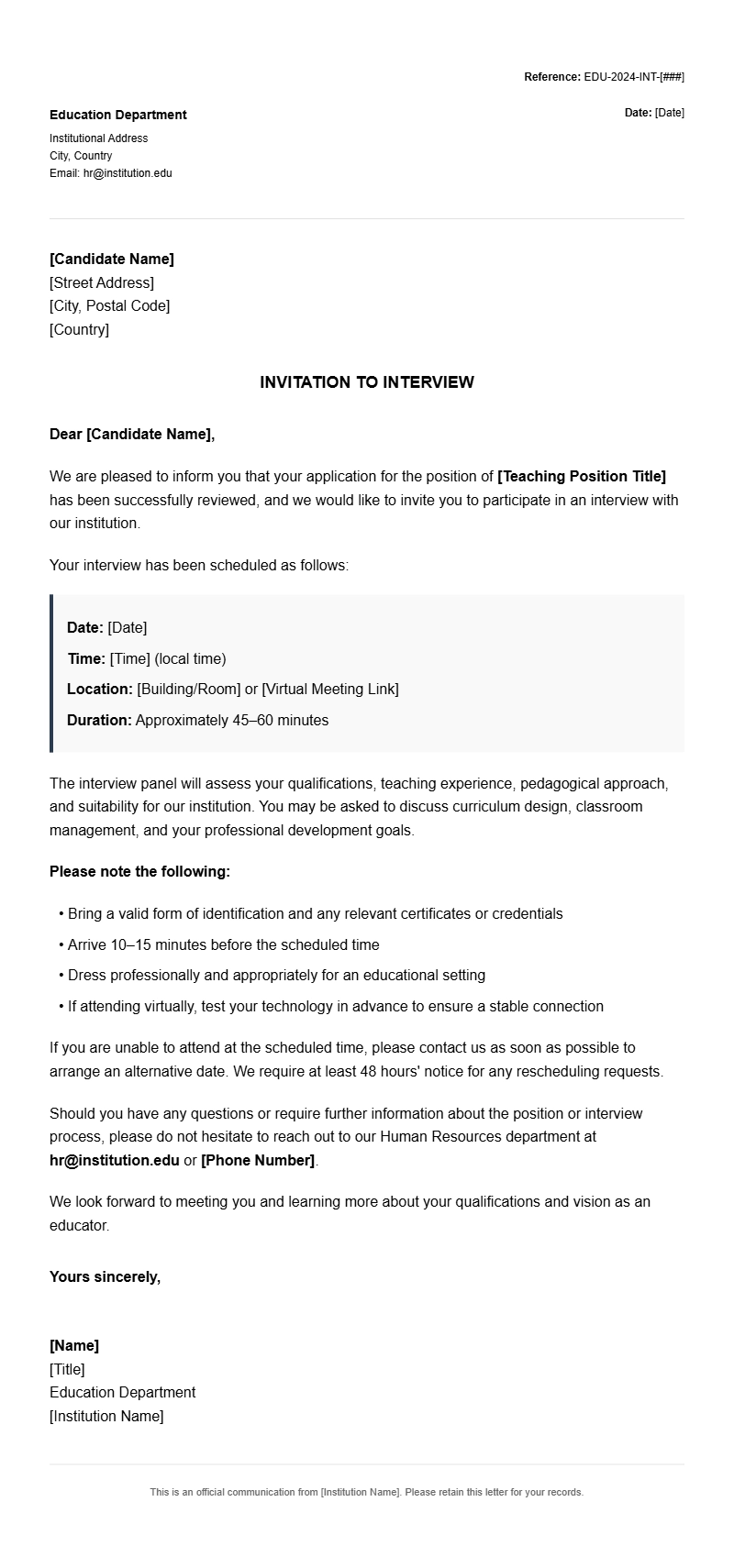
Teacher Interview Invitation Letter Template
Here’s a straightforward template you can adapt for your school:
[School Name]
[School Address]
[Phone Number]
[Email]
[Date]
Dear [Candidate Name],
We are pleased to invite you to interview for the position of [Position Title] at [School Name]. Your application materials impressed our hiring committee, and we would like to learn more about your background and teaching philosophy.
Interview Details:
Date: [Day, Month Date]
Time: [Time] [AM/PM]
Location: [Building Name], Room [Number]
[Parking/Entrance Instructions if applicable]
Your interview will consist of [describe format: e.g., “a 45-minute meeting with our principal and department chair, followed by a 15-minute teaching demonstration”]. The entire process typically takes approximately [time].
Please bring the following with you:
– Two copies of your resume
– Contact information for three professional references
– Your teaching license or credential
– [Any other specific items]
To confirm your attendance, please reply to this letter by [Date] at [Time]. If you have any questions or need to reschedule, please contact [Name] at [Phone] or [Email].
We look forward to meeting you and discussing how you might contribute to our school community.
Sincerely,
[Your Name]
[Your Title]
[School Name]
This template covers the essentials while remaining professional and welcoming. Adjust the language to match your school’s tone. Some schools prefer a warmer, more casual approach; others maintain formal business letter standards. Either works as long as you’re consistent.
Customization Tips For Different Situations
Not every teaching position or interview process is identical, so you may need to adjust the template.
For virtual interviews: Replace location details with video call instructions. Include the platform (Zoom, Google Meet, etc.), the meeting link, and a note about testing technology beforehand. Consider adding: “Please ensure you have a stable internet connection and a quiet space for the interview.”
For teaching demonstrations: If candidates need to prepare a lesson or activity, explain this clearly. Provide the grade level, subject, topic, and time limit. Example: “You will teach a 10-minute lesson on fractions to a group of 4th graders. Please bring any materials you’d like to use.”
For panel interviews: Let them know they’ll meet with multiple people. You can list titles without names: “You’ll meet with our Principal, Assistant Principal, and the 3rd Grade Team Lead.” This reduces anxiety by setting expectations.
For second-round interviews: Acknowledge that they’ve already interviewed once. “We were impressed with your initial conversation with our principal and would like to invite you to meet with our full hiring committee.” This shows progression and builds momentum.
For substitute or long-term positions: Adjust language slightly if it’s not a permanent role. “We are seeking a dedicated substitute teacher” or “We have an opening for a long-term substitute through the end of the school year.” The invitation format stays the same, but the context changes.
For international candidates: If the candidate is from outside your country, be extra clear about logistics. Include timezone information, visa sponsorship details if relevant, and any documents they’ll need for entry or employment verification.
Common Mistakes To Avoid
Even experienced hiring managers make errors on interview invitations. Here are the most frequent ones:
Being vague about timing: “Come in sometime next week” is not acceptable. Candidates need a specific date and time. Vagueness signals disorganization and wastes everyone’s time.
Forgetting to include location details: Telling someone to come to your school is not enough if it’s a large campus. Include the building, room number, and parking instructions. A candidate getting lost before the interview starts sets a bad tone.
Asking for too much documentation upfront: Don’t request their entire portfolio, lesson plans, student work samples, and reference letters before they’ve even interviewed. Keep the initial request reasonable. You can ask for more later if they move forward.
Making assumptions about availability: Always phrase it as an invitation with flexibility. “We would like to invite you to interview on March 14th. If this date doesn’t work for you, please let us know.” This shows respect and gives candidates a chance to suggest alternatives.
Sending it too late: Inviting someone to interview three days before the scheduled date is poor form. Aim for at least five to seven business days’ notice. Candidates need time to prepare and arrange their schedules.
Using a generic template without personalizing: If your letter sounds like it could go to anyone for any job, it feels cold. Use the candidate’s name, the specific position title, and details about your school. Small touches make a difference.
Forgetting to ask for confirmation: If you don’t ask them to confirm, you might show up with an empty interview room. Always request confirmation with a deadline.
Unclear contact information: Make sure the person listed as the contact is actually available and knows to expect calls or emails. Nothing frustrates candidates more than trying to reach someone who never responds.
Making Your Letter Stand Out
A functional invitation letter gets the job done. A thoughtful one makes a candidate feel valued before they even walk in the door.
Start by personalizing the opening. If you reviewed their application and noticed something specific—a relevant certification, experience in your district, or a unique project they mentioned—acknowledge it. “We were particularly interested in your experience implementing project-based learning, which aligns with our school’s recent initiatives.”
Be clear about your school’s culture or values. A brief sentence helps candidates understand what they’re interviewing for. “Our school prioritizes collaborative teaching and student-centered learning” tells them something real about your environment.
Include a welcoming note. Teaching candidates often feel nervous, and a genuine statement can ease that. “We’re excited to learn about your teaching philosophy and how you engage students” is warm without being unprofessional.
If your school has special characteristics, mention them. “We’re a Title I school serving a diverse community” or “We’re a magnet school focused on STEM” gives context and helps candidates prepare relevant questions.
Consider adding a line about what makes your school a good place to work. This isn’t about overselling—it’s about honesty. “We have strong administrative support for classroom teachers” or “Our staff collaborates closely on student outcomes” tells candidates what they might expect.
Digital Vs. Printed Invitations
Most schools now send interview invitations via email, which is faster and more practical. However, some districts still use printed letters, especially for formal or traditional hiring processes.
Email advantages: Faster delivery, candidates can easily forward or save the information, you get immediate confirmation through replies, and it’s environmentally friendly. Email also allows you to include links and attachments easily.
Printed letter advantages: More formal and memorable, no risk of ending up in spam folders, and it creates a physical record for your hiring files. Some candidates appreciate the personal touch of a printed letter.
The choice depends on your school’s culture and process. If you send via email, use a professional email template with the same information as a printed letter. Don’t make it casual or conversational—maintain business letter formatting even in an email.
What Happens After The Invitation Is Sent
Your job doesn’t end when you hit send. Track confirmations and follow up with candidates who don’t respond by your deadline. A simple email reminder works: “We haven’t heard back about your interview on March 14th. Please confirm your attendance or let us know if you need to reschedule.”
If a candidate requests a different date or time, try to accommodate if possible. Flexibility here can make the difference between hiring a great teacher and losing them to another school.
Keep copies of all invitations and confirmations. They’re part of your hiring documentation. If questions arise later about your hiring process or timeline, these records show you followed proper procedures.
Consider sending a brief reminder email a day or two before the interview. “We look forward to meeting you tomorrow at 2:00 PM in Room 205. Please arrive about 10 minutes early.” This reduces no-shows and last-minute cancellations.
Connecting Your Hiring Process
The interview invitation is one piece of a larger hiring workflow. Before sending it, you’ve already reviewed applications and possibly conducted phone screenings. After the interview, you’ll move toward making an offer or continuing your search.
Some schools use a similar formal letter approach for other hiring-related communications. You might send a formal employment verification letter later if the candidate is hired, or you might need to communicate about employment matters down the road. Having consistent, professional communication standards across all hiring documents reinforces your school’s credibility.
If you’re part of a larger district, you might also send formal invitations for staff meetings or other school events. The same principles of clarity, specificity, and professionalism apply across all these communications.
Final Thoughts
A teacher interview invitation letter is straightforward to write, but the details matter. Be specific about logistics, clear about expectations, and warm in tone. Give candidates enough notice and information to show up prepared and confident. When you handle this communication well, you set a positive tone for the entire hiring process and demonstrate that your school values professionalism and respect.
Use the template provided, customize it for your situation, and always double-check for accuracy before sending. A well-executed invitation reflects your school’s standards and makes candidates want to work for you.
Editable Document Format Examples